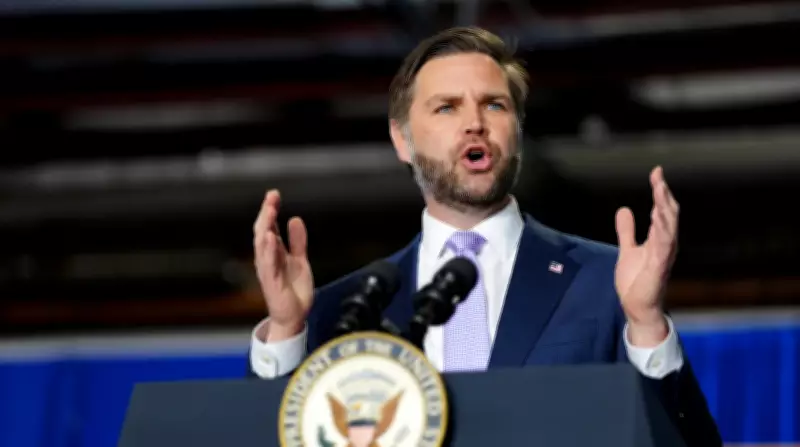
With his boss on the other side of the world, Vice President JD Vance spent his week spotlighting an issue much closer to home: the fraudsters who take advantage of federal programs. Vance traveled to Maine on Thursday to tout the Trump administration’s efforts to combat alleged widespread fraud in federal programs in the state. While federal programs can be vulnerable to fraud, some critics argue the problem is not nearly as widespread as the vice president makes it out to be.
A closer look at the administration’s own record suggests enforcement seems to be moving in the wrong direction. Speaking at the Bangor International Airport, Vance, who has been tasked with leading the White House’s anti-fraud task force, declared to supporters that “fraud has festered” in the state and that since President Donald Trump returned to office, the federal government has finally gotten serious about going after it.
The day before, Vance accused California of ignoring fraudulent healthcare claims and announced a $1.3 billion hold on state Medicaid payments. The vice president has sought to cast the Trump administration and Republicans as essentially the lone countermeasure to fraud in federal programs such as Medicare and SNAP, and Democrats as enablers of scams.

Since Trump took office, however, his Justice Department has quietly dropped thousands of fraud cases. According to a new analysis published by ProPublica, the Justice Department closed more than 23,000 criminal cases during the first six months of his administration, abandoning “hundreds of investigations into terrorism, white-collar crime, drugs and other offenses as it shifted resources to pursue immigration cases.” Among the cases dropped were over 900 cases of federal program or procurement fraud.
The White House and the Office of the Vice President did not immediately respond to requests for comment. Vance’s speech in Maine came the same day The New York Times reported the Justice Department was preparing to dismiss a bribery case against Indian billionaire Gautam Adani, a wealthy investor who had been charged with criminal fraud and bribery. Adani’s legal team, led by one of Trump’s personal attorneys, reportedly offered a $10 billion investment in the U.S. economy and the creation of 15,000 jobs if the charges were dropped.
The president has also taken other direct steps that have undercut his administration’s heavy anti-fraud posture. At the beginning of his second term, Trump fired more than a dozen inspectors general tasked with preventing and detecting fraud and abuse in federal programs and replaced them with his own appointees. He paused the enforcement of a statute that bans U.S. companies from accepting bribes from foreign officials. He used his clemency powers to commute or pardon corporate executives and other prominent individuals convicted of Medicare or Medicaid fraud, including Lawrence Duran, the former owner of a mental health company, who was convicted in 2011 for his role in a historic $205 million fraud and money laundering scheme.
“The Trump administration’s shattering of fraud and anti-corruption programs reveals its low prioritization of these kinds of crimes,” said Barbara McQuade, a former U.S. attorney for the Eastern District of Michigan and law professor at the University of Michigan Law School. “The focus on fraud in states run by leaders who are Democrats seems hypocritical at best, and, at worst, a thinly veiled effort to punish these states for their politics.”
Trump himself was also found liable for business fraud in a New York civil case in 2024 while running for reelection after prosecutors and the court found him guilty of running a yearslong scheme of inflating his net worth to obtain more favorable loans and lower insurance premiums. It was far from the first time Trump had been accused of fraudulent behavior in his personal business dealings — his now-defunct Trump University infamously presented itself as an accredited institution when it was not, ultimately leading to a $25 million settlement for former students. His charity, the Donald J. Trump Foundation, was also dissolved by a court order in 2018 after prosecutors argued the president and his children had illegally misused its funds.

During his Thursday remarks, Vance went on to claim that Maine’s Democratic Gov. Janet Mills has been reluctant to collaborate with the White House to address fraud in the state, and criticized other Democrat-led states as “impossible to work with.” McQuade added that, in cases of a weak indictment, the dismissal of a case can be the appropriate remedy, but that in cases such as Adani’s, good government requires that investigations be based on conduct, not political affiliation, and that “a defendant [getting] out from under an indictment in exchange for a donation is considered unethical.” “Wealthy people should not be able to buy their way out of prison,” she said.