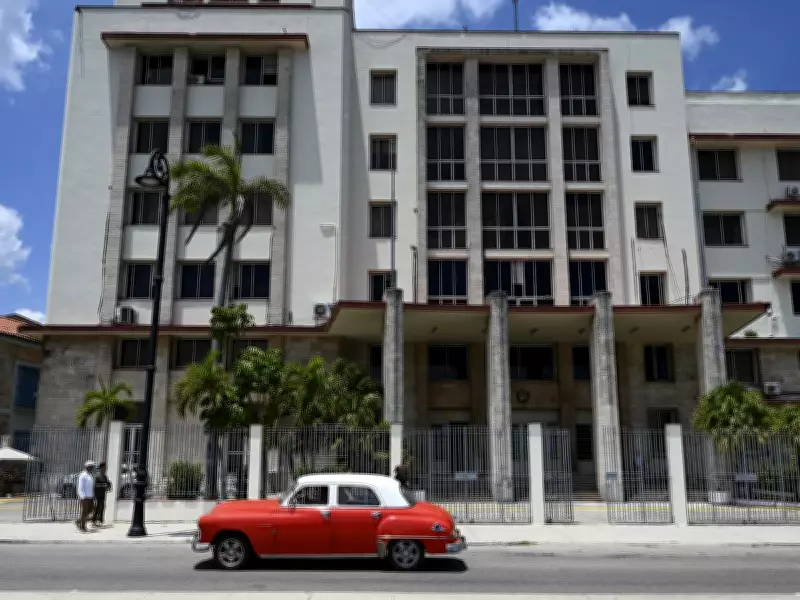
The Trump administration's maximum pressure campaign on Cuba is taking aim at the shadowy, military-run conglomerate that dominates the island's banking, retail, and tourism sectors.
Sanctions as 'Collective Punishment'
Cuba's foreign minister has described the sanctions as 'collective punishment' against the Cuban people. The U.S. State Department refers to Grupo de Administración Empresarial S.A. (GAESA) as the 'heart of Cuba's kleptocratic communist system.' This umbrella enterprise, run by the Cuban Revolutionary Armed Forces, is believed to control up to $20 billion in 'illicit assets,' with revenue likely three times Cuba's state budget, according to the State Department.
Expanded Sanctions Authority
A May 1 executive order signed by U.S. President Donald Trump, along with additional sanctions announced on May 7, broadens the U.S. government's authority to target GAESA, its head Ania Guillermina Lastres Morera, and Cuba's foreign investors. Lee Schlenker, a research associate with the Quincy Institute, explained that the sanctions not only freeze assets but also affect U.S. accounts and travel for shareholders, investors, and employees. 'This is bound to have an extremely significant impact on the presence of foreign companies,' he added.

Impact on Foreign Investment
The new sanctions have put one of Cuba's largest investors on notice. Toronto-based Sherritt International, which mines nickel and cobalt, announced it was suspending operations in Cuba after more than three decades. GAESA's prominent role in Cuba's economy, estimated at 40% of GDP, has made it a target for Washington amid a wider push for economic liberalization.
GAESA's Hidden Finances
GAESA was spearheaded by Raúl Castro, brother of Fidel Castro and Cuba's president from 2008 to 2018. Much of its finances are hidden; it is exempt from government audits and does not publish details about its revenue or how it is shared with the state. Gladys Bejerano, Cuba's general comptroller, spoke about the lack of oversight in a 2024 interview and was subsequently fired. Leaked financial statements obtained by the Miami Herald showed GAESA made $2.1 billion in profits in the first quarter of 2024. Its vast holdings include Cuba's largest commercial bank and some of its priciest luxury hotels and retail shops.
Economic Pressures Mount
However, GAESA's dependence on foreign currency has backfired amid low tourism and investment. Since January, the U.S. has blocked nearly all shipments of heavy oil and demanded that Cuba overhaul its political system and free political prisoners. This move followed Trump's capture of Venezuela's then-President Nicolás Maduro, one of Cuba's closest allies. In February, U.S. Secretary of State Marco Rubio blamed GAESA for Cuba's economic misfortunes, stating, 'None of the money that that company has generated flows to the coffers of the government.'