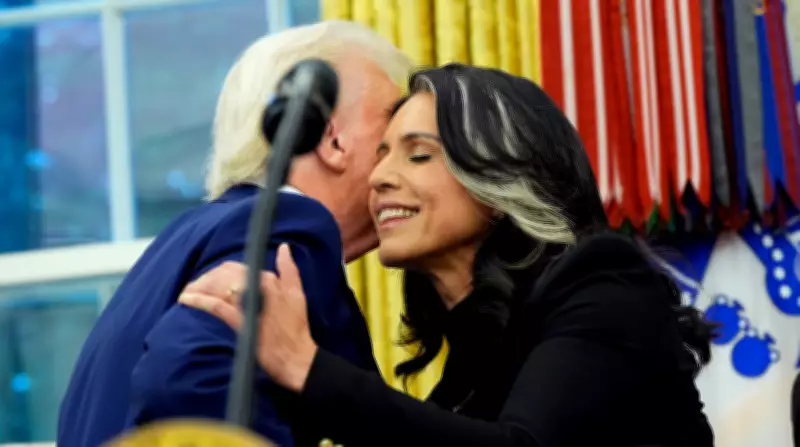
Tulsi Gabbard announced her resignation as Director of National Intelligence on Friday, citing her husband's diagnosis with a rare form of bone cancer. She informed President Donald Trump of her decision during an Oval Office meeting, with the resignation set to take effect on June 30.
Resignation Letter and Personal Reasons
In her resignation letter posted on X, Gabbard expressed deep gratitude for the trust placed in her by Trump and for the opportunity to lead the Office of the Director of National Intelligence for the past year and a half. She noted that her husband, Abraham Williams, was recently diagnosed with bone cancer. "I cannot in good conscience ask him to face this fight alone while I continue in this demanding and time-consuming post," she wrote.
Trump responded on his Truth Social platform, praising Gabbard for doing "a great job" and acknowledging that with her husband's diagnosis, she rightfully wants to be with him. He appointed Principal Deputy Director of National Intelligence Aaron Lukas as acting director. Lukas is a former CIA officer and analyst who served on the National Security Council during Trump's first term.

Speculation of Forced Departure
A source familiar with the matter told Reuters that Gabbard had been forced out by the White House. The White House did not respond to a request for comment, but spokesperson Davis Ingle stated on X that Gabbard's departure was due to her husband's diagnosis. Trump had previously hinted at differences with Gabbard over Iran policy, saying in March that she was "softer" than him on curbing Tehran's nuclear ambitions. In April, multiple sources indicated that Gabbard could lose her role in a broader cabinet shakeup, with Trump expressing displeasure and seeking potential replacements.
Controversial Tenure as DNI
Gabbard, a former Democratic member of Congress and lieutenant colonel in the U.S. Army Reserve, had no deep intelligence experience when Trump appointed her to oversee the 18 U.S. intelligence agencies. She faced bipartisan criticism for comments seen as echoing Russia's stance on NATO and for meeting with former Syrian President Bashar Assad in 2017. Once in office, Democrats accused her of using her position to advance Trump's agenda against perceived enemies and to support debunked claims of election fraud.
Signs of tension with the White House emerged when Trump suggested she was wrong in assessing that there was no evidence Iran was building a nuclear weapon. She was also absent from key deliberations on major foreign policy issues, including the U.S. military operation in Venezuela, Iran war, and Cuba. The source said the White House had been unhappy with her for some time, citing activities of her Director's Initiatives Group, which worked on declassifying documents related to JFK's death, investigating election machine security, and probing COVID-19 origins. Another point of friction was her revocation of security clearances for 37 current and former officials, which exposed an undercover intelligence officer.
Political Reactions
Senator Mark Warner, the top Democrat on the Senate Intelligence Committee, criticized Gabbard's tenure, stating that the position had become too politicized. He emphasized that the next director should focus on foreign intelligence and avoid involvement in domestic election matters.