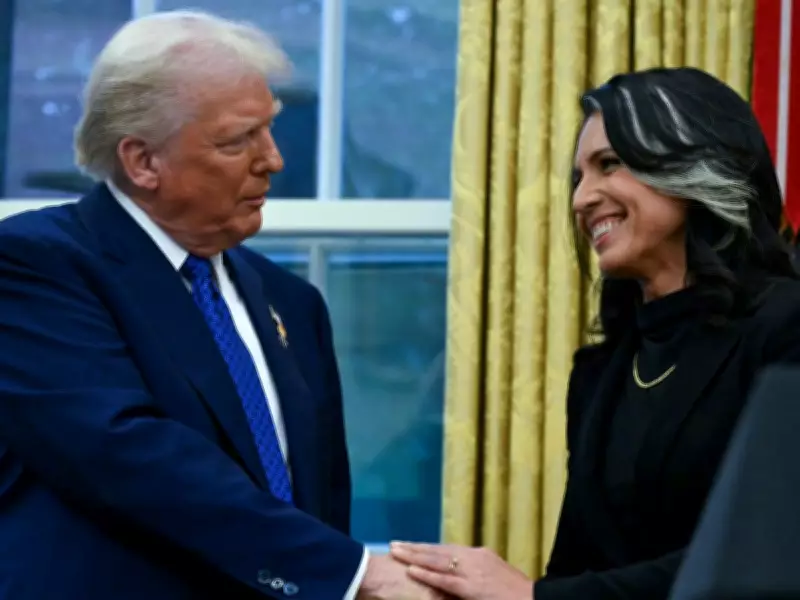
Director of National Intelligence Tulsi Gabbard, whose anti-war views had spurred tension with the White House, announced her resignation to help her husband confront a bone-cancer diagnosis. Gabbard notified President Donald Trump during an Oval Office meeting of her decision, with her last day expected to be June 30, according to a resignation letter she posted on social media.
Personal Reason for Resignation
“My husband, Abraham, has recently been diagnosed with an extremely rare form of bone cancer,” Gabbard said in the letter. She noted that her office had made significant progress “advancing unprecedented transparency and restoring integrity to the intelligence community.” Gabbard, a veteran of the Iraq War who continues to serve as an officer in the Army Reserve, emphasized her commitment to her family during this challenging time.
Awkward Tenure and Tensions
Gabbard, a long-time skeptic of American involvement in overseas wars, had been in an awkward position as Trump launched two military campaigns against Iran and ordered a raid to capture Venezuela’s president, Nicolas Maduro. She had been cut out of months of planning for the operation to capture Maduro, sources familiar with the matter said at the time. Her exclusion from meetings became so well-known that some White House aides joked that the acronym of her title, DNI, stood for “Do Not Invite,” the sources added.

President Trump praised Gabbard in a social media post, stating, “Tulsi has done an incredible job, and we will miss her.” He announced that her deputy, Aaron Lukas, would take over in an acting capacity.
Controversies and Clashes
Earlier this year, Gabbard was seen at an elections center in Atlanta, Georgia, during an FBI raid where voter records and other data had been seized. Gabbard told lawmakers in March she had been there at Trump’s request. Trump later said she went because then-Attorney General Pam Bondi — whom the president ousted in early April — “wanted her to do it.”
She also clashed with the intelligence community she ran and sought to root out “politicization” by referring intelligence officers for prosecution over alleged leaks of classified information. In 2025, she unveiled plans to shrink her agency by some 40% in what she said was a bid to make it more efficient.
Resignation of Adviser
Gabbard’s adviser Joe Kent — whom Trump endorsed in failed bids for Congress in 2022 and 2024 — resigned in mid-March over the war in Iran, claiming in a public letter that Israel misled Trump into believing the regime in Tehran posed an imminent threat.
Views on Foreign Policy
Gabbard, 45, declined to express her views on the decision to attack Iran, waiting more than three weeks to issue a statement. When she did, she said Trump “is responsible for determining what is and is not an imminent threat.” That drew skepticism from experts and members of Congress who said it was her job, not just Trump’s, to make an assessment of the threats faced by the US.
Gabbard, who ran for president in 2020, said in a speech in late October that “for decades, our foreign policy has been trapped in a counterproductive and endless cycle of regime change or nation-building.” She added, “The old Washington way of thinking is something we hope is in the rear-view mirror.”