Trump's Focus on Physical Abilities Sparks Debate Over Ableism in Politics
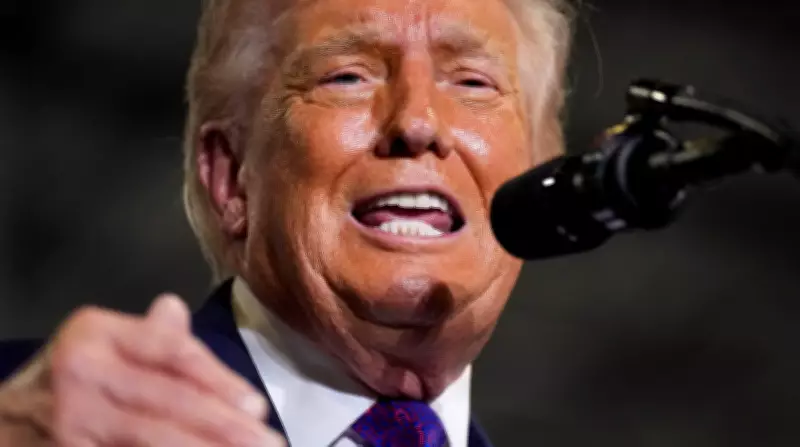
During his first rally since the United States and Israel initiated military action against Iran, former President Donald Trump emphasized his economic achievements and defended American military operations. However, a significant portion of his speech centered on criticizing the physical capabilities of his political rivals, reigniting discussions about ableism in political rhetoric.
Mocking Opponents' Mobility
At the Kentucky event, Trump described his careful descent down rain-slicked stairs, stating, "I do it very slowly...because nobody cares if you set a speed record." He then commented on former President Barack Obama's stair-walking technique, calling it "unpresidential" despite initially expressing admiration. Trump also referenced President Joe Biden's falls, suggesting that such incidents negatively impact global perceptions.
This preoccupation with opponents' stability is not new for Trump, who has frequently equated physical agility with leadership strength in past addresses. According to experts, this pattern reveals deeper issues regarding how society values different abilities.

Understanding Ableism
"His comments may reflect ableism, but they may also reflect general ageism and fear of getting older," explained Douglas Kruse, co-director of Rutgers University's Program for Disability Research. "My guess is that he's trying to prove he's still able, as many older people do."
Davey Shlasko, CEO and founder of Think Again Training & Consulting, defined ableism as "a system of oppression that privileges people whose bodies and minds are considered 'normal' while excluding and marginalizing people whose bodies or minds are not considered 'normal.'"
Shlasko noted that Trump's remarks reflect a widespread assumption: "The comments reflect a very common ableist assumption that an impairment in any area of functioning implies a general incompetence in every area." This mindset often manifests in everyday interactions, such as speaking excessively slowly to wheelchair users, incorrectly associating mobility limitations with cognitive deficits.
The Ripple Effect of Ableist Language
Trump's rhetoric extends beyond personal attacks. At the same rally, he mocked California Governor Gavin Newsom's dyslexia, claiming it represented "mental problems" and a "cognitive deficiency" that disqualified him from presidential office. Shlasko countered that "a specific learning disability doesn't imply anything about someone's ability to reason," adding that such comments implicitly devalue people with learning disabilities.
Critically, responses to Trump's ableism sometimes perpetuate the same harmful patterns. Newsom replied by calling Trump a "brain-dead moron" on social media, which Shlasko identified as containing "offensive ableist language" since "moron is an outdated and offensive diagnostic category for people with intellectual [or] developmental disabilities."
Shlasko observed that people often use ableism to combat ableism because, for many, "ableism doesn't stand out as a problem because they think it is a natural hierarchy, that it is correct and obvious, that everyone would prefer to be...able-bodied."
Alternative Approaches to Criticism
Representative Ilhan Omar (D-Minn.) demonstrated a more constructive approach after deleting a 2020 post that mocked Trump's stair navigation. She later wrote, "I'm taking down the tweet about Trump. Trump is a racist incompetent wannabe dictator. That is enough! We should criticize him on those grounds, not on his physical abilities—and that includes me."
Experts suggest focusing on policy impacts rather than personal attributes. The Trump administration's record includes shutdown layoffs that disproportionately affected workers with disabilities, rollbacks of "disparate impact" policies designed to prevent disability discrimination, and reductions to the U.S. Department of Education's special education office, which serves over 7.5 million children with disabilities.
The Center for American Progress, a left-leaning think tank, characterized the first six months of Trump's second term as "an all-out war against disabled people."

Moving Beyond Personal Attacks
"I hope we can focus not only on the inappropriateness of what [Trump] said, but also on the crucial programs and protections that his administration has sought to undermine," Shlasko urged.
For critics, these policy decisions provide substantial grounds for opposition without resorting to ableist commentary. As the late disability activist Stacey Milbern described, ableism ultimately prioritizes "ablebodied-ness at any cost, frequently at the expense of people with disabilities." This framework encourages evaluating leaders based on their actions toward vulnerable populations rather than physical or cognitive stereotypes.