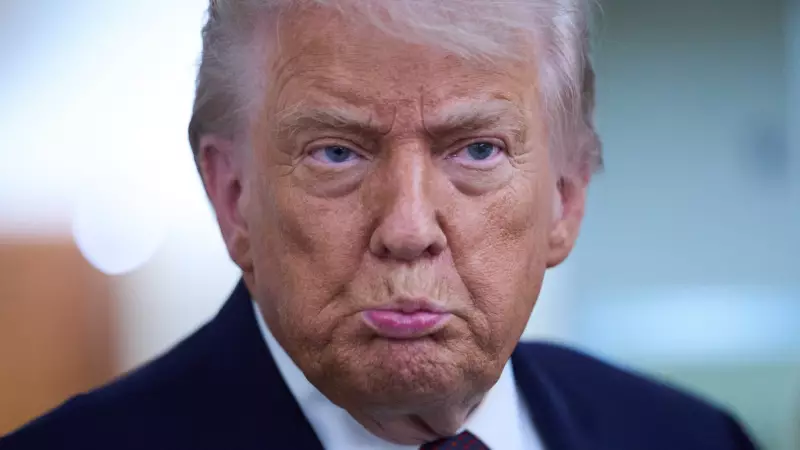
Trump's Verbal Gaffe on Peace Draws Intense Scrutiny and Mockery
Former President Donald Trump made a statement that critics are labeling as a Freudian slip during a recent interaction with reporters aboard Air Force One. The incident occurred as Trump was returning from the World Economic Forum in Davos, Switzerland, where he had delivered a lengthy and meandering address to global leaders.
The Controversial Remarks on Peace and Conflict
When questioned about the substantial $1 billion entry fee for his proposed "Board of Peace" initiative—a program he claims will help resolve international disputes—Trump avoided providing specific details. Instead, he acknowledged that the sum represents "a lot of money" for participating nations to contribute.
However, he quickly added, "But it's nothing compared to the value of peace." In a moment that has since captured significant attention, Trump then stated, "Peace is so destructive for everyone. Even countries that are not involved. It's so destructive for everyone, when you have wars." This contradictory phrasing, equating peace with destruction, has left many observers puzzled and critical.

Social Media Erupts with Criticism and Concern
The "peace is so destructive" comment rapidly went viral across various social media platforms, fueling existing concerns about Trump's mental acuity and verbal precision. Users from diverse political backgrounds seized on the remark to question his fitness for leadership and the coherence of his policy proposals.
One user pointedly remarked, "Mashed potatoes have better logic. MAGA brought this shame on themselves, while believing their delusions that Trump's the best thing since sliced bread." Another expressed frustration, stating, "Do something. Please. Enough is enough," reflecting a broader sentiment of exhaustion with such verbal missteps.
Broader Implications for Political Discourse
Several commentators linked the gaffe to larger issues of global stability and governance. One individual noted, "Suggesting the global stability of the world as 'destructive for everyone,' just means we need to indict this administration even faster," highlighting how such statements can influence public perception of political competence.
Others questioned Trump's grasp of basic concepts, with queries like "Peace, War...What's the difference?" and "He is delusional—does he believe his own delusions?" These reactions underscore the deepening divide in how Trump's communication style is interpreted by supporters and detractors alike.
Ongoing Debates About Leadership and Cognitive Health
The incident has reignited discussions about the importance of mental sharpness in political leadership. As one observer reflected, "One day, not too long from now, America will have a president whose politics will be contested but whose mental acuity won't be." This perspective emphasizes a desire for leaders whose cognitive abilities are beyond reproach, regardless of ideological differences.
Further criticism targeted Trump's aspirations for recognition, with a user noting, "This is the same guy who is begging for the Nobel Peace Prize. His brain is completely fried." Such comments illustrate how verbal slips can undermine credibility and public trust in a figure's diplomatic ambitions.
In summary, Trump's latest verbal misstep has not only provided fodder for online mockery but has also intensified scrutiny of his cognitive state and its implications for effective governance. As social media continues to amplify these moments, the intersection of political communication and public perception remains a critical area of focus in contemporary political discourse.