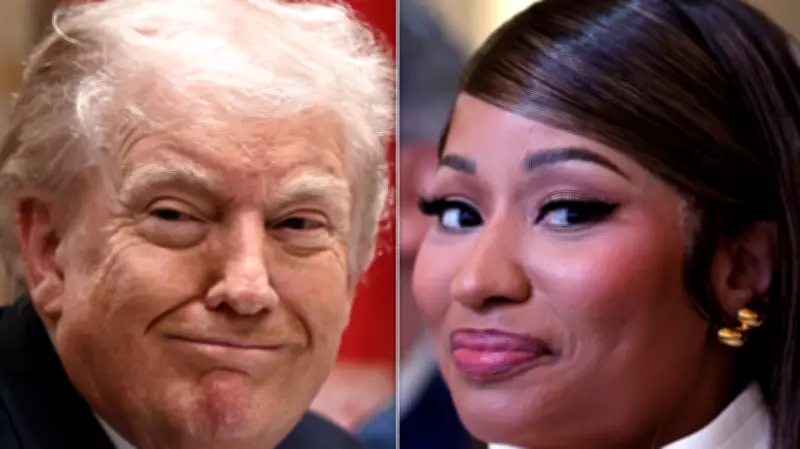
Trump's 'Community' Reference to Nicki Minaj Draws Scrutiny from Political Experts
During a Wednesday summit in Washington, D.C., celebrating the launch of "Trump Accounts" investment vehicles for children, President Donald Trump made remarks about rapper Nicki Minaj's "community" that have since drawn significant analysis from political scientists and race relations experts. The president's comments, described by some observers as awkward and transactional, reveal deeper patterns in his approach to racial politics and voter outreach.
The Washington Event and Trump's Remarks
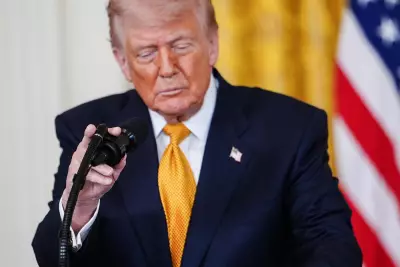
Speaking at the Andrew W. Mellon Auditorium, Trump announced that Minaj was in attendance and had pledged to invest substantial funds in the newly created accounts. The president emphasized that Minaj, who has recently aligned herself with the MAGA movement despite previous criticism of Trump, represents a "big Trump supporter and Trump fan."
Trump then referenced the rapper facing "a little heat on occasion" from her "community" before appearing to correct himself, stating: "We did pretty damn well with your community, as we say." The president did not elaborate on what he meant by Minaj's "community," but the remark follows a pattern of Trump boasting about support from Black communities throughout his political career.

Expert Analysis of Racial Dynamics
Alvin B. Tillery Jr., a professor of political science and African American studies at Northwestern University, told media outlets that when Trump refers to Minaj's "community," he is "almost certainly signaling Blackness — both hers and, by extension, his supposed connection to Black voters."
"That move matters because it reveals how instrumental he views her presence," Tillery explained. "He's not primarily engaging Minaj as an artist, a cultural critic or even an independent political actor; he's treating her as a conduit to a racialized audience he knows he struggles to reach."
Tillery believes Trump's remarks represent an example of "othering," where whiteness is treated as universal while Blackness is highlighted only when politically useful. "By emphasizing her 'community,' Trump implicitly marks her as outside the default political mainstream — the community rather than our community," he said.
Context of Trump's Claims About Black Support
The president's comments come amid ongoing claims about his support among Black voters. During his 2024 presidential campaign, Trump suggested that the "Black population" embraced his mug shot more than any other community. At a Pennsylvania rally last month, he declared that "Black people love Trump" and claimed to have received "the biggest vote with Black people."
However, exit polling data tells a different story. According to an NBC News exit poll, 86% of Black voters supported former Vice President Kamala Harris in the 2024 election, including 77% of Black male voters and 92% of Black female voters. While Trump made some marginal gains with Black voters compared to previous elections, particularly among Black men, experts note these gains have been consistently overstated.
"Trump absolutely exaggerates his support among Black voters," Tillery stated. "It's true that he made some marginal gains — particularly among Black men — but those gains are routinely overstated to obscure a basic reality: An overwhelming majority of Black voters, men and women alike, supported Kamala Harris."
The Transactional Nature of the Exchange
Kari J. Winter, a professor of American studies at the University at Buffalo specializing in gender, feminism, race and class, characterized the exchange between Trump and Minaj as "so cringe and shameless."
"The blatantly transactional nature of the staged exchange of hyperbolic praise between Trump and Minaj is so cringe and shameless as to defy description," Winter said. "Trump revels in being around wealthy people, but he never forgets the color of their skin, as we can see in his awkward, non-sequitur comments about Minaj's 'community.'"

Shaun Harper, a professor of public policy, business and education at the University of Southern California, questioned why Trump didn't explicitly say Black people instead of using the term "community." Harper noted that Minaj represents multiple identities — she's Black, a woman, a mother, a rapper and an immigrant — but said Trump remains "delusional" about his actual support among Black voters.
Strategic Media Calculations
The administration's enthusiastic promotion of Minaj's support appears to be part of a calculated media strategy. Following the Washington event, White House press secretary Karoline Leavitt shared a TikTok video on social media showing Minaj calling Trump her "favorite president" and "the best president of all time." Trump appears in the video calling Minaj "the queen of rap."
Meanwhile, conservative media figures have embraced Minaj's endorsement despite apparent unfamiliarity with her work. During a Fox News segment, host Laura Ingraham confused Minaj's music with that of other artists, mistakenly attributing the song "WAP" to Minaj when it was actually released by Cardi B featuring Megan Thee Stallion.
"Ingraham's confusion between Minaj, Cardi B and Megan Thee Stallion might be intentional or accidental, but in either case it signals to her audience that she does not know or care who Minaj is or what her music is about," Winter analyzed. "Minaj is a stand-in for 'Black female entertainer' who is, in Ingraham's rhetoric, obviously morally inferior to people like herself."
Symbolism Versus Substance in Political Outreach
Tillery believes the right's enthusiasm for Minaj represents less about genuine appreciation for the artist and more about what she symbolizes politically. "Promoting her aggressively is a low-cost way to signal cultural relevance and racial outreach without changing policy positions that remain deeply unpopular with most Black voters," he explained.
Harper raised practical questions about the longevity of this political alliance, asking: "How many MAGA Republicans will buy Minaj's next album? How many of them can name three Nicki Minaj songs? They are profiting from using her as a mascot."
The professor added that while he respects Minaj's right to make her own political choices, he questions whether her alignment with Trump will translate to genuine support from his base beyond symbolic appearances.
Ultimately, experts suggest that the excitement surrounding Minaj's endorsement represents an attempt to create "a symbolic breach in the Democratic Party's longstanding relationship with Black voters." However, as Tillery concluded: "The problem for Trump is that symbolism can't substitute for substance — and Black voters, by and large, continue to vote as if they know the difference."