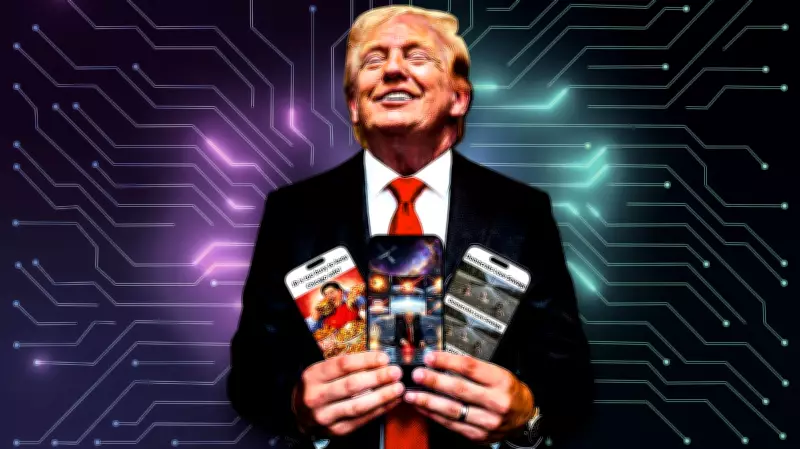
Donald Trump is president of the United States, but on his Truth Social platform, he uses artificial-intelligence-generated images to portray himself as more than a politician. Online, Trump becomes a pope, a buff “Star Wars” Jedi, or an all-powerful space leader.
And Trump doesn’t just use social media to elevate his image –– he also uses it to make his political enemies look worse. Trump has a habit of posting Democrats, mayors and members of Congress as cartoonish stereotypes in AI-generated images. In one recent posting spree, Trump posted an AI-altered image of former Presidents Barack Obama and Joe Biden, along with ex-House Speaker Nancy Pelosi (D-Calif.), as “Dumacrats” stewing in sewage at 7:53 a.m. on May 12.
Two minutes later, Trump posted a fatphobic AI-generated image of Illinois Gov. JB Pritzker eating piles of fast food. This image caption read that Pritzker was “too busy” to keep Chicago safe. And shortly after that, Trump posted an image of House Minority Leader Hakeem Jeffries (D-N.Y.) surrounded by money while his district was in ruins. Trump dubbed Jeffries “low IQ” in the AI-altered image.

Trump often intersperses his visual insults with written ones. This month, The Wall Street Journal published an analysis of Trump’s Truth Social posts and found that about 1 in 10 of his account’s text posts will involve name-calling with insults such as “crooked,” “sleazebag,” “loser” or “low IQ.”
By sharing AI-generated images that can be disseminated quickly, Trump is creating and sharing “a visual equivalent of his version of the classic propaganda tactic of name-calling,” said Nick Cull, a historian of propaganda and professor of communication at the USC Annenberg School for Communication and Journalism. This tactic of name-calling has a long history. It was identified in the 1930s by the Institute for Propaganda Analysis as one of the seven basic propaganda techniques. Cull said Trump does name-calling regularly along with other tactics such as “bandwagoning,” where he strengthens a claim by attributing it to many people. Cull noted that Trump also deploys the “glittering generalities” tactic, where he promises an audience “an inflated but imprecise outcome” such as “winning so big” in the Middle East.
Sharing propaganda that elevates one’s strength and diminishes one’s enemies is not a new technique. Authoritarian leaders like Vladimir Putin have used propaganda in this way to promote their agenda. What makes Trump’s AI propaganda different is that it’s unusual for leaders of a democracy to be so publicly divisive, said Emma Briant, a researcher and expert on contemporary propaganda and information warfare.
“Most democratic leaders want to unite the country in support of whatever they’re doing, because they want to win more elections,” Briant said. “But Trump isn’t doing that at all.” By deliberately alienating half the country that did not vote for him, Briant said Trump’s offensive, shocking imagery “does imply that those people’s votes don’t matter to him.”
“We know from their respective secret tapes that some past presidents were similarly scathing of their adversaries,” Cull said. “What is fascinating about Trump is that his criticism is so public and presented as a kind of achievement.”
AI images are particularly potent because they immediately teach you what to feel. Briant said Trump’s use of AI-generated cartoons reflects his “politics of feeling” because it’s a visual reminder “of how you are against them.”
And though these images might appear to have a simplistic message, “This propaganda that it produces is quite sophisticated and nuanced ... it’s very good at conveying everything he wants to convey very effectively,” Briant noted. “It sets an image and a stereotype in people’s minds that sort of inoculates them to the news, so if you are constantly showing people images of, ‘Look, they’re bathing in swamps of corruption,’ you’re ... making it seem like both sides are just as corrupt,” she said.

Briant said that Trump’s habit of sharing images of himself as powerful suggests he might be playing out fantasies where he is perpetually in power. For her, Trump’s recent AI-generated post where he blows up targets from space does not suggest “‘I’m going to nuke everyone,’ but what I do think it says is ‘I have no limits.’”
Perhaps Trump’s propensity to antagonize his enemies is revealing, but not in the way he intends. Propaganda experts said that Trump’s habit of posting negative images of his opponents might say more about him than about them. “He seems to obsess over people,” Briant said. “I think that’s a big part of it, is that kind of revenge focus.”
“There are only so many ways to represent power and only so many reasons to do it: to reassure and feed one’s base; to antagonize or demoralize one’s enemies; or to affirm one’s self as power becomes increasingly uncertain,” Cull said. “The most confident and secure leaders don’t need fantasy images for support.”