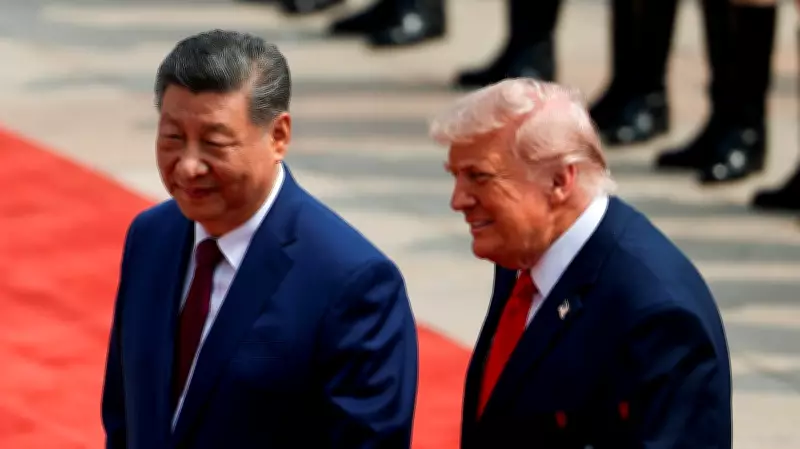
President Donald Trump told Chinese President Xi Jinping on Thursday that it was an honor to be his friend, even as Xi issued warnings about avoiding a potential clash between the two nations during their highly anticipated bilateral meeting in Beijing. The sharp contrast in tone underscored the deep divisions between the leaders on contentious issues such as the war in Iran, trade disputes, and Washington's relationship with Taiwan, suggesting that their meetings would be longer on pageantry and symbolism than on major breakthroughs.
Xi's Warnings on Taiwan and the Thucydides Trap
The meeting was held behind closed doors, but the official Xinhua news agency reported that Xi told Trump that if Taiwan is not handled correctly, the United States and China risk clashes and even conflicts, putting the entire relationship in great jeopardy. This followed public opening remarks at the Great Hall of the People, where Trump was full of platitudes, calling Xi a great leader and promising that the relationship between China and the USA would be better than ever before.
Xi was darker in his opening remarks, expressing hope that the U.S. and China can avoid conflict while questioning whether the two countries can transcend the Thucydides Trap and forge a new model for relations between major powers. The Thucydides Trap refers to the idea that when a rising power threatens to displace an established power, the result is often war. Xi emphasized that cooperation benefits both sides, while confrontation harms both, and that the two countries should be partners rather than rivals.

Elaborate Welcome Ceremony
The meeting wrapped up after about two hours, following a sweeping greeting for Trump that featured booming cannons and a band playing The Star-Spangled Banner and China's national anthem. School children in bright colors offered a welcome routine, jumping as the girls waved flowers and the boys hoisted American and Chinese flags while the two leaders walked past them. Trump was subsequently planning to visit the Temple of Heaven before attending a state banquet with Xi.
Economic and Trade Issues Loom
The White House has insisted that Trump would not be making the trip without an eye toward securing results before he leaves, suggesting there could be announcements on trade, including a Chinese commitment to buy U.S. soybeans, beef, and aircraft. Trump administration officials also want to work toward establishing a Board of Trade with China to address commercial differences. However, neither side has yet offered concrete details on what might come out of the three-day visit at a time when Beijing's close economic ties to Iran could complicate matters.
Trump's trip comes as Iran continues to dominate his domestic agenda and stoke fears about a weakening U.S. economy as the election season ahead of November's midterms begins heating up. The U.S. and Israel's war in Iran has led to the effective closure of the Strait of Hormuz, stranding oil and natural gas tankers and causing energy prices to spike, threatening global economic growth.
Mixed Messaging on Iran and the Economy
Secretary of State Marco Rubio said that Trump will make the case for Beijing to exert its influence on Iran, noting that economies are melting down because of this crisis, which means consumers are buying less Chinese product. This contradicted Trump, who has downplayed suggestions that he will press Xi to do more to pressure Iran to open the strait. The president also says pressure on the U.S. economy will not compromise U.S. demands as he negotiates with Iran. Asked if the financial stability of ordinary Americans factors into Iranian negotiations, Trump responded, Not even a little bit.
Mixed messaging was also evident on inflation and the war, as Vice President JD Vance denied Trump's own words that the U.S. economy was not a major factor in seeking a resolution with Tehran.

Taiwan and Technology Discussions
Looming large is the status of Taiwan, given that China is displeased with U.S. plans to sell weapons to the self-governing island that the Chinese government claims as part of its territory. The Trump administration has approved an $11 billion weapons package for Taiwan but has yet to begin fulfilling it. Trump has also demonstrated greater ambivalence toward Taiwan, raising questions about whether he might be open to dialing back support for the island democracy.
Taiwan is also the world's leading chipmaker, producing components essential to the development of artificial intelligence. Trump has sought to bolster trade deals with Taiwan that can stimulate chip production in the U.S. Trump personally called Nvidia's Jensen Huang to invite him to join the delegation on Air Force One. Huang is one of a large group of CEOs from the tech, defense, finance, and agriculture sectors who are part of the delegation.
The U.S. and China reached a trade truce last year that calmed each side's threats to impose steep tariffs on the other. The White House says there have been ongoing discussions and mutual interest in extending the agreement, though it is unclear whether any such announcement could come during Trump's visit.
Leaving the Xi-Trump meeting, SpaceX chief Elon Musk called what occurred wonderful and said it featured many good things. Huang said that Mr. Xi and President Trump were incredible.