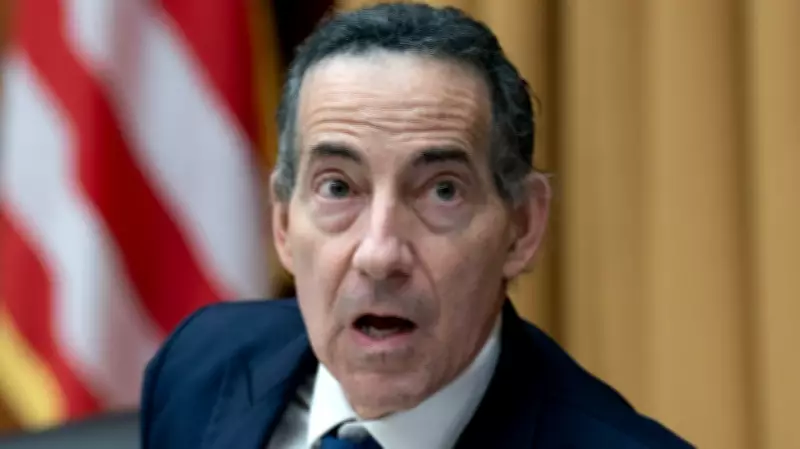
In a startling revelation, Representative Jamie Raskin, a Democrat from Maryland, announced on Tuesday that he conducted a search for any mention of former President Donald Trump within the unredacted versions of the Jeffrey Epstein files provided to him earlier this week. Raskin, who serves as the top Democrat on the House Judiciary Committee, stated that Trump's name "appears more than a million times" in the documents, indicating its pervasive presence throughout the materials.
Initial Review and Concerns Over Redactions
Speaking in an interview with Axios published on Tuesday, Raskin expressed deep concern about the extensive redactions in the files. "I mean, there's tons of redacted stuff," he remarked, emphasizing the opacity surrounding certain sections of the documents. He further explained that when he input Trump's name into the database, it yielded over a million results, suggesting a significant volume of references to the former president.
This disclosure comes amid ongoing efforts by Trump to distance himself from Epstein, the late convicted child sex offender who died in 2019 while awaiting trial on federal sex trafficking charges. Notably, Trump signed the Epstein Files Transparency Act into law in November, which aims to increase transparency regarding the case.

Access to Unredacted Documents and Legal Violations
Members of the House Judiciary Committee were granted access to the unredacted versions of the Epstein files on Monday. Following his initial review, Raskin asserted that the Justice Department appeared to be in violation of the Epstein Files Transparency Act. A key provision of this act prohibits the DOJ from redacting the names of Epstein's accomplices, raising questions about compliance and accountability.
Later on Tuesday, Raskin clarified his comments in a statement to Axios, providing more context about his search methodology. "In the database, I typed in the words 'Trump,' 'Donald or Don' and it came up with more than a million results," he explained. However, he acknowledged the limitations of this approach, noting, "I obviously didn't have the time to review each one, and I obviously cannot guarantee that every mention of a Donald is Donald Trump as opposed to some other Donald."
Technical Challenges and Notable Findings
Raskin also highlighted the technical difficulties associated with the database review tool provided to committee members, including Representatives Ro Khanna (D-Calif.), Thomas Massie (R-Ky.), and Becca Balint (D-Vt.). He described the tool as "confusing, unreliable, and clunky," which may impact the accuracy and efficiency of document analysis.
Among the documents reviewed, Raskin pointed to a particularly noteworthy 2009 email from Epstein to his co-conspirator Ghislaine Maxwell. This email contained a forwarded conversation between Epstein's lawyers and attorneys for Trump, which Raskin discussed with reporters earlier in the week. He explained that the email synopsized Trump as stating that Epstein was not a member of his Mar-a-Lago club but was a guest who had never been asked to leave.
"And that was redacted for some indeterminate, inscrutable reason," Raskin continued, questioning the rationale behind such redactions. This finding appears to contradict Trump's prior claims that he had severed ties with Epstein years earlier than indicated.
Trump's Denials and Ongoing Scrutiny
Trump has consistently denied any wrongdoing and has asserted that he expelled Epstein from Mar-a-Lago after discovering that Epstein "stole people" who worked there. Raskin, however, emphasized that the 2009 exchange is "just one memo out of 3 million" Epstein files currently in the DOJ's possession, suggesting there may be more revelations to come.
Raskin expressed a strong desire to review the millions of documents that have not yet been publicly released, dismissing claims from the Trump administration that these are merely duplicate copies of previously shared files. "If they're duplicative, what's the problem?" he questioned, adding, "We'll be the judge of that." This statement underscores the committee's commitment to thorough investigation and oversight.

The ongoing scrutiny of the Epstein files continues to raise important questions about transparency, accountability, and the relationships between high-profile individuals and the late financier. As the House Judiciary Committee delves deeper into the documents, further insights may emerge regarding the extent of Trump's connections and the broader implications for justice and public trust.