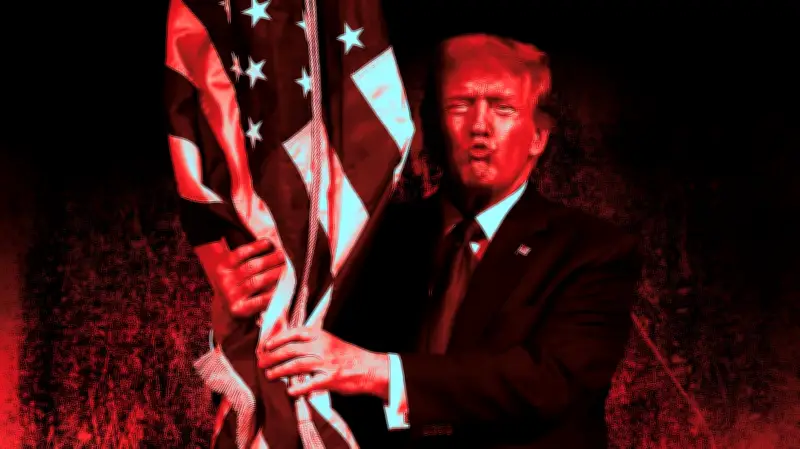
With the nation's semiquincentennial fast approaching, President Donald Trump is set to host a celebration that centers himself on the National Mall on July 4. This “most spectacular TRUMP RALLY of them all,” as he calls it, is officially billed by the White House as “one of the grandest displays of patriotism that the world has ever seen.” But true patriotism actually looks very different than the grand spectacle Trump has planned.
The Example of Viola Liuzzo
Back in 1965, Viola Liuzzo, a white 39-year-old mother of five from Detroit, Michigan, heeded the call of Rev. Martin Luther King, Jr. to volunteer for a Civil Rights march from Selma, Alabama, to the capital, Montgomery, to demand voting rights. Liuzzo left her home and drove three days to help. The first such attempt had been dubbed “Bloody Sunday” after police attacked marchers on the Edmund Pettus Bridge. Once in Selma, Liuzzo staffed a volunteer welcome desk, marched across the Pettus Bridge and helped drive marchers back and forth along their journey. After joining the final leg of the march and witnessing King's address from the state capital, she volunteered to drive other activists back to Selma that night. On that trip, Klansmen shot and killed Liuzzo.
Liuzzo gave her life as a patriot in service to her country. She did so not out of blind faith, but because she believed in the country becoming what it promised to be. “My wife died for a sacred battle, the rights of humanity,” her husband, Anthony Liuzzo, told President Lyndon Johnson after learning of his wife's death. “She had one concern and only one in mind.” That concern, he said, was to fulfill the promise that “all men are created equal.”

Trump's Alternative Vision
Trump offers a different vision: a patriotism rooted in a martial and jingoistic nationalism that celebrates blood-and-soil citizenship and authoritarian fantasies of cleansing the country of perceived enemies, where some are granted the rights put forth by those words in the Declaration of Independence, and others are excluded.
The people of the United States have struggled over competing visions for what it means to be an American and, thus, to be patriotic. Conservatives have long held that they alone hold this mantle — casting the Left, liberals and progressives alike, as subversive or treasonous. Efforts to suppress dissenting voices that targeted socialists, communists, labor activists, radical feminists, LGBTQ people and Black Americans, among others, came wrapped in a flag with the Constitution in one hand and the Bible in the other.
But Trump has taken this even further. Whether hugging the flag, literally, or using the Bible for a photo op, he calls all of his political opponents “the enemy within,” immigrants as “vermin” and claims that those who oppose him are “not people.” As to the Constitution, he says he doesn't know if he has to uphold it. Patriotism is judged by adherence to his counter-subversive vision and devotion to him, personally.
This vision is exclusionary, sectarian and hierarchical. It also stands as the antithesis of what love for one's country should actually mean: As the country celebrates this 250th anniversary, the Declaration's promise of equality still stands as the base upon which all true patriotism is built. “National pride is to countries what self-respect is to individuals: a necessary condition for self-improvement,” wrote the political philosopher Richard Rorty.
The Tradition of Egalitarian Patriotism
That self-improvement is what true patriotism is all about. All great movements of American progress have in common the drive to make the country achieve those words in the Declaration of Independence: “We hold these truths to be self-evident, that all men are created equal …”
Abolitionists, particularly Black abolitionists, were the first to turn the Declaration's words into a new constitutional politics. The Anti-Slavery Society called the Declaration's preamble “[t]he cornerstone upon which [was] founded the Temple of Freedom.” Frederick Douglass called it “the ringbolt to the chain of your nation's destiny.”

For Abraham Lincoln, the Declaration and its preamble served as the central principle of the United States. This “immortal emblem of Humanity” acted as an “electric cord … that links the hearts of patriotic and liberty-loving men together.” Invoking Biblical language, he said the Declaration “proved an ‘apple of gold’ to us,” with the nation and its Constitution serving as “the picture of silver subsequently framed around it.” “The picture was made for the apple — not the apple for the picture,” Lincoln wrote.
Lincoln consecrated this ideology, affirming the drive for equality as the country's purpose in the Gettysburg address when he declared, “Four score and seven years ago our fathers brought forth on this continent, a new nation, conceived in Liberty, and dedicated to the proposition that all men are created equal.”
Suffragists and the Labor Movement
As with those who pushed to end slavery, suffragists advocating for women's right to vote grounded their arguments in the Declaration. “[A]ll men and women are created equal,” the Declaration of Sentiments issued at the 1848 suffragist convention in Seneca Falls, N.Y., pronounced. This was a common refrain among suffragists until women won the right to vote in 1920 and for the feminist movement that further expanded women's rights up to this day.
The Declaration's insistence on equality also inspired the labor movement, as workers identified exploitation and domination by capital as the same form of tyranny that the Declaration's authors identified in 1776. “On July Fourth, 1776, the American people declared their independence of political tyranny from which they had long suffered,” the 1938 Steelworkers' Declaration of Independence stated. “They pledged themselves to protect the right of all to life, liberty, and the pursuit of happiness. But today we find the political liberty for which our forefathers fought is made meaningless by economic inequality. In the steel and other like industries a new despotism has come into being.”
The Civil Rights Movement
And the civil rights movement, like the abolitionists before them, grounded their claims in the Declaration's preamble, which Rev. Martin Luther King, Jr. called a “promissory note” that the country had “defaulted on.” “Instead of honoring this sacred obligation, America has given the Negro people a bad check, a check that has come back marked ‘insufficient funds,’” King said. “But we refuse to believe that the bank of justice is bankrupt.”
This is the language of a patriotism that does not hide from the country's failure to live up to its ideals. It instead calls upon the people to right those wrongs by achieving the ideal that defines the nation. It is the questioning, critical patriotism that the author James Baldwin laid claim to when he wrote, “I love America more than any other country in the world, and, exactly for this reason, I insist on the right to criticize her perpetually.”
The Anti-Egalitarian Counter-Tradition
But this tradition is countered by the vision upheld by those like Trump who see American patriotism as open only to some. And he was not the first to do so. The Constitution itself was designed to rein in the growing claims for equality that were unleashed by the Revolution. John Adams, the second president, called the equality promised by the Declaration “a fraud.” Indeed, those who wrote and signed the Declaration did not believe that “all men” meant all men — Black people, women, Native tribes and other races were kept out — and the Constitution enshrined many of those exclusions.
But it was the Southern slave aristocracy that became the predominant purveyors of such anti-egalitarian sentiments. John Calhoun, the South's great ideologist, called the Declaration's promise of equality “the most false and dangerous of all political errors,” as it promised to lead to the subjugation of the white majority. “Taking the proposition literally (it is in that sense it is understood), there is not a word of truth in it,” Calhoun said in 1848 while debating the admission of Oregon as a free state.
This view was even constitutionalized — albeit temporarily — in the Supreme Court's ruling in Dred Scott, in which Chief Justice Roger Taney declared that Black Americans “had no rights which the white man was bound to respect.”
Such anti-egalitarian attitudes carried over to the economy, where corporate barons made use of them to justify the domination of workers. In his autobiography, Henry Ford stated plainly that “any democratic conception which strives to make men equal is only an effort to block progress.”
All of these sentiments are visible among today's conservatives, who claim that efforts to mitigate or reverse past inequality are themselves inegalitarian because they treat the white majority unequally. Far-right trillionaire Elon Musk warns of white replacement and racial subjugation. Billionaire venture capitalist Peter Thiel, who helped bankroll Vice President JD Vance's Senate campaign, explicitly opposes the universalism of the Declaration, once claiming, “I no longer believe that freedom and democracy are compatible.” He blamed that incompatibility on women obtaining the right to vote.
Meanwhile, the conservative Supreme Court, backed by the Trump administration and the Republican Party, ended affirmative action and destroyed the Voting Rights Act on claims of unequal treatment for whites (and Asian-Americans, but only when legally useful). Trump's anti-DEI initiatives borrow from the same tradition and are being used to resegregate universities, the military and cultural life.
Conclusion: Rejecting False Patriotism
The version of patriotism Trump hopes to display for his July 4 celebration is rooted in this anti-egalitarian, anti-Declaration ethos. The celebration is privatized, sectarian and narcissistic. It is everything democracy is not. That is no surprise from a vain billionaire who led a coup to overthrow an election, hopes to destroy the 14th Amendment's promise of birthright citizenship and believes in natural hierarchies, often racialized, of IQ and blood heredity.
But Trump's sacrilegious celebration provides the opportunity to reject the false patriotism of nationalism and reaffirm the commitment to the true promise of the country: that all are created equal.
Today, the same spirit that led Liuzzo to give her life for her country still lives. It lives in Americans' continuous refusal to go along with abuses, injustice and persecution, sometimes at great personal risk. It lives in the ongoing efforts by the people of Los Angeles, Chicago, Washington, Minneapolis-St. Paul and numerous other localities that put themselves on the line to uphold that principle in protest against Trump's mass deportation campaigns. And it lives in the memories of people like Renée Good and Alex Pretti, who, like Liuzzo, were killed in protest of conditions afflicting people of a different race whom they did not know. They were Americans defending their fellow countrymen and would-be countrymen in service to that principle written 250 years ago.
That patriotism outshines Trump's narrow vision. It promises that the revolutionary spirit of '76 rests in the people. And to uphold the country's true ideal, we must fix or replace the frame that failed it. We are called to remember what another great Founding Father wrote 250 years ago: “We have it in our power to begin the world over again.”