During his summit with U.S. President Donald Trump in Beijing, Chinese President Xi Jingping posed a question: “Can China and the United States transcend the so-called ‘Thucydides trap?’ and forge a new paradigm for major-power relations?” This marked the second prominent reference to the ancient Greek general and historian by a world leader this year, following Prime Minister Mark Carney’s speech at Davos in January. But why is Thucydides having a political moment, and what makes his writing relevant today?
Who Was Thucydides?
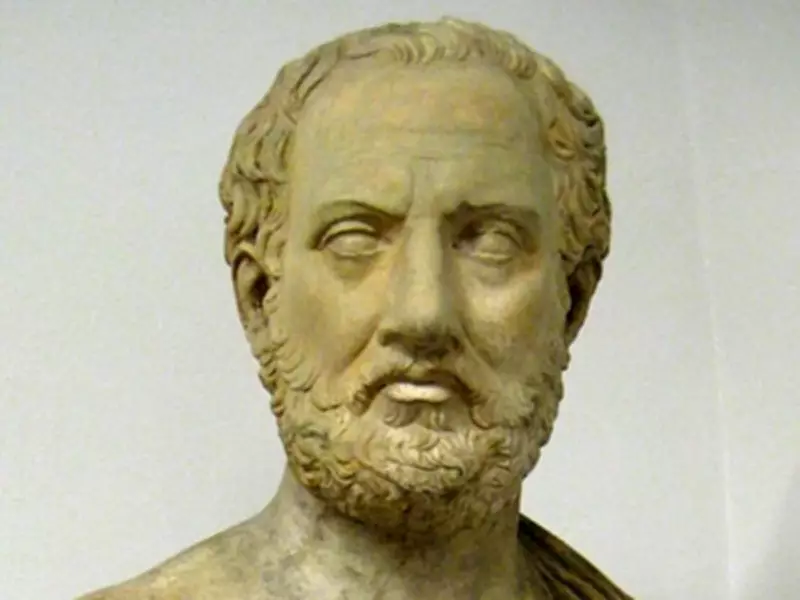
Thucydides was a Greek general and historian known for writing the “History of the Peloponnesian War,” an account of the conflict between Sparta and Athens that lasted from 431 to 404 BCE. As a general during the early part of the war, he was an eyewitness to many events. His writing stands out for its logical analysis, a departure from the storytelling and mythology common in his era, according to Michael Carter, a professor in the department of classics and archaeology at Brock University in St. Catharines, Ontario. “It’s very rational, almost scientific in a way,” Carter said. “And in many ways, I would say he’s the first real modern Western historian.”
While the “History of the Peloponnesian War” is considered a foundational work, the man behind it remains mysterious. Little is known about Thucydides’ personal life beyond what he included in his book, and for reasons unknown, his account ends mid-sentence in 411 BCE.

What Did Xi Say About Thucydides?
During the summit, President Xi posed a series of questions to President Trump about future bilateral relations, including the one referencing the ‘Thucydides trap.’ The term was popularized by political scientist Graham Allison in his 2017 book “Destined for War,” which examines China–U.S. relations. It refers to the idea that conflict is likely when a rising power threatens to challenge a ruling one; in the 16 historical examples Allison cites, only four avoided it.
The theory derives from a line in the “History of the Peloponnesian War”: “It was the rise of Athens and the fear that this instilled in Sparta that made war inevitable,” according to a common translation. “That’s what Graham Allison’s argument is, that the United States is the hegemon or the leader of the world and then there’s China as a rapidly rising power,” Carter explained. “And at one point, something is going to happen and there’s going to be a break.” In response to his own questions, Xi said the two leaders would have to answer them together.
What Did Carney Say?
In his speech to the World Economic Forum in Davos in January, Carney also referenced a Thucydides quote. “It seems that every day we’re reminded that we live in an era of great power rivalry, that the rules-based order is fading, that the strong can do what they can, and the weak must suffer what they must,” Carney said in his remarks.
Thucydides is considered the ‘guiding light’ of political realism, the philosophy that states operate out of self-interest and the pursuit of power, not morals or ethics. His insights into power dynamics and conflict remain strikingly relevant in today’s geopolitical landscape, as world leaders grapple with the implications of shifting global power structures.