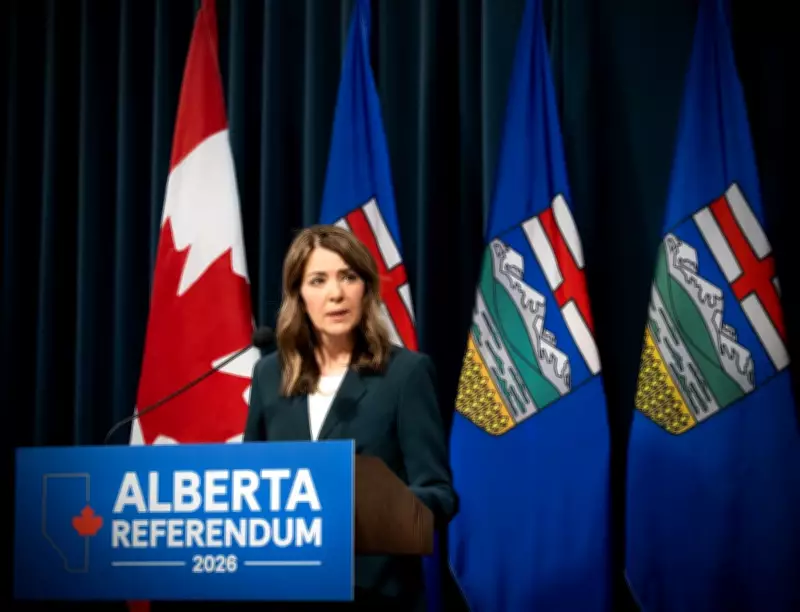
Alberta Premier Danielle Smith defended her decision Friday to hold a vote on whether the province should begin the process of separating from Canada, while separatists warned the move could trigger a revolt within her governing United Conservative Party (UCP).
On Thursday evening, Smith took to the airwaves in a televised address indicating that a tenth question on separation will be added to the referendums already scheduled for Oct. 19 of this year. That question asks if Alberta should begin the process required to hold a future legally-binding separation vote, and reads: “Should Alberta remain a province of Canada or should the government of Alberta commence the legal process required under the Canadian Constitution to hold a binding provincial referendum on whether or not Alberta should separate from Canada?”
On Friday, Smith reiterated her earlier position that over 700,000 Albertans signed two rival petitions calling for Alberta to either remain a part of or secede from Canada, and that the issue had reached a point where those views should be put to a public vote.

“We cannot kick this can down the road. We need to get direction from all Albertans on this matter now, not three years from now,” she said. “Now is the time for Albertans to decide whether we want to spend the time, expense and effort pursuing separation or whether Albertans want to remain in Canada.”
When asked by reporters, she said she intended to campaign throughout the summer on the side of those calling on Alberta to remain a part of Canada, citing the recent progress towards improving the province’s relationship with the federal government under the leadership of Prime Minister Mark Carney.
“I have seen enough from the directional change that we have with the new prime minister. He’s prepared to work with us, he’s prepared to give Albertans hope again,” she said, adding she plans to have town halls and meetings over the summer about why Albertans should vote to remain in Canada.
“I’m prepared to work to give Albertans hope again, but we need to question the results, so that we can end that uncertainty.”
Separatists Accuse Smith of Betrayal
Separatist organizers, however, are accusing Smith of defusing the independence movement while denying its supporters the referendum question they wanted. Alberta Prosperity Project lawyer Jeffrey Rath told Postmedia in an interview Friday that he wasn’t surprised by Smith’s Thursday night address and that she has angered people on both sides of the issue equally.
“It’s cynical. It’s despicable. It’s low. It’s underhanded, and it’s morally bankrupt,” he said. “Danielle Smith has lost the moral authority to continue to lead the UCP. She knows that a super-majority of her base wanted an independence referendum.”
Rath argued that Smith’s unity campaign is a tactical move to undermine separatist momentum. “She seems to have forgotten who elected her,” he said, noting that momentum is building within the UCP to oust the premier from her leadership. The separatist lawyer claimed that Smith’s decision to include a remain option in the referendum question is a deliberate attempt to confuse voters and dilute support for independence.
Leadership Challenge Looms
The dispute highlights growing tensions within the UCP, where a faction of separatist members has been pushing for a more aggressive stance on leaving Canada. Smith’s centrist approach, which seeks to balance the demands of both separatists and unionists, has left her vulnerable to criticism from both sides. Political analysts suggest that the upcoming referendum could become a flashpoint for a leadership review, with separatist-aligned members already gathering support to challenge Smith’s position.
Smith, however, remains defiant, framing the referendum as a necessary step to resolve the province’s long-standing grievances with Ottawa. “We need to get direction from all Albertans,” she reiterated, emphasizing that the vote will provide clarity on the province’s future direction. As the summer campaign begins, all eyes will be on Smith’s ability to hold her party together while navigating the volatile issue of separation.