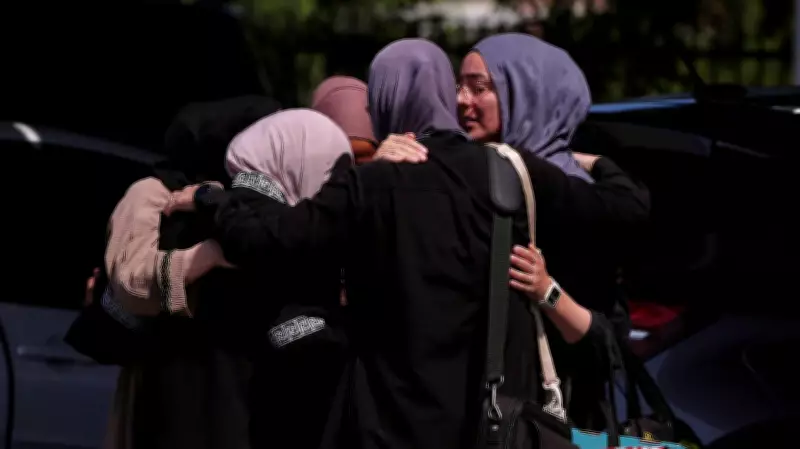
People embrace outside of the Islamic Center of San Diego on Tuesday, a day after a deadly shooting there.
Tazheen Nizam is haunted by what she saw when she arrived at the Islamic Center of San Diego on Monday. Nizam was among the first people on the scene after two teenagers opened fire at the mosque. When she saw the body of Amin Abdullah, the security guard who saved the lives of the nearly 140 children who were at the on-site school, she said, “That’s the moment I broke down.” The next day, Nizam returned to the mosque. Lunchboxes and water bottles littered the playground, an eerie reminder of what had occurred the day before.
“It’s going to be a long, drawn-out healing process,” said Nizam, the executive director of the San Diego chapter of the Council on American-Islamic Relations. “We are never going to be the same.”

The two shooters killed three men before killing themselves in an attack police are investigating as a hate crime. The three men — Abdullah, as well as Nadir Awad and Mansour Kaziha — have been celebrated as heroes for preventing the gunmen from reaching the schoolchildren. Police have said that Abdullah was instrumental in preventing the shooting from becoming a bigger massacre. Kaziha, who owned a nearby store and catered for a community event every Friday, was the first person to call 911. Meanwhile, Awad, who lived across the street, ran into the school when he heard there were people with guns on the premises. His wife is a teacher at the school.
San Diego residents are still in shock, unable to process the violence against their community. “We can’t even be safe to learn and to be in community,” said Homayra Yusufi, a local community advocate whose nephew attends the school. “Our children have to live in constant fear of going to a place that’s supposed to provide that.” Many people are frustrated with local police and question why law enforcement didn’t arrive on the scene more quickly.
“It was our community servants, who have been serving our community, who were the ones who saved those children,” Yusufi said. “It wasn’t the police. They were too late.”
The San Diego Police Department did not immediately respond to a request for comment. A woman prays beside flowers placed outside of the Islamic Center of San Diego the day after the shooting.
Khalid Alexander, the founder of Pillars of the Community, a nonprofit organization that advocates for communities and people negatively impacted by law enforcement, said police “failed by every possible rubric you can come up with.” “These folks that are supposed to be there to protect and serve,” he said. Funerals for the three victims are set to take place on Thursday.
CAIR documented 8,683 civil rights complaints nationwide in 2025 — the highest single-year total since the organization began tracking incidents in 1996. Another study, documented by the Center for the Study of Organized Hate, found a 1,450% surge in anti-Muslim posts by Republican officials between February 2025 and March 2026.
“It’s absolutely infuriating to see the kinds of commentary that’s going out,” said Yusufi, who believes the shooting is a “direct result” of unchecked Islamophobia by elected officials. “Terrible things that have been said by Congress, by this administration, and that hate and vitriol was going to come back.”
The teenage gunmen met online and left behind a 75-page document that preached hate and racism, including against Muslims and Black people. The manifesto also referenced the gunman who killed 51 people and injured 89 more in an attack on two mosques in 2019 in Christchurch, New Zealand — the deadliest anti-Muslim terrorist attack in modern history.
Back in San Diego, local organizers are already thinking about what healing looks like in the long term. “If we can, as a collective, know our neighbors and build our bonds, we will not learn to hate our neighbors so much that we drive down the street and shoot them,” Nizam said.