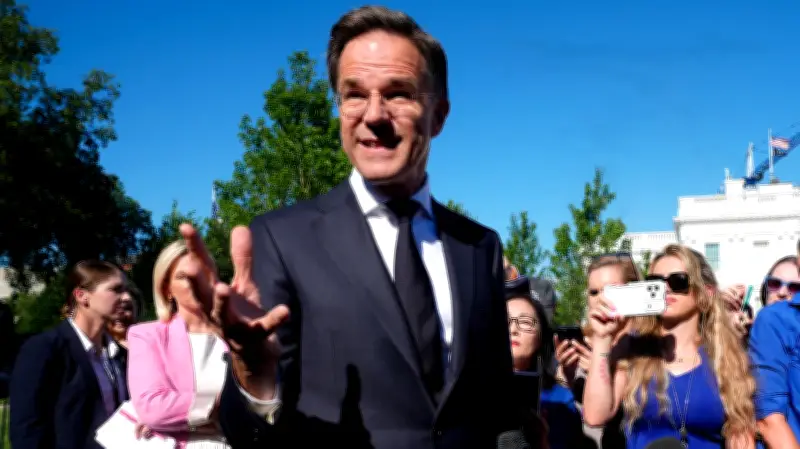
Since becoming NATO secretary-general almost two years ago, Mark Rutte has dedicated much of his time to keeping the United States anchored to the world's largest military alliance, employing flattery to dissuade President Donald Trump from acting on threats to abandon it. But the goalposts keep shifting, raising the stakes ahead of this week's summit in Turkey.
From Money to Capabilities
Initially, the focus was on money. Trump has long criticized NATO allies for spending too little on defense. At last year's summit, allies committed to investing as much as the U.S. in gross domestic product terms, addressing that concern. Now, NATO's real problem is converting that money into military capabilities, especially as European countries worry about a possible attack from Russia.
At a White House meeting last month, Rutte tried to put lingering concerns to rest with a chart labeled 'The Trump Trillion' in gold letters, showing $1.2 trillion in spending by European allies and Canada since 2017. But Trump appeared unmoved, saying he was still disappointed at some allies' refusal to join the Iran war, which he launched alongside Israel without consulting them. 'We don't need their money — we don't need anything,' Trump said. 'I just want loyalty.'

Trump's Summit Threats
Trump suggested he might have skipped the upcoming summit entirely if it were not hosted by Turkish President Recep Tayyip Erdogan. This indicates that even Erdogan and Rutte—foreign leaders Trump seems to hold in rare esteem—will have their work cut out in keeping the summit on track.
Historically, NATO's top civilian official has encouraged consensus among the 32 member countries. But during both of Trump's terms, Rutte and his predecessor Jens Stoltenberg have dedicated huge energy to keeping the U.S. in the alliance. Trump has threatened to leave NATO, considered pulling U.S. troops out of Europe, and vowed to take over Greenland, a semiautonomous part of ally Denmark. He has also cast doubt on defending members not spending enough on their military, eroding trust.
Flattery as a Strategy
Rutte's approach has been heavy on flattery. Last month's carefully choreographed Oval Office pitch—with props evoking the American flag—set a new marker. The charts showed tens of thousands of U.S. jobs created and a backlog of $300 billion in European orders for military equipment, all thanks to the 'leader of the free world,' Rutte said. He gently pushed back on Trump's complaints about Iran, noting that up to 5,000 U.S. planes took off from European bases before an April ceasefire.
NATO cannot function without its biggest ally. Europe is being pushed to fend for itself even as Russia poses a greater threat. Last month, the Pentagon surprised allies by scaling back troops, warships, aircraft, and drones it would provide if one came under attack. Trump has also sent conflicting signals about U.S. troop numbers. The cutbacks and mixed messaging have undermined unity, just as Russia probes Europe's defenses with drone flights near military bases, according to a study released Thursday.
Shifting Demands
Each summit is meant to showcase collective security under Article 5 of NATO's treaty, invoked only once after the Sept. 11 attacks. Last year's summit in The Hague, Rutte's hometown, saw allies back a major defense spending pledge, and Trump left calling NATO a 'nice group of people.' This year's summit, hosted by Erdogan, may keep Trump at the table but is unlikely to mend rifts.
Rutte has tried to convince Trump that European partners are spending so much more that America can focus on China while they handle Ukraine. But Trump wants more now, and his demand for 'loyalty' is hard to capture on any chart. Stoltenberg wrote in his memoir about chairing a 2018 summit that Trump nearly upended: 'If an American president says he no longer wishes to defend the other allies and leaves a NATO summit in protest, then the NATO treaty and its security guarantee aren't worth very much.'