Sen. Rand Paul Launches Fiery Attack on DHS Nominee Markwayne Mullin in Confirmation Hearing
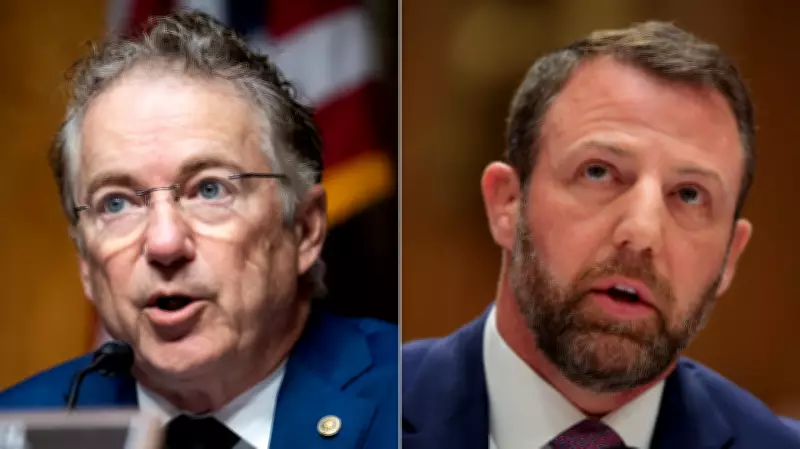
The confirmation hearing for Markwayne Mullin, President Donald Trump's nominee to lead the Department of Homeland Security, descended into chaos almost immediately on Wednesday morning. Sen. Rand Paul (R-Ky.), who chairs the Senate Homeland Security Committee, launched a blistering personal attack on Mullin, focusing on past remarks the Oklahoma Republican made about Paul being physically assaulted by his neighbor in 2017.
Personal Grudge Takes Center Stage
Paul devoted the majority of his opening statement to confronting Mullin over comments where Mullin allegedly said he could "understand" why Paul was attacked, an incident that left the Kentucky senator with broken ribs and long-term health issues. "You told the media that I was a freakin' snake and that you completely understood why I had been assaulted," Paul fumed. He questioned whether someone who appears to condone violence against political opponents is suitable to lead an agency tasked with enforcing limits on the use of force.
The confrontation escalated as Paul accused Mullin of lying about whether he had directly told Paul he deserved the assault. "Tell me to my face why you think I deserved it," Paul demanded, adding that Mullin's alleged anger issues raise concerns about his ability to set a proper example for Immigration and Customs Enforcement and Border Patrol agents.

Mullin's Defense and Counterattacks
When Mullin finally had the opportunity to respond, he disputed Paul's characterization of him as "a liar" and insisted he does not condone violence. However, he repeatedly stated that he could "understand" the motivations behind the attack on Paul, a stance that did little to defuse the tension. Mullin also criticized Paul for allegedly fighting against fellow Republicans more than collaborating with them, noting that Paul has spent millions of dollars opposing his campaigns.
The hearing continued to unravel as Paul played a video clip from a 2023 Senate hearing where Mullin nearly engaged in a fistfight with Sean O'Brien, president of the International Brotherhood of Teamsters. Paul highlighted Mullin's subsequent interview comment that "sometimes people just need to be punched in the face," questioning whether Mullin believes political disputes can be resolved through violence.
Historical References and Heated Exchanges
The debate took a bizarre turn when Paul referenced Mullin's past suggestions that caning and dueling could be justified forms of violence. Paul brought up the 1856 caning of Sen. Charles Sumner, an abolitionist who was nearly beaten to death on the Senate floor, asking Mullin if he believed such an act was justified. Mullin attempted to clarify by mentioning that dueling rules still technically exist for consenting adults, but Paul quickly interjected, noting that dueling has been illegal for over 170 years with no legal precedent.
Throughout the hearing, the two senators talked over each other, with Mullin accusing Paul of engaging in "character assassination" and Paul retorting that Mullin was the one who initiated the personal attacks. "Character assassination, when you're the one lobbing the insult?" Paul snapped. "Who do you think started that character assassination? I'm just repeating what you have done in character assassination!"
Outcome and Caveats
Despite the intense clashes, Paul indicated that the committee is expected to vote on advancing Mullin's nomination on Thursday. However, he attached a significant caveat: Mullin must first meet with senators in a secured room to explain a classified trip he took in 2016, which has raised questions among committee members. Paul later confirmed to reporters that he will be voting "no" on Mullin's nomination, underscoring the deep personal and political divisions highlighted during the hearing.
This confirmation hearing not only exposed longstanding personal beef between the two Republicans but also raised critical questions about Mullin's temperament and suitability for a key national security role. The episode underscores the volatile nature of political appointments in a highly polarized environment.