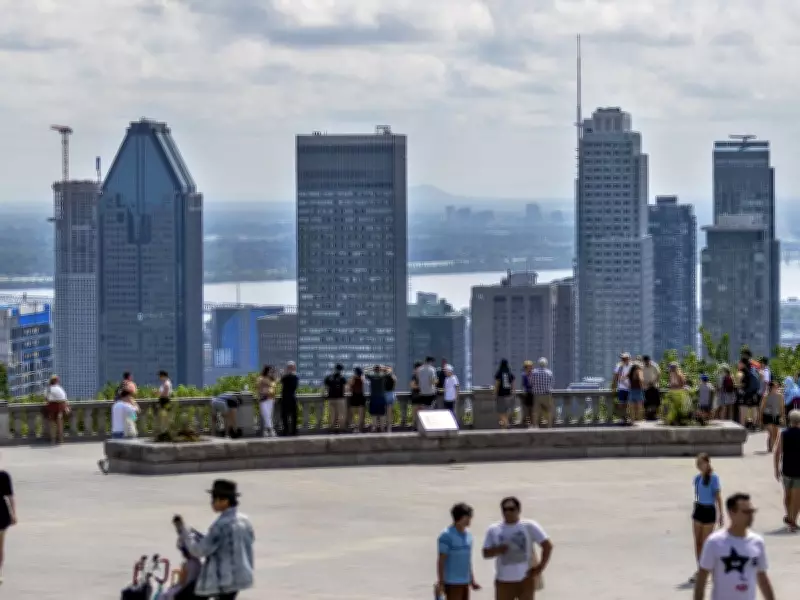
Christopher Skeete, Quebec minister of international relations and la Francophonie, makes the case for Montreal as the host city for the new Defence, Security and Resilience Bank (DSR Bank). In a series advocating for five Canadian cities vying to host the institution, Skeete argues that Montreal is uniquely positioned to meet the challenges of the emerging security economy.
Europe's Defence Rebuilding and North America's Fragmentation
Europe is rebuilding its defence industrial base at a speed unseen since the 1950s, while North America is fragmenting its trade and alliance relationships at a comparable pace. Amid this shift, Canada and a coalition of partners are launching the DSR Bank, the first multilateral lender designed for the security economy. Skeete notes that multilateral lenders are shaped by their host environments, drawing a parallel to the European Bank for Reconstruction and Development, which was placed in London in 1991 to anchor it in Europe's deepest capital market.
Three Tests for a Host City
The DSR Bank must finance dual-use industrial capacity at a moment when capacity is being rebuilt. A host city should meet three tests: bridge European and North American defence and financial communities, sit inside the dual-use industrial ecosystem, and operate in a diplomatic and multilateral ecosystem. Skeete asserts that Montreal meets these tests in a way no other North American city does, and few European cities could match.

Montreal's Unique Advantages
Montreal is the only North American metropolis where French is the official language and English remains unavoidable in business, science, and diplomacy. It hosts more than 70 international organizations, the third-largest concentration on the continent after New York and Washington, including the International Civil Aviation Organisation. Over six decades, Quebec has built the policy framework, diplomatic protocols, and inter-governmental practice required to host multilateral institutions.
Industrial and Financial Fit
Montreal is the world's third-largest aerospace cluster after Toulouse and Seattle, with more than 230 firms and 43,000 jobs. Quebec accounts for three-quarters of Canadian aerospace research and development and close to a third of Canadian defence exports. The city also hosts one of the two leading concentrations of artificial intelligence research globally, anchored by Mila, now integrated into defence and dual-use applications. Skeete argues that a bank whose mandate combines defence, security, and resilience cannot credibly operate from a city that does not produce the technologies it is meant to finance. The financial environment is also strong, with global insurers, pension funds with deep infrastructure and project-finance experience, and a workforce capable of supporting a multilateral lender from its first operational quarter.
Skeete concludes that while other Canadian cities have legitimate claims to international institutions, the decision before the Canadian government and its partners is whether the DSR Bank will be built to match the seriousness of the moment. That calls for Montreal.