London Witnesses Dual Demonstrations on Al-Quds Day Amid Government Ban
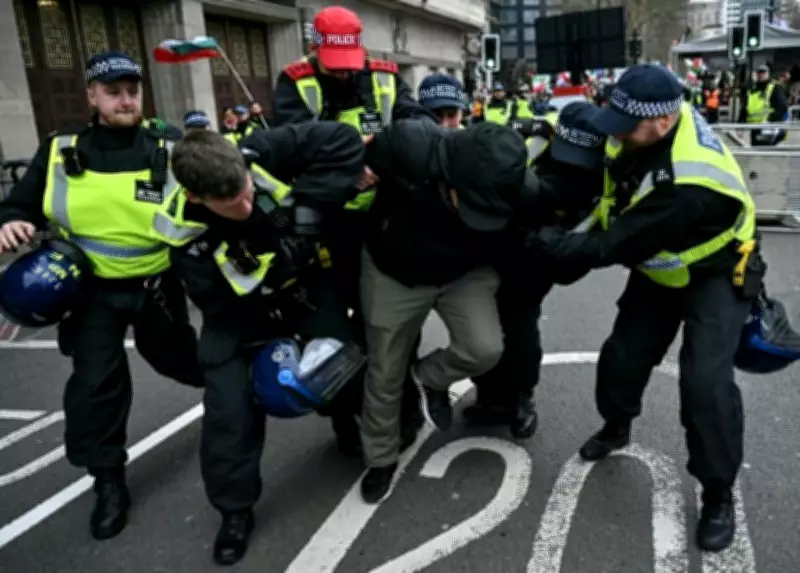
Hundreds of individuals assembled in London on Sunday for a stationary pro-Palestinian demonstration and a concurrent counter-protest, marking the annual Al-Quds Day. The event unfolded under heightened security after the British government prohibited a planned march, citing potential public disorder risks linked to the ongoing Middle East conflict.
Police Intervention and Arrests
Law enforcement officials confirmed three arrests during the gatherings. One individual was detained for showing support for a proscribed organization, another for dangerous driving, and a third for engaging in threatening and abusive behavior. Authorities maintained order by separating the pro-Palestinian protesters and counter-demonstrators to opposite sides of the River Thames, near the parliamentary district.
Government Justifies Ban on March
Interior Minister Shabana Mahmood authorized the ban earlier in the week, asserting it was necessary to "prevent serious public disorder" amidst regional tensions, including Iranian strikes in retaliation to US-Israeli military actions. This marks the first prohibition of a protest march in London since 2012, though a static demonstration was permitted. The Metropolitan Police stated the banned march was organized by a group "supportive of the Iranian regime."

Protesters Voice Their Causes
On the south side of the Thames, pro-Palestinian participants waved flags and displayed placards with messages like "Stop Israeli war crimes," referencing Israel's offensive in Gaza following the October 7, 2023 attacks. Jean Apps, an 81-year-old pensioner from Purley, expressed her solidarity, stating, "I just feel so strongly that what has happened to the Palestinians is so unjust." She also criticized recent attacks on Iran, emphasizing that its people should resolve their own issues.
Across the river, counter-protesters rallied with US, Israeli, and Lion and Sun Iranian flags, symbolizing support for exiled communities. They chanted "Long live the king" in reference to Reza Pahlavi, the exiled son of Iran's last shah, and held signs reading "Make Iran great again" and "Standing with my Jewish friends." Shiva, a 37-year-old Iranian chef in London, advocated for eliminating Iran's Revolutionary Guards, describing the regime as cruel and indifferent to its citizens.
Organizational Backlash and Historical Context
The Islamic Human Rights Commission (IHRC), which organizes the Al-Quds Day march, condemned the ban as "politically charged" and accused London police of echoing Zionist narratives without evidence. They described the event as an international demonstration supporting Palestinians and oppressed groups worldwide. Al-Quds Day, named after the Arabic term for Jerusalem, originated in Iran in 1979 to protest Israel's occupation of East Jerusalem and is now observed globally.
Assistant Commissioner Ade Adelekan of the London police reiterated concerns about the march organizers' ties to the Iranian regime. In response, Minister Mahmood emphasized her expectation for the full force of the law against those spreading hatred and division, underscoring the government's commitment to maintaining public safety during politically sensitive events.