Prime Minister Mark Carney's recent announcement of a "new strategic partnership" with China has sparked renewed scrutiny of the Liberal Party's longstanding affinity for Beijing, with critics warning that prioritizing trade may compromise Canadian security and human rights principles.
Historical Context of Liberal Fondness
This cozy relationship traces back years. In 2013, then-Liberal leader Justin Trudeau expressed admiration for China's "basic dictatorship," praising its ability to swiftly implement green energy policies. Five years later, Environment Minister Catherine McKenna was approvingly quoted in Chinese state media for labeling China—the world's largest industrial greenhouse gas emitter—as a global climate change leader.
Diplomatic Incidents and Controversial Statements
The pattern continued through various diplomatic tensions. In July 2019, former Liberal ambassador to China John McCallum cautioned Beijing against escalating disputes with Canada, noting that "anything that is more negative against Canada will help the Conservatives, who are much less friendly to China than the Liberals." This followed McCallum's January 2019 firing for essentially advocating China's position during the "two Michaels" affair, when China imprisoned Canadians Michael Kovrig and Michael Spavor in retaliation for Canada's arrest of Huawei executive Meng Wanzhou.

Later that November, Defence Minister Harjit Sajjan surprised attendees at a Halifax security conference by stating Canada did not view China as an "adversary" while Kovrig and Spavor remained detained. In February 2020, China praised Health Minister Patty Hajdu for rejecting flight bans from China during the pandemic's early stages, and by May 2020, Trudeau announced a joint Canada-China COVID-19 vaccine development agreement that ultimately collapsed.
Carney's Strategic Shift
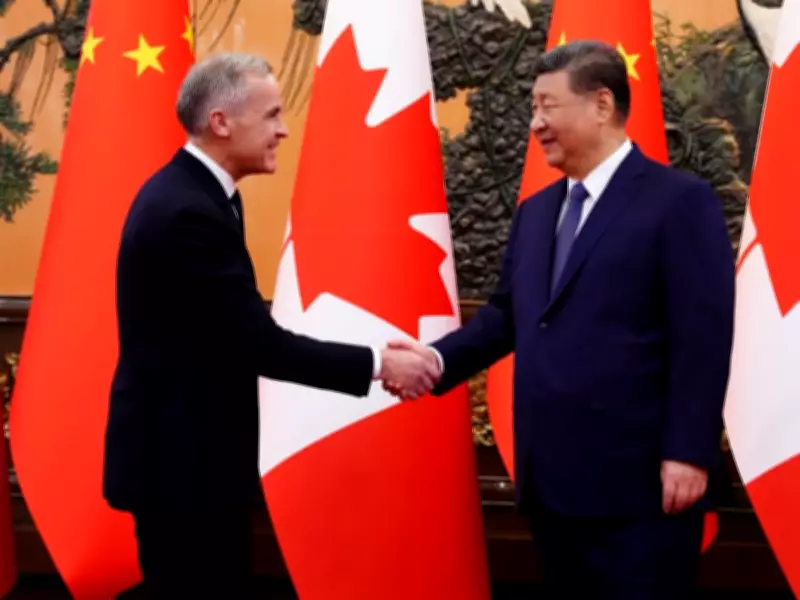
Despite calling China Canada's "greatest security threat" during last year's election campaign, Prime Minister Carney unveiled a comprehensive partnership with Beijing on January 16, 2026. The agreement includes:
- Mutual tariff reductions between the two nations
- Canadian acceptance of up to 49,000 Chinese-made electric vehicles
- Enhanced cooperation in law enforcement, cultural exchanges, and tourism
This reset comes as part of Carney's ambitious plan to double Canada's non-U.S. exports by 2035, a response to protectionist policies from U.S. President Donald Trump. However, critics argue this warming of relations risks sacrificing Canadian security and soft-pedaling China's documented human rights violations.
Forced Labor Controversy
The tension between economic interests and ethical principles became particularly apparent during recent Commons committee hearings. Liberal MP Michael Ma attempted to dismiss expert testimony from Margaret McCuaig-Johnston regarding China's use of forced labor, labeling her evidence "hearsay" through aggressive questioning demanding simplistic "yes or no" answers.
While Ma later apologized, stating he condemns forced labor "in all its forms," his comments were approvingly quoted in Chinese state media. The Liberal government issued only a pro-forma statement through a spokesman—not from the prime minister himself—asserting Canada condemns forced labor wherever it occurs and that Ma's remarks didn't reflect official policy.
Regulatory and Trade Implications
Canada maintains numerous laws and regulations prohibiting imports of goods manufactured using forced labor, including provisions in the Canada-U.S.-Mexico Agreement currently up for renewal. The timing is particularly sensitive given Carney's decision to permit thousands of Chinese-made EVs into the Canadian market.
The United States is currently investigating 60 countries, including Canada, regarding enforcement of forced labor bans, potentially leading to new Trump administration tariffs despite accusations of similar U.S. enforcement failures.
Government Response
When questioned about Ma's committee behavior, Natural Resources Minister Tim Hodgson—reportedly instrumental in convincing Ma to cross the floor from the Conservatives—stated that Ma has apologized, Canada firmly opposes importing forced labor goods, and Carney's China trade deal benefits the Canadian economy.

Regarding Canada-China relations, Hodgson explained: "We've got clear categories of where we agree, and we've got places where we don't agree. Those lines are clear. We don't need to have public discussions about where we disagree. We make that clear to our friends in China."
This approach reflects the delicate balancing act the Liberal government continues to navigate between economic opportunities with a global powerhouse and maintaining principled stands on security and human rights issues that affect Canadian interests and values.