Senator John Kennedy's Defense of Iran Military Action Ignites Orwellian Comparisons
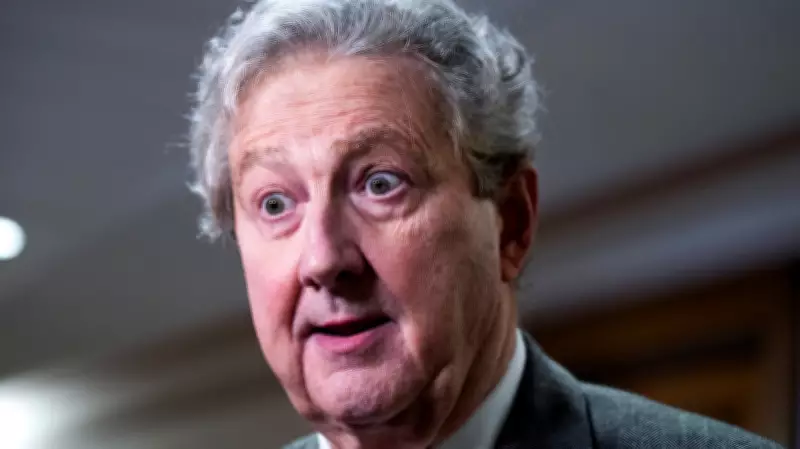
Republican Senator John Kennedy of Louisiana found himself at the center of a political firestorm on Wednesday after defending former President Donald Trump's decision to launch military strikes against Iran. During an interview on Fox Business with host Larry Kudlow, Kennedy employed reasoning that critics immediately likened to the dystopian logic portrayed in George Orwell's classic novel "1984."
Kennedy's Controversial Justification
The senator asserted that Trump had no alternative but to authorize the attack on Iranian targets. "Here's why we went into Iran. We had no choice. The president didn't start a war, he was trying to stop a war," Kennedy told Kudlow during the televised exchange. He further amplified Trump's unverified assertions regarding Iran's military capabilities, claiming the nation was rapidly expanding its missile arsenal and represented a mounting danger to American interests.
Kennedy placed full responsibility for regional tensions on Tehran, specifically citing the blockade of the Strait of Hormuz. "Iran shut it, we didn't! We're not to blame," he declared, referencing the critical maritime passage through which approximately twenty percent of global oil shipments travel. The senator's comments were captured in a video clip that quickly circulated across social media platforms.

Swift and Scathing Backlash
The response to Kennedy's remarks was immediate and overwhelmingly critical. Numerous observers drew direct parallels to the manipulative language techniques employed by the authoritarian regime in Orwell's "1984," where contradictory concepts are presented as complementary truths.
One critic succinctly summarized the perceived hypocrisy by quoting the novel's infamous party slogan: "War is peace." Another referenced Orwell's warning about authoritarian control: "The Party told you to reject the evidence of your eyes and ears. It was their final, most essential command."
Social media platforms became arenas for pointed criticism, with users employing sarcasm and historical analogies to challenge Kennedy's position. "Everyone knows the best way to stop a war is to start one. Duh," wrote one commentator, while another compared the reasoning to historical justifications for persecution: "Reminds me how the Spanish Inquisition argued that torturing people and burning them at the stake was done out of love and compassion."
Broader Political Implications
The controversy extended beyond literary comparisons to encompass substantive political debates. Critics accused Trump of initiating unnecessary conflict, with one stating plainly: "Trump 100% started this war. And it was an unnecessary war." Others questioned the consistency of Trump's foreign policy promises, noting his campaign pledges to avoid military entanglements.
The intensity of the backlash highlighted deepening political divisions, with some commentators suggesting that such reasoning should have electoral consequences. "Republicans can't be allowed to have majorities in Congress if they're going to be this ridiculous," argued one critic, while another described Kennedy's position as "MAGA Cult personified."
Several commentators pointed to what they perceived as a pattern of disinformation, with one noting: "I'm used to politicians lying. But the scope of this administration and its cronies' lies are completely off the charts." The debate also touched on historical context, with references to the Iran nuclear agreement signed years earlier as a potential alternative approach to diplomacy.
As the discussion continued to unfold across digital platforms, the fundamental disagreement remained starkly evident: where Kennedy and Trump supporters saw necessary defensive action, critics perceived dangerous escalation justified through what they characterized as Orwellian doublethink.