Long-Delayed Jan. 6 Memorial Plaque Finally Erected at U.S. Capitol
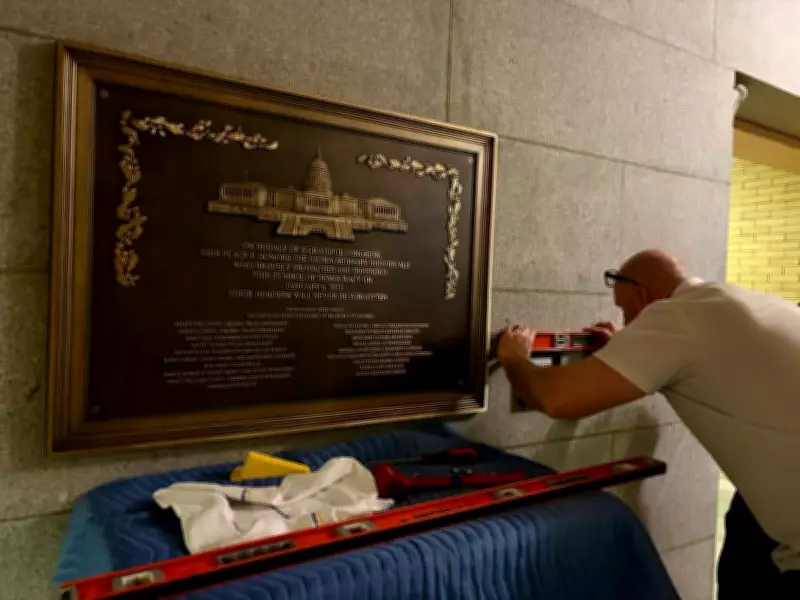
In a quiet overnight operation, workers have installed a bronze plaque at the U.S. Capitol honoring law enforcement personnel who defended the building during the January 6, 2021 attack. The installation comes more than five years after the violent assault and years after Congress first ordered the memorial's creation.
The Violent Events of January 6
On that fateful day, police officers faced brutal attacks as hundreds then thousands of supporters of former President Donald Trump swarmed the Capitol building. Officers were taunted, beaten, knocked unconscious, and dragged down stone steps while tear gas filled the air and chants of "U.S.A.! U.S.A.!" echoed through the halls. The mob sought to overturn the 2020 presidential election results, creating one of the most significant assaults on American democracy in modern history.
The Overnight Installation
Around 4 a.m. on Saturday, March 7, 2026, staff from the Architect of the Capitol quietly bolted the plaque to a granite wall near a west front entrance. This location is close to where the armed crowd had gathered and scaled scaffolding that had been erected for the presidential inauguration. The workers wheeled the plaque across the stone basement floor, guided it through double doors, raised it with a jack table, and secured it to the wall. The clang of their tools echoed through otherwise empty hallways as most of Washington slept.

There was no announcement, ceremony, or news cameras present – just two employees completing the installation during their routine overnight shift. The plaque had been stored in the Capitol basement, surrounded by maintenance equipment, for an extended period before finally being put in place.
Congressional Mandate and Delays
Congress passed legislation in March 2022 requiring the installation of a memorial plaque within one year. However, the project faced significant delays and political obstacles. Democrats argued that House Speaker Mike Johnson, a Republican from Louisiana, had failed to instruct the Architect of the Capitol to install the plaque. Johnson's spokesperson at the time claimed the project was "not implementable."
Some lawmakers took matters into their own hands, mounting copies of the plaque outside their office doors as a temporary memorial. The plaque itself lists nearly two dozen local, state, and federal law enforcement agencies that responded to the attack, including:
- District of Columbia Police
- U.S. Secret Service
- U.S. Capitol Police
- National Guard
- Maryland State Police
- Virginia State Police
Legal and Political Context
The installation marks the latest development in the contested effort to memorialize January 6, as former President Trump continues to reframe the riot as a patriotic event and the rioters as victims of what he calls a weaponized justice system. Last summer, two police officers who responded to the riot sued the Architect of the Capitol to force installation of the congressional memorial.
In January 2026, senators passed a resolution by unanimous consent ordering display of the plaque on the Senate side of the Capitol building until it could be placed in its permanent location. This rare moment of bipartisanship was led by Senator Thom Tillis, a Republican from North Carolina, and Senator Jeff Merkley, a Democrat from Oregon.
The plaque's quiet installation contrasts sharply with the violent events it commemorates and the ongoing political debates surrounding January 6. While the physical memorial is now in place, the nation continues to grapple with the meaning and legacy of that day's attack on the Capitol.