On Wednesday, the two-week ceasefire between the United States and Iran ended. Late Tuesday night in Washington D.C., President Donald Trump announced that the truce would be extended indefinitely. Shortly after the ceasefire was announced, Vice President J.D. Vance met with senior Iranian officials in Islamabad in a 21-hour marathon negotiation. The U.S. red lines were clear: access to the Strait of Hormuz must be opened to all maritime traffic and Iran must abandon its ambition to develop nuclear weapons.
Both demands were rejected outright by Iran, which has illegally claimed (but not always asserted) sovereignty over Hormuz for decades. This impasse over a 165-km-long narrow waterway linking the Persian Gulf to the open sea is choking maritime commerce and the global supply of oil and natural gas, 20 per cent of which is carried through the Strait.
The Strategic Importance of the Strait of Hormuz
Bordered on its northern shore by Iran, the southern edge of the Strait abuts numerous Gulf and Middle Eastern states: Oman, Saudi Arabia, Qatar, Kuwait, Bahrain, the UAE and Iraq. For all but Oman and Saudi Arabia, the Strait of Hormuz provides the only access they have to the open sea. It is a critical lifeline for global maritime commerce.

It is also very challenging to navigate, due to its narrowness and shape — like a tightly bent elbow. To manage this chokepoint situated in a volatile part of the world, an unwritten protocol has developed and become accepted over decades. Shipping lanes — each one approximately three kilometers wide (at its narrowest, the Strait is 40 km wide) — are used for incoming and outgoing traffic. It works.
Iran's Desperate Military Position
Hormuz is an international waterway that has long accommodated global shipping traffic without incident. But that changed with the creation of the Islamic Republic of Iran in 1979. From time to time during the last 47 years, Iran has claimed and attempted to assert absolute control over maritime traffic in the Strait, but never in such a sustained and aggressive manner as we are witnessing today. And Iran is likely doing so because it has been pummeled militarily, dramatically reducing its strategic and tactical options.
By the end of March, 92 per cent of Iran's largest naval vessels and more than 80 per cent of its air force assets had been destroyed by American and Israeli air attacks. With limited military leverage in the ongoing conflict with the United States, in recent weeks, the Iranian regime resorted to its most extreme tactic: claiming total control over the Strait of Hormuz.
The American position is clear. Either the status quo that prevailed for decades in the Strait is restored, or American attacks on Iran will resume.
Iran's Blockade Tactics and Global Impact
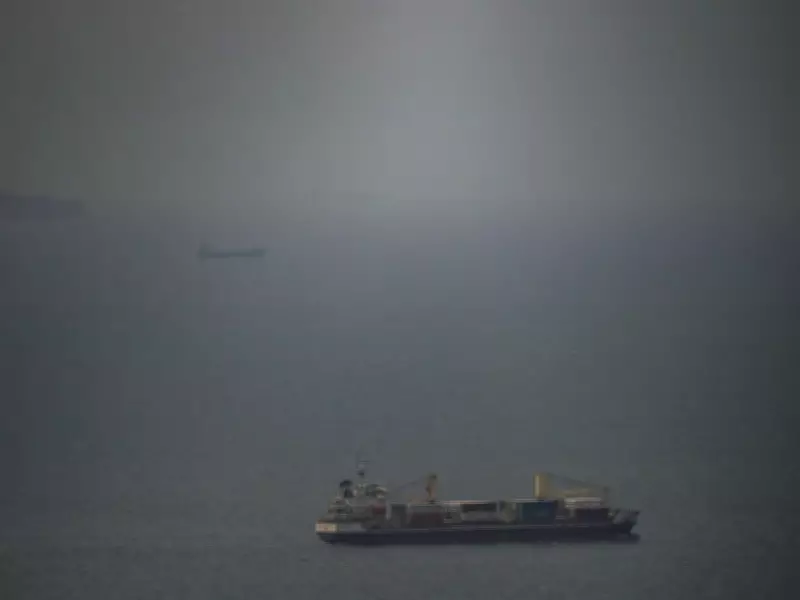
As retired U.S. rear admiral Mark Montgomery told me in a recent interview, Iran's unilateral control initiative is the 'first step of illegal behaviour.' For weeks now, he explained, the regime has permitted vessels carrying flags of 'friendly' nations — like China and India — to pass through. Many Iranian tankers are also believed to have slipped through the dragnet. Virtually all other tankers are either refused passage or harassed and threatened. Hundreds of massive shipping vessels have been anchored in the Persian Gulf for weeks, unable to move through Hormuz to the Gulf of Oman and open seas beyond. And clumps of vessels await permission to travel into the Persian Gulf through Hormuz.
The desperation behind Iran's actions is evident. Delayed salaries for the Islamic Revolutionary Guard Corps (IRGC) and a shattered navy and air force underscore the regime's weakened state. Despite these vulnerabilities, Iran continues to pursue a blockade that disrupts global energy supplies and maritime trade. However, analysts predict that this strategy will ultimately fail, as international pressure and military options remain on the table.