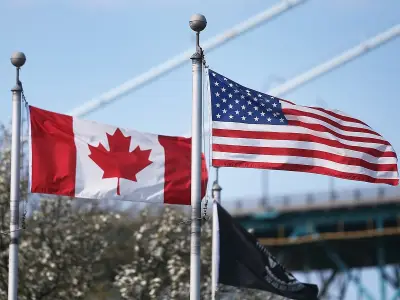
The United States' refusal to extend the USMCA for another 16 years comes as no surprise, foreseen for weeks by anyone following Donald Trump's MAGA trade agenda. The entire review process in the agreement is largely a sham, designed to give maximum leverage to the American side once that review began, according to Lawrence Herman, counsel at Herman & Associates, a member of the Expert Group on Canada-U.S. Relations and a senior fellow at the C.D. Howe Institute in Toronto.
Canada and Mexico Face Acrimonious Negotiations
Canada and Mexico are now engaged in a lengthy and acrimonious period of tough negotiations with the Americans that will spill over into broader areas of public policy. The Trump administration is applying pressure on its two partners to make concessions across many sectors for continued access to the U.S. market. Hovering over the talks is the possibility that President Trump would seek to withdraw the U.S. from the agreement entirely.
The 'Fortress North America' Proposal
Recently, there has been talk of a 'Fortress North America' arrangement – a coordinated continental program of secure supply chains and external tariffs – to attract U.S. support for the continuation of some form of the USMCA. This idea is advocated by the Ontario government and supported by the Business Council of Canada, with a few U.S. politicians voicing approval. Prime Minister Mark Carney appeared to support it as well, when he spoke about Canada remaining open to the concept in certain sectors, though he did not specify which ones.

Risks of Sovereignty Surrender
While the fortress initiative is interesting in some ways, the brakes should be put on this whole business, Herman argues. Several knowledgeable commentators, such as Peter Donolo and Claude Lavoie, have underscored the perils, pointing out that such an arrangement will inevitably be one-sided and involve the surrender of major aspects of Canadian policy to Washington.
Apart from these serious sovereignty risks, the USMCA itself is totally unworkable as a vehicle for any kind of coordinated North American trade and tariff policy. Unlike some other trade deals, there is no central administering body in the USMCA that supervises its implementation or has executive authority to settle differences or issue corrective decisions. While theoretically overseen by a 'Free Trade Commission' – comprised of the trade ministers of the three governments – that body is essentially a fiction with no executive authority.
Historical Context of U.S. Hostility to Supranational Bodies
This model dates back to the original Free Trade Agreement of 1988 and the 1994 NAFTA, reflecting U.S. hostility to any kind of supranational body in its trade deals that might override unilateral U.S. policies or actions on any trade-related matter. Contrast this with trade agreements like Mercosur, the free trade agreement among Brazil, Argentina, Uruguay, Paraguay and Bolivia, which has a common external tariff, a permanent executive body with supervisory powers, and requires consensus among member governments to make any tariff changes.
None of this applies to the USMCA. The Americans would never accept proposals to change its basic free-wheeling structure, which ensures complete freedom of action by Washington. It means that, as seen since Mr. Trump first assumed office in 2017, the U.S. will call the shots as the dominant partner in any fortress arrangement. Mr. Trump will not have it any other way – and we cannot assume his successors, Republican or Democrat, would act differently.

Early Warning: China Consultation Clause
An early warning signal of Washington's aim to control the policies of its USMCA partners is the provision strong-armed into the agreement by the first Trump administration requiring advance consultation with the White House before Canada can even start trade negotiations with any non-market economy country – meaning China. Integrated arrangements and policies involved in a Fortress North America concept would give even more leverage to the White House, not only to arbitrary demands for increasingly higher levels of U.S. content in goods but changes to or removal of Canadian policies on digital services, critical minerals, energy and financial services. American officials have already criticized Canada for allowing Chinese EVs into its market, an indication of what would happen in spades under some kind of North American fortress regime.
Conclusion: Reject Fortress North America
Let us have no illusions: Fortress North America would reinforce U.S. leverage and continual pressures to pursue a common external trade policy issued out of the White House, forcing Canada to man the trade ramparts against the rest of the world. It would represent nothing less than Canada's sovereign independence being held hostage to diktats from the Oval Office. The fortress idea should be stricken from Canada's strategic playbook.