

FBI Executes Search Warrant in Georgia Amid Trump's Persistent 2020 Election Claims
Donald Trump lost his bid for reelection in 2020, but for over five years, he has consistently attempted to persuade Americans otherwise by propagating false claims of widespread election fraud. Now, as president once again, Trump is leveraging the federal government to substantiate these baseless allegations.
Federal Action in Fulton County
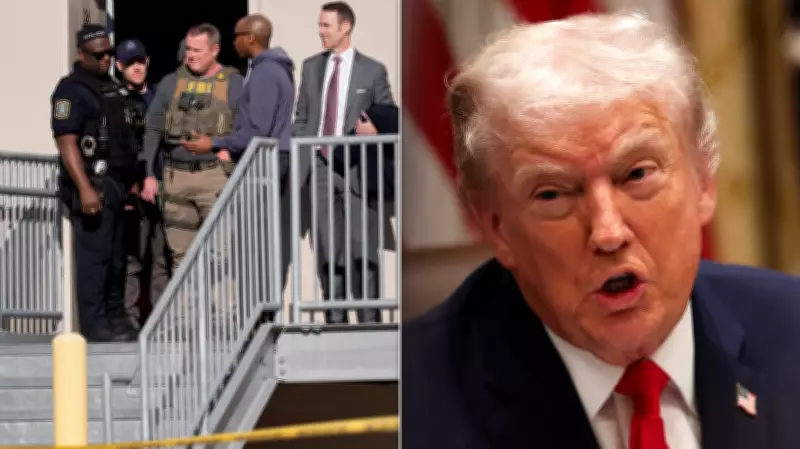
On Wednesday, January 28, 2026, FBI agents served a search warrant at the election headquarters of Fulton County, Georgia, which encompasses most of Atlanta. The operation aimed to secure ballots from the 2020 presidential election. This development follows Trump's remarks earlier this month at the World Economic Forum in Davos, Switzerland, where he hinted at impending charges related to the election.
Rick Hasen, a law professor at UCLA, commented on the situation, stating, "The man has obsessions, as do a fair number of people, but he's the only one who has the full power of the United States behind him." Hasen and other observers note that Trump's utilization of the FBI to pursue his fixation on the 2020 election exemplifies a broader pattern of transforming federal agencies into instruments of personal retribution.

Political Reactions and Broader Implications
Senator Jon Ossoff, a Democrat from Georgia, drew parallels between the search and recent immigration enforcement actions in Minnesota, which resulted in the deaths of two U.S. citizen protesters. Ossoff criticized Trump's approach, declaring in a statement, "From Minnesota to Georgia, on display to the whole world, is a President spiraling out of control, wielding federal law enforcement as an unaccountable instrument of personal power and revenge."
This incident occurs as election officials nationwide prepare for the 2026 midterm elections, where Trump faces challenges in assisting his party to retain congressional control. Given Trump's past contemplation of using the military to seize voting machines after his 2020 defeat, concerns are mounting that he may be establishing a precedent for similar actions in the future.
Kristin Nabers of the left-leaning organization All Voting Is Local expressed apprehension, noting, "Georgia's a blueprint. If they can get away with taking election materials here, what's to stop them from taking election materials or machines from some other state after they lose?"
Georgia's Central Role in Election Controversies
Georgia has been a focal point of Trump's post-2020 election narrative. On January 2, 2021, Trump famously contacted Republican Secretary of State Brad Raffensperger, urging him to "find" an additional 11,780 votes to overturn Joe Biden's narrow victory in the state. Raffensperger declined, citing multiple audits that confirmed Biden's win.
These audits were part of a series conducted in key battleground states, often led by Republicans, which affirmed Biden's triumph in Michigan, Wisconsin, and Nevada. Trump also faced numerous legal defeats in court challenges to the election results, and his own Attorney General at the time acknowledged no evidence of widespread fraud.
Legal Repercussions and Defamation Cases
Allies who echoed Trump's false claims have faced defamation lawsuits. Former New York Mayor Rudolph Giuliani settled with two Georgia election workers after a court ruled he owed them $148 million for defamation. Additionally, voting machine companies have initiated defamation cases against conservative-leaning media outlets that broadcast unsubstantiated allegations of fraud.
Fox News settled one such case by agreeing to pay $787 million, with the judge emphasizing that the claims were unequivocally false.
Prosecution Attempts and Executive Actions
Trump's efforts to contest Georgia's election results prompted an unsuccessful prosecution attempt by Fulton County District Attorney Fani Willis, a Democrat. The case dissolved due to conflict-of-interest concerns, leading Trump to seek damages from the office.

Upon returning to office, Trump pardoned or commuted sentences for approximately 1,500 individuals charged in the January 6, 2021, Capitol attack. He also issued an executive order aiming to establish new rules for state election systems, though courts have repeatedly blocked it, affirming that election authority resides with states and Congress.
Ongoing Retribution and Election Integrity Concerns
Trump has discussed criminally charging lawmakers involved in the House committee investigating the January 6 attack and targeted former cybersecurity officials who vouched for the 2020 election's security. Despite handling international conflicts and legislative matters, Trump frequently reverts to disputing the 2020 election, falsely labeling it as rigged and displaying a White House plaque alleging corruption.
David Becker, a former Department of Justice voting rights attorney and executive director of The Center for Election Innovation & Research, expressed skepticism regarding the FBI search's potential for successful prosecutions. He remarked, "So much this administration has done is to make claims in social media rather than go to court. I suspect this is more about poisoning the well for 2026."
As the 2026 midterms approach, Trump's relentless focus on the 2020 election continues to shape political discourse and raise questions about the appropriate use of federal power in electoral matters.





