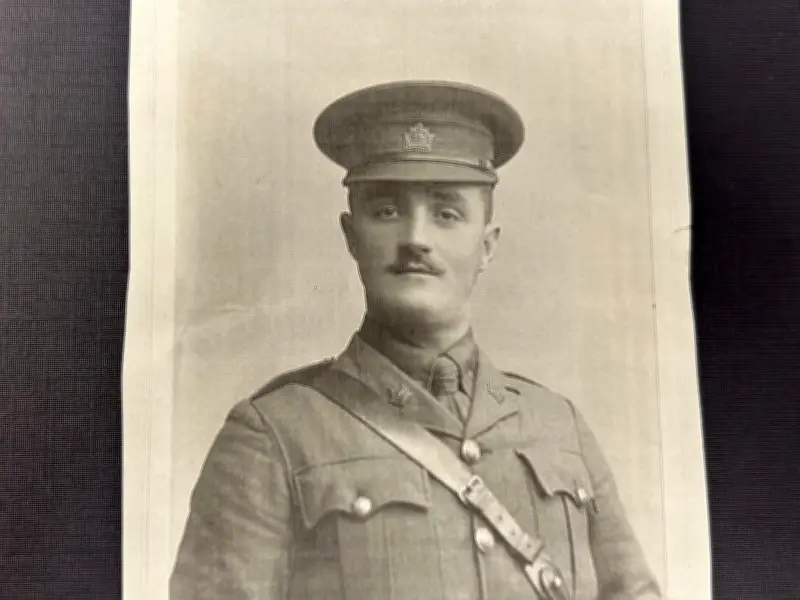
A Canadian family is renewing efforts to bring home the remains of their great-great-uncle, Lieutenant Lionel Tranter, who disappeared during the First World War. The search, spanning more than a century, has gained momentum with new archival research and DNA analysis.
Disappearance in the Trenches
Lieutenant Tranter, a soldier with the Canadian Expeditionary Force, was reported missing in action on November 20, 1917, during the Battle of Cambrai in France. He was 24 years old at the time. Despite extensive searches by the military and his family, no trace of his remains was ever found. His name is inscribed on the Canadian National Vimy Memorial, which commemorates soldiers with no known grave.
According to family member Alicia Trelford, who has spearheaded the research, the family has long believed that Tranter may have been buried in an unmarked grave near where he fell. “We’ve always held onto hope that one day we could bring him home,” Trelford said. “New technology and access to war diaries have given us fresh leads.”

DNA and Archival Breakthroughs
The family has submitted DNA samples to the Canadian Armed Forces’ Casualty Identification Program, which uses genetic testing to identify unknown soldiers. They have also combed through battalion war diaries, maps, and burial records from the Commonwealth War Graves Commission. A key clue emerged from a 1918 letter from a fellow officer who described burying Tranter near a makeshift aid post, but the location was later lost due to shelling.
“We’ve narrowed down the possible area to a few hundred meters,” Trelford explained. “The ground was churned up so badly that many graves were never marked.” The family is now working with historians and archaeologists to plan a field survey of the site, pending permission from French authorities.
Impact on the Family
The search has become a multi-generational project, involving cousins across Canada and the United Kingdom. Tranter’s story was passed down through oral histories, but only recently did the family begin systematic research. “It’s a way to honor his sacrifice and give closure to our family,” Trelford said. “We feel a duty to bring him back to Canadian soil.”
The effort has also drawn attention from local veterans’ organizations, who have offered support. “Every soldier deserves a proper burial,” said a spokesperson for the Royal Canadian Legion. “This family’s persistence is inspiring.”
Broader Context of Missing Soldiers
More than 11,000 Canadian soldiers who died in the First World War have no known grave, according to Veterans Affairs Canada. The Casualty Identification Program has successfully identified over 30 soldiers since its inception in 2007, often through DNA matching with living relatives. Each identification brings closure to families who have waited decades.
The family hopes that their efforts will not only find Tranter but also raise awareness about the ongoing work to identify the fallen. “We’re not giving up,” Trelford said. “We owe it to him and to all those who never came home.”