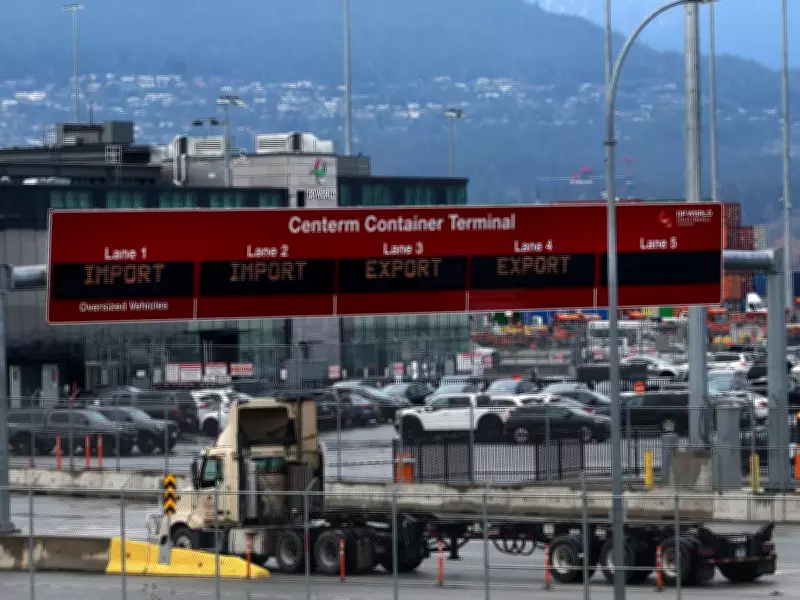
The head of the U.S. Drug Enforcement Agency has publicly alleged that the Port of Vancouver serves as an entry point for chemicals used in the production of fentanyl, which eventually make their way into the United States. DEA Administrator Terrance Cole stated during a Senate appropriations committee hearing that the agency is "very conscious" of precursor chemicals moving through the port and is "keeping its eye on Canada."
Cole testified before U.S. senators in Washington on Tuesday, explaining that the chemicals enter the port before being transported to cartel-linked laboratories in Canada. From there, the finished product crosses into the U.S. via the shared border, according to a CBC report.
DEA Plans to Expand Canadian Presence
During the hearing, which examined budget requests from the DEA, FBI, and other federal law enforcement agencies, Cole revealed that the DEA intends to expand its operations in Canada. The agency currently maintains two offices in the country: one at the U.S. Embassy in Ottawa and another at the U.S. Consulate in Vancouver. Cole mentioned plans to open two additional offices in 2027, though he did not specify whether Vancouver would be included.

Port Authority Responds
In response to the allegations, Vancouver Port Authority communications advisor Arpen Rana emphasized that terminal operators at the Port of Vancouver adhere to stringent safety and security measures approved and regulated by government agencies. While the port authority does not operate any container terminals, it routinely coordinates security efforts with multiple law enforcement and regulatory bodies whose jurisdictions include the port. Rana also noted that the port authority has partnered with the Canada Border Services Agency on state-of-the-art container inspection facilities to support national safety and security.
The Canadian Border Services Agency is responsible for border protection at points of entry, including the container terminal in Vancouver. National Post has reached out to the CBSA for further details about its operations at the port.
Discrepancies in Seizure Data
Canada's fentanyl czar has disputed claims that Canada is exporting significant quantities of fentanyl into the U.S. Data from U.S. Customs and Border Protection supports this position, showing that only a minor amount of fentanyl crosses from Canada compared to the substantial trade via Mexico. During the 2024-25 fiscal year, U.S. officials seized 35 kilograms of fentanyl along the Canada-U.S. border, compared to 5,215 kilograms at the Mexican-American border. In the early part of the 2025-26 fiscal year, U.S. Border Patrol officers seized just 2.7 kilograms of fentanyl along the Canadian border, while nearly 1,000 times that amount—2,630 kilograms—was seized along the U.S.-Mexico border.
Political Context
Fentanyl from Canada was a significant talking point for former U.S. President Donald Trump after his return to the White House last year. It served as a trigger for the first set of tariffs he imposed on Canadian goods, despite efforts from Ottawa to crack down on cross-border traffic. The Canadian federal government subsequently launched a $1.3-billion border security plan and appointed a fentanyl czar to address the issue.