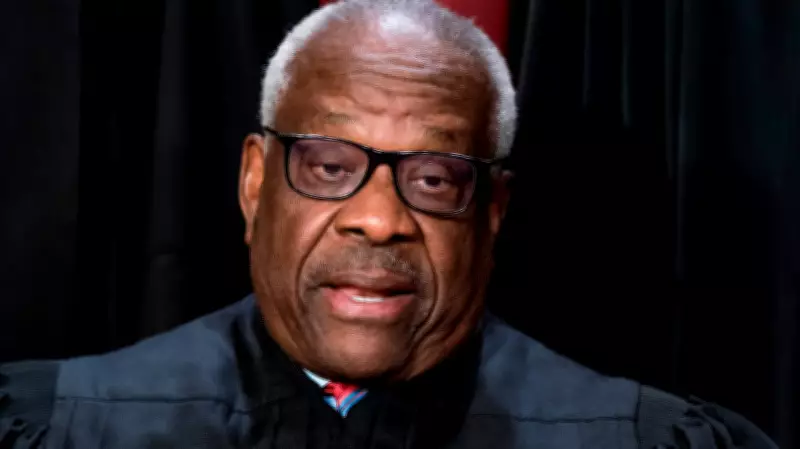
WASHINGTON (AP) — The first baby boomer on the Supreme Court reached a milestone on Thursday, becoming the second-longest serving justice in history at a time when his influence has never seemed greater.
Once an outlier on the nation’s highest court, Justice Clarence Thomas has emerged as a towering figure in the conservative legal movement over the last decade. He helped secure landmark rulings on abortion, voting rights, and Second Amendment protections.
The only justice with a longer tenure is liberal William O. Douglas. Thomas would overtake Douglas in 2028 if he remains on the court — and there is no indication he plans to retire soon.

“I think he’s more energized and excited now than when I first met him,” said John Yoo, a law professor at the University of California, Berkeley, who served in Republican President George W. Bush’s administration after clerking for Thomas three decades ago.
Thomas was confirmed in 1991 after contentious hearings that included sexual harassment allegations. More recently, his acceptance of luxury trips has raised ethics questions. Nevertheless, he has gone from near-silence at oral arguments to asking the first questions and authoring a landmark ruling expanding Second Amendment rights.
Following the appointment of three conservative justices by Republican President Donald Trump, Thomas is now the most senior member of a supermajority that has also overturned abortion as a constitutional right, ended affirmative action in college admissions, and sharply limited the Voting Rights Act.
“The court has radically moved in his direction over the course of his time on the court,” said Stanford University law professor Pamela Karlan. Thomas’ seniority means he can decide who writes an opinion if he is part of a majority that does not include Chief Justice John Roberts, a factor that can influence other votes behind closed doors, Karlan added.
Off the bench, Thomas’ sphere of influence includes his large, close-knit network of former clerks, who have served in the Trump administration and are increasingly filling federal judgeships.
“That is an important legacy that he will leave,” said Sarah Konsky, director of the Supreme Court and Appellate Clinic at the University of Chicago Law School. “Even as justices’ own time on the court winds down, significant influence lives on through their clerks.”
That is not to say Thomas’ time on the court is ending. In a recent speech, he tied the nation’s highest ideals to a conservative vision of limited government and launched a broadside on progressivism, which critics deemed unfair and inappropriate. However, at the University of Texas, it earned a standing ovation.
Thomas, who became the second Black member of the court, now has a tenure exceeding 34 years, placing him ahead of Justice Stephen J. Field, appointed by Lincoln before the end of the Civil War and serving until 1897.
For Thomas, 77, this marks a long journey from the hearings where his nomination by Republican President George H.W. Bush was nearly derailed by allegations of sexual harassment from Anita Hill, charges he forcefully denied.
Thomas has more recently faced scrutiny for lavish, undisclosed trips from a GOP megadonor and the conservative political activism of his wife, who supported false claims that the 2020 election was stolen from Trump. The justice stated he was not required to disclose trips with friends and ignored calls to recuse himself from election-related cases.
On the court, recent years have brought some of the most significant work of his career, especially a 2022 opinion he wrote affirming the right to carry a gun in public. Thomas did not respond to a request for comment on his tenure.
His jurisprudence has changed little over the years, said Scott Gerber, author of “First Principles: The Jurisprudence of Clarence Thomas.” Even as the majority moves his way, he continues to write dissents that garner attention.
“He’s incredibly consistent,” Gerber said. Once known for solo dissents, “now he writes majority opinions.”