Federal-Alberta Climate Agreement Nearing Breaking Point
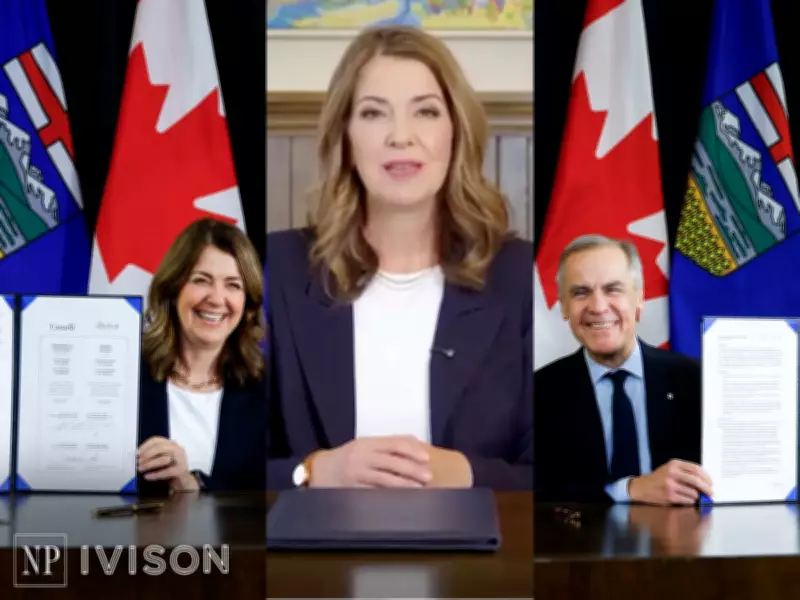
Prime Minister Mark Carney's landmark memorandum of understanding with Alberta Premier Danielle Smith is facing significant challenges that threaten to derail the agreement entirely. According to political analysts Ian Brodie and Eugene Lang, who joined journalist John Ivison for a recent panel discussion, the deal's future appears increasingly precarious as practical realities collide with political ambitions.
Industrial Carbon Price Threatens Oil Economics
The most immediate obstacle involves negotiations over industrial carbon pricing to fund a major carbon capture and storage project that Carney hopes will help decarbonize Western Canada's oil industry. Brodie revealed that federal and provincial officials are grappling with industry resistance to proposed pricing levels that could fundamentally alter the economics of oil expansion.
"There's a deadline between now and April 1st for an agreement on what the new industrial carbon price will be," Brodie explained. "If the stories circulating are true, the price they're going to settle on is around $120 per tonne of carbon dioxide. That works out to about $20 per barrel."

This additional cost would represent a substantial burden for an industry already operating within tight margins. With long-term oil prices projected between $50 and $70 per barrel, a $20 per barrel carbon cost could render expansion projects economically unviable overnight.
Industry Pushback and Political Realities
The oil industry's growing resistance was highlighted during a recent appearance by Federal Transport Minister Steven MacKinnon in Calgary. While his comments about port and rail expansion received enthusiastic applause, his mention of the federal-provincial MOU was met with complete silence.
"He had to stop and ask why they weren't applauding," Brodie noted. "On mature reflection, this agreement goes to the heart of whether the oil export industry will serve Canada's economic purposes in the future."
Industry representatives have reportedly warned both governments that the proposed carbon pricing would effectively achieve through indirect means what previous governments attempted directly: keeping oil resources in the ground rather than developing them for export.
Alberta's Political Maneuvering Complicates Negotiations
Eugene Lang criticized Premier Smith's approach to provincial-federal relations, particularly her announcement of multiple plebiscites aimed at challenging federal authority and limiting immigration.
"These plebiscites are a really bad idea," Lang argued. "It's the oldest trick in the book – blame immigrants, the downtrodden and the federal government for your government's fiscal woes."
Lang suggested these measures represent grievance-stoking tactics rather than substantive policy solutions, noting that Alberta's projected budget deficit has increased by approximately one billion dollars due primarily to soft oil prices rather than immigration pressures.
Spring Election Speculation Dismissed
Despite rumors circulating in Ottawa political circles, both panelists dismissed the likelihood of a spring election. Lang characterized such a move as unnecessarily risky for Carney, who currently enjoys a de facto working majority in Parliament.
"I see nothing but downside risk," Lang stated. "We don't really need it at this point, even if polls suggest the Liberals are in a dominant position."
Brodie added that an election would be particularly damaging during ongoing trade negotiations with the United States, potentially forcing Carney into a polarized position against former President Donald Trump that could harm Canadian trade interests during CUSMA renegotiations.
Opposition Leader's Foreign Policy Dilemma
The discussion also touched on Conservative Leader Pierre Poilievre's upcoming speech on Canada-U.S. relations. Brodie noted that while Poilievre has demonstrated political acumen on domestic issues like housing, he faces challenges establishing credibility on foreign policy matters.

"Poilievre has never been a foreign policy leader," Brodie observed. "He's not a defence hawk and reluctantly moved on defence spending commitments under pressure from his own caucus."
Lang highlighted Poilievre's delicate political position, noting that while some Conservative voters sympathize with Trump's MAGA agenda, most Canadians remain strongly opposed to it. This creates limited political space for Poilievre to differentiate himself from Carney's approach to U.S. relations.
The panel's analysis suggests that the Carney-Smith agreement faces multiple simultaneous challenges: economic realities that threaten its financial viability, political dynamics that complicate implementation, and broader geopolitical considerations that constrain all federal political actors. With the April 1 deadline approaching, the coming weeks will determine whether this ambitious climate agreement can survive these mounting pressures or whether it will become another casualty of Canada's complex energy politics.