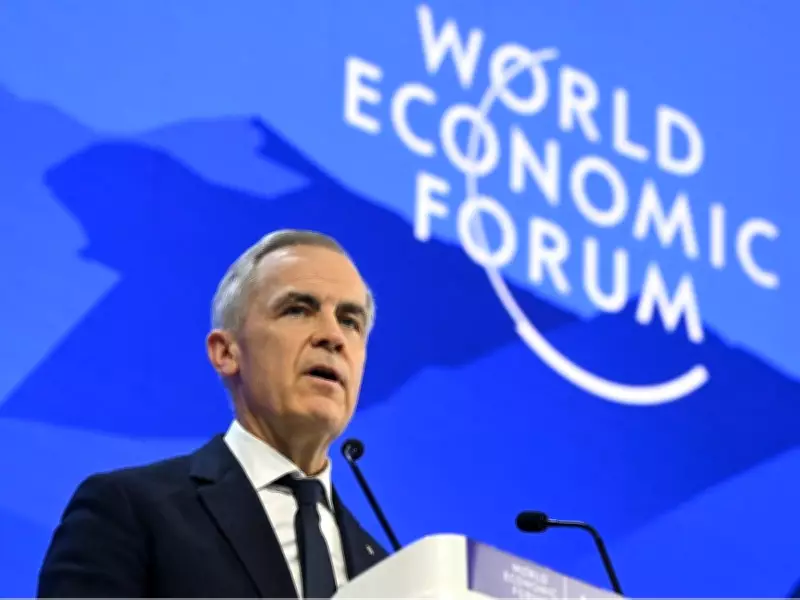
Canada's Global Stance Transformed: Carney's Davos Speech Marks New Era of Leadership
For decades, Canada has been characterized by its reputation as an ultra-polite, apologetic, and somewhat boring nation on the world stage. A famous radio contest once sought a Canadian equivalent to "as American as apple pie," with the winning phrase being "as Canadian as possible under the circumstances." This sentiment reflected a global perception that has persisted through generations, with international media often describing Canadians as reserved and unassuming.
A Defining Moment in Davos
That perception has undergone a dramatic shift following Prime Minister Mark Carney's stirring address at the World Economic Forum's annual meeting in Davos on January 20, 2026. The speech, delivered to global leaders and media representatives, has fundamentally altered Canada's international reputation and positioned the country at the forefront of global diplomatic leadership.
Renowned Canadian journalist Chantel Hébert described Carney's address as "one of the best speeches ever delivered on the world stage by a Canadian prime minister," a sentiment echoed by numerous prominent world and media figures. The speech received praise from leaders across Australia, Estonia, California, and beyond, signaling broad international approval for Canada's new direction.

The Substance of Carney's Message
At the heart of Carney's Davos address was a call for "middle power" nations to unite in defense against what he characterized as global bullying tactics. His most quoted line—"If we're not at the table, we're on the menu"—encapsulated this strategic approach to international relations. However, Carney emphasized that this time, "the food on the menu is fighting back," suggesting a more assertive stance from traditionally moderate nations.
What makes Carney's approach particularly noteworthy is its quintessentially Canadian character. Dubbed "Cool Hand" Carney by observers, the prime minister maintains the polite, understated, and diplomatic demeanor for which Canadians are known, while simultaneously demonstrating steely resolve and straightforward firmness in his statesmanship.
Contrasting Leadership Styles
The contrast between Carney's leadership style and that of other global figures has become particularly apparent. A veteran U.S. journalist conducted a revealing word count analysis comparing Carney's Davos speech with that of former U.S. President Donald Trump. The analysis found Trump used first-person pronouns ("I," "my," or "me") 284 times, while Carney used them only six times. Furthermore, Trump reportedly confused Iceland with Greenland on multiple occasions, while Carney demonstrated precise geographical knowledge.
This contrast highlights what many see as Canada's emerging role as a counterbalance to more self-focused approaches to international relations. Carney has positioned himself as what one might call "the new global gunslinger," calling for middle-power nations to join what he describes as a "makeshift posse" to defend against international bullying.
Domestic Implications and Challenges
While Carney's international leadership has garnered praise, it has also sparked complex domestic conversations. Parti Québécois Leader Paul St-Pierre Plamondon has intensified his push for Quebec sovereignty, arguing that Quebec's primary threat comes from being "swallowed by the minnow called Canada" rather than from the "Trump-led U.S. whale." This perspective contrasts sharply with Carney's vision of unity against global challenges.
Carney himself acknowledged the delicate balance required in Canadian unity, describing the country as "a hybrid version of our powerful southern neighbour with more social services, fewer guns, safer streets and winter ice, not murderous ICE." He emphasized the importance of protecting Canada's second official language while maintaining national cohesion.
Navigating International Uncertainty
The global context in which Carney is positioning Canada remains uncertain and volatile. Questions persist about how other nations might respond to Canada's new assertiveness, particularly given what Carney describes as the "new world disorder." Some observers wonder whether Canada might face retaliatory measures or increased pressure as it assumes this more prominent global role.

Domestically, Canadians are grappling with what this new international posture means for national identity. While many embrace the shift from being perceived as "boring and forgettable," others express nostalgia for Canada's traditionally low-profile approach to international affairs. The tension between these perspectives will likely shape Canada's political landscape in the coming years.
The Path Forward
As Canada navigates this transformed global role, several key questions emerge. How will middle-power nations respond to Carney's call for collective action? Can Canada maintain its distinctive character while assuming greater international leadership? And how will domestic political dynamics, particularly regarding national unity, interact with this new foreign policy direction?
What remains clear is that Carney's Davos speech has marked a turning point in Canada's international presence. The country that was once described as "as boring as two Swiss or three Belgians" has emerged as a leading voice in global diplomacy, challenging traditional power structures and offering an alternative vision of international cooperation. Whether this represents a temporary shift or a permanent transformation of Canada's global role will depend on how both the nation and the world respond in the months and years ahead.