Readers, I bring glad tidings: Canada has solved a problem, and solved it well. Don't head to the fireworks store or plan a parade; it was quite a simple problem. But Canada lets all kinds of simple problems fester without lifting a finger, so this is worthy of note, if only to prove that we can and should solve simple problems. And also because some people in Ottawa seem determined to solve the problem much less elegantly.
The Long Ballot Problem
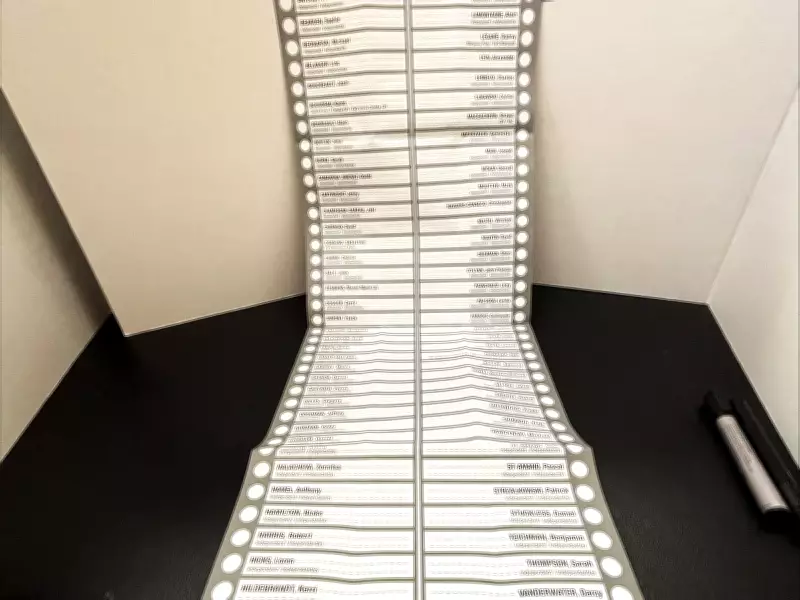
The problem was the Longest Ballot Committee, which derives cheap yuks from getting as many independent candidates as possible nominated in a riding to make the multiple-choice ballot as long—almost a metre in one case—and as time-consuming as possible. Ostensibly a protest about first-past-the-post voting, it's better seen as trolling. The Long Balloters are affiliated with the Rhinoceros Party.
But the Long Balloters have stated principles too, and they're pretty dumb. "Long ballots are a lot of fun," spokesperson Tomas Szuchewycz told The Canadian Press in March—fact check: false—"but most importantly they create a platform which we use to point out that politicians shouldn't be in charge of their own election rules because it's an obvious inappropriate conflict of interest."

Instead, the Long Balloters want a citizens' assembly—with members appointed by God, presumably, and with no political opinions of their own—to implement some form of proportional representation (PR). PR is a decent cause, in some forms, but its worst feature is its most ardent proponents.
Elections Canada's Simple Solution
Elections Canada's solution was as follows: Instead of printing a ballot with 48 names on it for the byelection in Terrebonne, Que., last month, they just had voters write in the name of their preferred candidate. They did the same thing last year in the Battle River—Crowfoot byelection that returned Conservative Leader Pierre Poilievre to the House of Commons. That one had 214 candidates.
What I like in particular about this solution, not to suggest this was Elections Canada's intent, was that it quite elegantly undercut the argument against first-past-the-post. It reminded voters that they weren't voting for a party or a party leader—Elections Canada made clear that "Liberal" or "Conservative" wouldn't be counted as legitimate votes—but rather for a local representative, even if that local representative happened to be a party leader dragging a parachute around behind him.
There's no evidence this confused voters. The rejected-ballot totals in each byelection were well within the normal range.
Potential Structural Changes
There are structural changes that might make sense to thwart the Long Balloters, and I'm not opposed to all of them. But I am opposed to one that the House of Commons' procedures committee recently recommended: Making it illegal for someone to sign more than one candidate's nomination form. (You need 100 signatures from qualified voters to run for MP.)
In the end, Canada has shown that a simple, intuitive solution can work without the need for lengthy committees or complex legislation. The write-in ballot is a shockingly simple fix that preserves the integrity of the vote while neutralizing the trolls. Other Canadian decision-makers might want to study this approach.