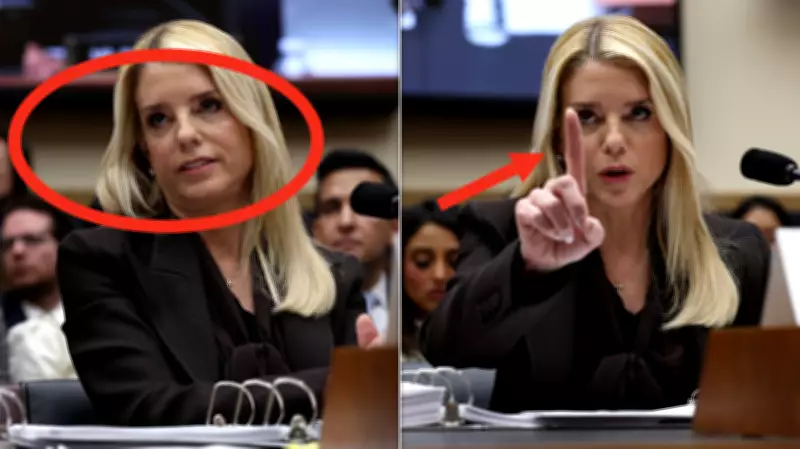
Body Language Experts Decode Pam Bondi's Explosive Hearing Exchange on Epstein Files
Attorney General Pam Bondi's appearance before the House Judiciary Committee regarding the handling of the Jeffrey Epstein files featured numerous dramatic moments, but one particular interaction has captured widespread attention for its revealing nonverbal cues. During the now-viral exchange, Bondi became visibly agitated when Representative Jerry Nadler, a Democrat from New York, pressed her with pointed questions about the investigation into Epstein's co-conspirators.
The Heated Exchange and Its Nonverbal Cues
Nadler's inquiry—"How many of Epstein's co-conspirators have you indicted? How many perpetrators are you even investigating?"—prompted a noticeable reaction from Bondi. She fell silent for approximately six seconds, adjusting herself and her notebook before responding. When Nadler suggested she was avoiding the question and repeated it, Bondi's voice escalated in volume. She pointed her finger directly at Nadler, declaring, "I'm gonna answer the question the way I want to answer the question," and criticized his "theatrics" as ridiculous. Later, she labeled Representative Jamie Raskin, a Democrat from Maryland, a "washed-up, loser lawyer" as he began to contribute. Notably, victims of sex offender Jeffrey Epstein were seated just feet behind Bondi during this confrontation.
Body language experts assert that Bondi's movements, finger-pointing, and facial expressions were highly indicative of her emotional state and strategic approach. According to Patti Wood, an expert in body language and nonverbal communication and author of "SNAP: Making the Most of First Impressions, Body Language, and Charisma," Bondi employed her pen as a "symbolic weapon." Wood observed that Bondi held the pen between her fingers, pointing it at Nadler as she started to speak, which she described as a secretive weapon-like gesture.

"It's interesting, because a lot of times when people use a pen as a symbolic weapon, they hold it like a knife, but this is between her fingers. So, it's a secretive, in some way, weapon," Wood explained. She noted that Bondi then pushed the pen forward in a strong, quick motion as she began to answer, a gesture Wood links to "DARVO"—deny, attack, reverse victim and offender—a manipulative tactic often used to evade accountability.
Performative Anger and Aggressive Gestures
Wood emphasized that Bondi's actions appeared calculated rather than spontaneous. "She's making the immediate choice to go into attack mode," Wood stated, pointing out that Bondi followed up with a finger-pointing "stabbing" gesture. "And again, very strong motions. Many times, these are very subtle, not super obvious, symbolic weapons. Both of these are dramatic choices for her," Wood added. The key term here is "choices"; Wood believes Bondi's behavior was an acting decision, not a genuine emotional outburst.
This performative aspect was further highlighted by a mismatch in her behavior. When Bondi insulted Raskin, there were no accompanying large hand gestures or pointing motions, suggesting a deliberate inconsistency. Wood also cited Bondi's increased volume as part of this performance, noting that it was pushed outward from her diaphragm, indicating a controlled act rather than a primitive, authentic response.
Denise Dudley, a clinical psychologist and behavioral expert, underscored the aggressiveness of pointing. "Pointing at anyone is technically aggressive, unless you are truly trying to direct them to the bathroom," Dudley remarked. She explained that pointing evokes fundamental evolutionary responses, making the recipient feel threatened, as if being attacked with a sharp object. Dudley described Bondi's pointing as a "jab," emphasizing its direct and aggressive nature.

Anger as a Defense Mechanism and Political Context
Experts interpret Bondi's anger as a defense mechanism aimed at shutting down questioning. Dudley observed that Bondi glared at Nadler and Raskin while raising her voice, behaviors that signal a lack of openness to inquiry. "If you're really open to being questioned, you're looking at people. You're nodding yes, yes, go on," Dudley said, contrasting this with Bondi's reaction. Wood added that anger is often used as the strongest persuasive emotion in such contexts, suggesting Bondi may have felt other approaches would be ineffective.
The analysis extends to the broader political environment. Dudley characterized the Trump administration as an "undisciplined group of politicians who are outrageous, say what they want, no consequence for it," and suggested Bondi's behavior aligns with this pattern. She speculated that Bondi might be following a strategy to distract from the Epstein files, with such "out-of-control, outrageous behavior" being reinforced within that political regime. Dudley noted that while professional handlers typically advise calmness and avoiding pointing, the current political climate may encourage more confrontational tactics.
In summary, body language experts reveal that Pam Bondi's explosive hearing exchange was marked by performative gestures, aggressive nonverbal cues, and a strategic use of anger, all set against a backdrop of political dynamics that may influence such behavior.