Undercover Antifa Operatives Infiltrate White Nationalist Groups Across America
In a diner adjacent to Seattle-Tacoma International Airport, five men took turns loudly uttering a racial slur to affirm their membership in Patriot Front, a prominent white nationalist organization. Later, one of them returned alone, leaving a $300 tip for their server, a woman of color, with a revealing message: “Those guys aren’t my friends.” This individual, known as “Vincent,” was among several anti-fascist spies who have covertly joined fascist groups nationwide, gathering critical intelligence to undermine their operations.
Covert Operations and Data Exfiltration
Over several months, Vincent embedded himself with Patriot Front, participating in workouts, hikes, and camping trips with committed white nationalists. He joined them as they dropped propaganda banners and vandalized public artwork depicting people of color. In a bold move months later, during a nationwide Patriot Front video call, Vincent played a recording of “Bella Ciao,” the Italian anti-fascist anthem, taunting the group by asking if they had forgotten to revoke his access.
While undercover, Vincent expropriated extensive membership data and logistical information previously unknown to the public. This intelligence enabled anonymous anti-fascist collectives across the country to “dox,” or publicly identify, the group’s members. These collectives took actions such as:

- Vandalizing extremists’ vehicles
- Alerting neighbors and employers about their affiliations
- Systematically working to diminish their influence in American public life
Similar infiltrations have targeted several neo-Nazi and white nationalist groups over the years, showcasing a persistent effort to combat extremism from within.
Chronicling the Fight Against Fascism
For years, journalist Christopher Mathias, a former longtime HuffPost reporter, has documented these efforts. He cultivated sources from antifa groups nationwide, verified the information they gathered, and publicly exposed individuals—including cops, teachers, and military members—leading secret double lives as neo-Nazis and white power activists. Mathias’ new book, “To Catch a Fascist: The Fight to Expose the Radical Right,” delves into the behind-the-scenes struggle to push back against the rising tide of fascism since Donald Trump entered the political arena over a decade ago.
While some perceive the antifa movement as merely about “punching Nazis in the street,” Mathias’ exploration reveals it encompasses much more. It builds on generations of activists fighting for civil rights and resisting racial domination in the United States. The book examines this long history up to the present day, as Trump’s second term deploys armed, masked federal agents to communities nationwide, conducting stops based on skin color and accents.
Redefining Fascism in the American Context
Mathias challenges conventional notions of fascism, arguing that it has been a reality for many Americans throughout history. “Throughout American history, fascism has been a fact of life for many people,” he states. He points to the mythology of defeating fascism in World War II, noting that while the U.S. Army defeated the Nazis, it was also a segregated, colonial force. Black soldiers returned to Jim Crow and mass incarceration, experiences Mathias equates with living in a fascist state.
He emphasizes that fascism in America is not a threshold to be crossed but an intensification of underlying social dynamics of domination. Scholar Robert Paxton initially hesitated to label Trump a fascist in 2016 but revised his assessment after the January 6, 2021, insurrection. Mathias notes that Trump’s actions, such as threatening to invade Greenland and deploying secret police for warrantless raids, make the designation increasingly blatant.

The Weaponization of “Antifa” as a Political Bogeyman
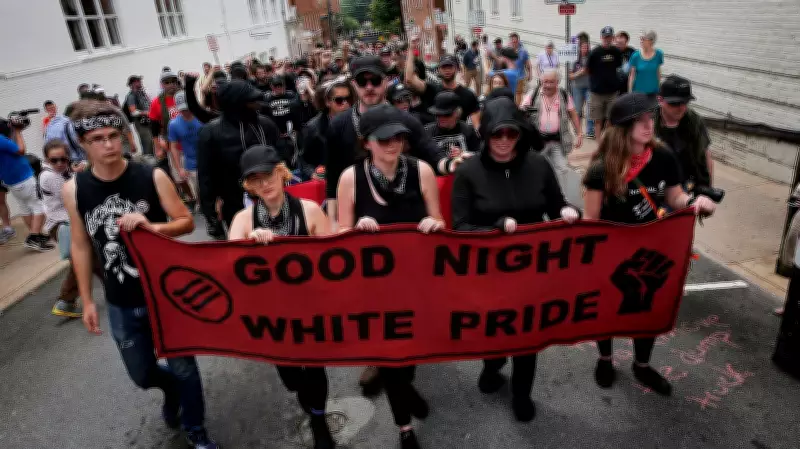
Mathias addresses how the term “antifa” has been co-opted as an all-purpose bogeyman by Trump and the right. Before 2017, few in America knew what antifa was. However, with Trump’s inauguration and viral videos of Nazis being punched, the term entered the public lexicon. After the deadly “Unite the Right” rally in Charlottesville, Virginia, dictionaries added “antifa,” and it became shorthand for militant anti-fascism.
The right, finding itself on the defensive post-Charlottesville, began using antifa as a distraction. A pro-Trump troll initiated a petition to designate antifa a domestic terror group, not expecting legal action but to create a false equivalency between left-wing and right-wing extremism. Despite the far right having killed hundreds over decades, antifa has not been linked to any fatalities. Conspiracy theories emerged, blaming antifa for mass shootings, natural disasters, and even beheadings, all to deflect from escalating right-wing violence.
In 2020, this narrative was repurposed to blame antifa for the George Floyd uprisings, aiming to distract from the protests’ core grievance: police brutality against Black people. By labeling activists as antifa, the right sought to exclude them from political respectability, justifying state prosecution or vigilante violence. In 2025, Trump’s claim to designate antifa a domestic terror group continues this tactic to repress opposition to his agenda.
Antifa as a Militant Tradition and Journalistic Force
Mathias distinguishes between “antifa” as a term and anti-fascism as an ideology. Antifa refers to a specific militant tradition combating the far right “by any means necessary,” with tenets including:
- Confronting fascists in the streets, sometimes violently
- Denying platforms for fascist speech and organization
- Distrusting the state and law enforcement as inherently white institutions that may collaborate with fascists
This tradition emerged from networks of anarchists, socialists, and communists in the 1980s and 1990s, initially focused on expelling Nazis from the punk scene. Mathias traces its roots further back to figures like investigative journalist Ida B. Wells and Walter White of the NAACP, who resisted racial domination long before the term “fascist” existed.
He highlights antifa’s role as modern-day journalists, with anonymous collectives conducting skilled investigations. For instance, one anti-fascist analyzed 60,000 tweets to uncover a Nazi’s identity, while outlets like Unicorn Riot created databases of leaked white supremacist chat messages. Mathias argues that journalism should be explicitly anti-fascist, serving the public interest by exposing extremism.
Personal Motivations and Evolving Tactics
Mathias developed source relationships with anti-fascists over a decade, gaining their trust by protecting their identities amid threats from fascists and the state. Many were motivated by personal encounters with fascism, such as losing someone in the El Paso Walmart massacre. His own reporting was shaped by witnessing the beating of DeAndre Harris at the “Unite the Right” rally in Charlottesville, an event that radicalized him and underscored the urgency of combating bigotry.
As fascism gains strength within the U.S. government, tactics are evolving. In Minneapolis, communities are adapting anti-fascist methods—such as doxing and noise demonstrations—to target ICE agents, creating a social cost for their actions. Mathias notes that doxing relies on societal taboos against white supremacy, and efforts to identify ICE agents aim to maintain that stigma. Public opinion is shifting, with polls showing growing support for abolishing ICE, even among Republicans.
Mathias concludes that anti-fascism is “fundamentally hopeful,” a struggle against impossible odds. While antifa’s local efforts have successfully made Nazis uncomfortable in specific areas, the movement is too small to halt the broader rise of MAGA fascism. However, the adaptation of its tactics on a larger scale, as seen in Minneapolis, offers a model for resistance. By exposing and challenging extremism, anti-fascists continue a long history of community self-defense, inspiring action in the face of escalating authoritarianism.