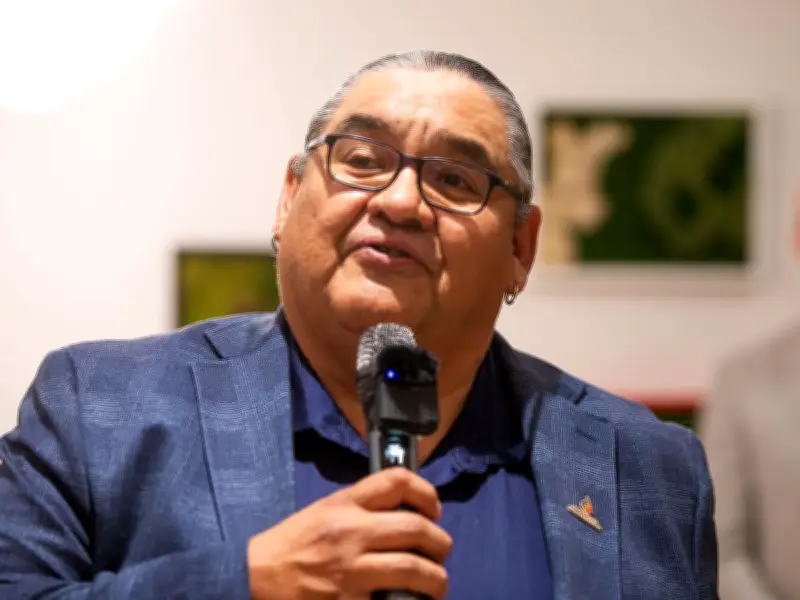
OTTAWA — Karen Restoule, the director of Indigenous affairs at the Macdonald-Laurier Institute, says she was struck by the number of times she heard the word “Indigenous” during Thursday’s federal-Alberta announcement regarding a new West Coast oil pipeline.
“(Prime Minister Mark) Carney and (Alberta Premier Danielle) Smith must have both said ‘Indigenous’ or ‘First Nations’ at least a dozen times each,” said Restoule. “I honestly lost track.”
Pipeline Route and National Interest Status
Carney and Smith appeared together in Calgary to announce that they’d agreed on a route for a new pipeline, running southwest from Bruderheim, Alta. to the Roberts Bank terminal near Vancouver. The premier had originally preferred a northern route to Prince Rupert, B.C., which is closer to Asian markets, but some Indigenous groups along that route had said they were opposed.

Smith announced that she’d formally submitted the southerly pipeline proposal to the federal Major Projects Office for consideration as a project of national interest, and Carney has committed to declaring it as a national interest project by September 2027.
Indigenous Engagement and Co-ownership
But what was just as key in the announcement, say observers, is how much emphasis Smith has been putting on ensuring buy-in from Indigenous communities. Tellingly, Smith was flanked at the announcement by Alberta Indigenous Affairs Minister Rajan Sawhney, who she said will be “very busy over the coming months.”
Sawhney met with more than 40 First Nations, in Alberta and British Columbia, in the months leading up to Thursday’s announcement, according to her staff. Alberta’s November 2025 memorandum of understanding with the federal government laying the groundwork for the new pipeline said that it would entail “Indigenous Peoples’ co-ownership and economic benefits.”
The new pipeline will be built and majority owned by the Trans Mountain Corporation, a federally owned Crown corporation, with minority participation from Pembina Pipeline Corp. But Smith said Thursday that the proposal includes an equity ownership opportunity for First Nations’ partners, saying more details of that will be shared in the coming months.
Reaction from Indigenous Leaders
Stephen Buffalo, president of the Indian Resource Council, praised the approach. “This is reconcili-action,” he said. “You're seeing (Indigenous) ownership of infrastructure.”
Pembina previously formed a 50-50 partnership with a coalition of First Nations and Métis communities to try buying the existing Trans Mountain Expansion pipeline, which was completed in 2024 after the federal government took over the beleaguered company as it was preparing to walk away from the politically fraught project. At the time, Ottawa said it wasn’t interested in selling.
Restoule says that Thursday’s pipeline announcement reflected a quiet shift in Indigenous relations that was started in Alberta years ago by Smith’s predecessor.