

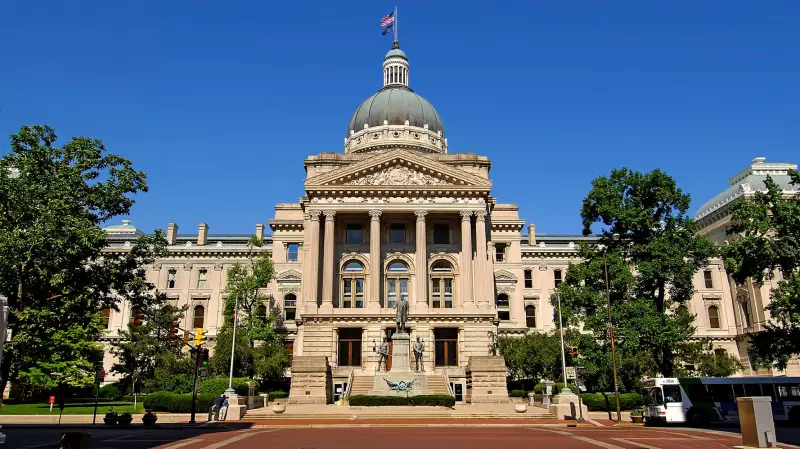
Republicans in the Indiana House of Representatives have advanced a highly contentious new congressional district map, setting the stage for a political showdown in the state Senate. The legislation, passed on a 57-41 party-line vote, redraws the state's electoral boundaries in a move that could significantly alter the balance of power in future U.S. House elections.
A Map Designed for Political Gain
The newly approved map strategically divides the Democratic stronghold of Indianapolis into four separate districts, merging each quadrant with surrounding conservative rural areas. This tactic, known as "cracking," dilutes the urban vote and could potentially allow Republicans to win all nine of Indiana's congressional seats. Currently, the GOP holds seven.
State Representative Greg Porter, a Democrat from Indianapolis, delivered a passionate critique on the House floor. He argued the map intentionally weakens the political influence of minority communities. "What we’re doing today with this proposed legislation is taking away the rights of Black and brown people in Indiana," Porter stated. "It cracks Marion County!"

The map also targets another Democratic seat by grouping the cities of East Chicago and Gary with Republican-leaning northern Indiana counties, threatening the re-election of Democratic U.S. Representative Frank Mrvan.
National Strategy and Swift Timeline Draw Fire
The legislation's author, Republican State Representative Ben Smaltz, revealed that the map was provided by the National Republican Redistricting Trust, the party's main redistricting organization. This group also assisted with Texas's recent map. Smaltz indicated this mid-decade redistricting may become a recurring national battle between Democrats and Republicans.
Democrats have fiercely criticized the accelerated process. The map was introduced on Monday, October 28, 2024, and passed by Friday, bypassing the extensive public hearings held over several months during the last redistricting cycle in 2021.
The push for new maps originates from the highest levels of the Republican Party. Former President Donald Trump has urged GOP-led states to redraw lines ahead of the 2026 midterms to secure an easier path to maintaining a U.S. House majority. He has promised to support primary challenges against any Republican senator in Indiana who opposes the effort.
Uncertain Fate in the State Senate
The map's future is now uncertain as it moves to the Indiana Senate. Senate President Pro Tempore Rodric Bray has previously stated there are not enough votes to support mid-decade redistricting. In the 50-member chamber, Republicans need at least 25 votes, with a potential tie-breaking vote from Republican Lieutenant Governor Micah Beckwith.
The issue has deeply divided Indiana Republicans, leading to reported threats and swatting attempts against lawmakers on both sides of the debate. Furthermore, half the Senate, including Bray, is not up for re-election until 2028, potentially insulating them from Trump's primary threats.
This state-level conflict mirrors a national trend. Following actions in Texas, Missouri, Ohio, and North Carolina, Indiana's move pressures Democratic states like California and Virginia to consider similar counter-measures. The political tit-for-tat, as Smaltz noted, may be "the new normal" for American elections.






