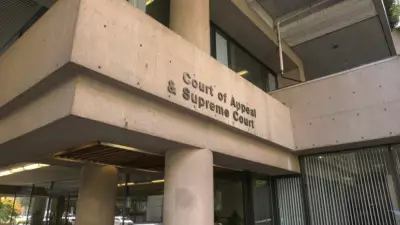
WASHINGTON (AP) — Democrats on Monday filed an emergency appeal with the U.S. Supreme Court, seeking to halt a Virginia ruling that invalidated a ballot measure which would have granted their party four additional winnable U.S. House seats.
Background of the Case
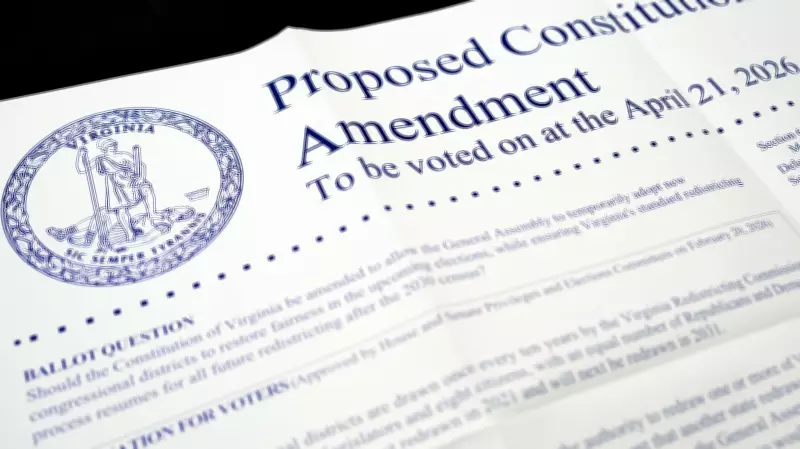
The appeal follows a Friday decision by the Virginia Supreme Court that struck down a constitutional amendment narrowly passed by voters just last month. The 4-3 state court ruling determined that the Democratic-controlled legislature had improperly initiated the process of placing the amendment on the ballot after early voting had already commenced in Virginia's general election last fall.
Democrats had argued, albeit unsuccessfully, that the U.S. Supreme Court has previously held that an election does not occur until Election Day itself, even if early voting is underway.

National Implications
This appeal represents the latest development in the nation's mid-decade redistricting competition, which was spurred last year by President Donald Trump's encouragement of Republican-controlled states to redraw their congressional lines. The process was further intensified by a recent Supreme Court ruling that significantly weakened the Voting Rights Act.
Democrats acknowledge that their request to reverse the Virginia ruling is a legal long shot, as the Supreme Court typically avoids second-guessing state courts' interpretations of their own constitutions. In 2023, the Court declined a similar request from North Carolina Republicans to overturn a state Supreme Court decision that blocked the GOP's congressional map.
Political Ramifications
Politically, the appeal could benefit a party struggling to compete with Republicans in the unusual mid-decade redrawing of congressional boundaries. It provides fodder for election-year messaging about a partisan Supreme Court, which recently allowed Louisiana Republicans to proceed with redistricting after the justices struck down a majority Black district as an unconstitutional racial gerrymander.
Democrats have been on the defensive because, just days after the Virginia ballot measure passed, the Supreme Court's conservative majority reversed decades of precedent and effectively neutered the Voting Rights Act. This paved the way for Southern states to eliminate some majority Black districts and pad Republican margins in Congress.
Impact on Redistricting
The Virginia amendment was initiated long before that ruling. It was designed as a countermeasure to Republican gains in Texas, Missouri, North Carolina, and Ohio, and to blunt a new map in Florida that had just become law. When the Virginia amendment passed, it briefly turned the nationwide redistricting scramble into a draw between the two parties.
However, that balance was unraveled by the Virginia Supreme Court's decision. The justices are appointed by the legislature, which has shifted between parties in recent decades, and the court is generally not perceived as having a clear ideological bent.