

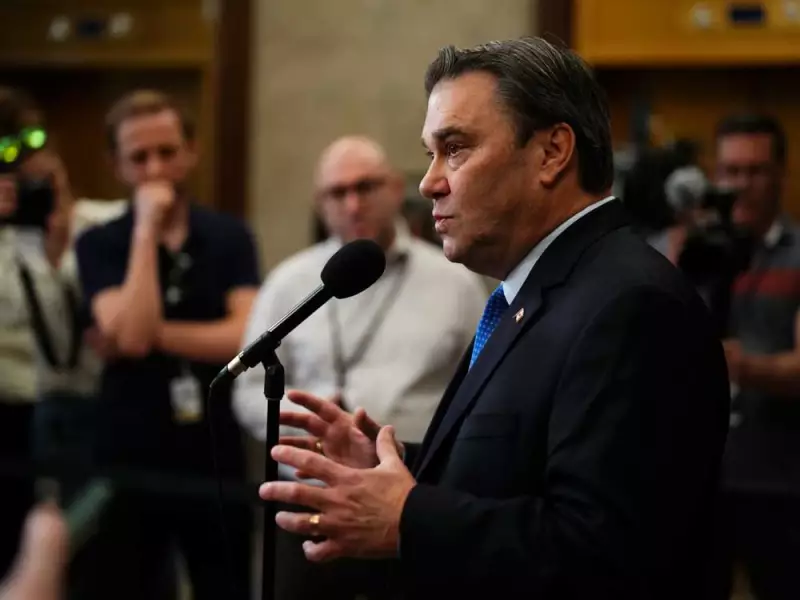
The New Democratic Party of Canada is actively campaigning to regain official party status in the House of Commons after a devastating electoral performance last spring. However, a comparative look at parliamentary rules across the country suggests their argument for a rule change may not hold water.
The NDP's Post-Election Plea
Following the federal election in April 2025, the NDP suffered a significant setback, losing more than two-thirds of its seats. This collapse left the party with only seven seats in the House of Commons, five short of the current requirement of 12 seats needed for official party status.
Since the defeat, interim NDP Leader Don Davies has publicly urged Prime Minister Mark Carney to intervene and lower the threshold. Davies argues that cooperation with the NDP is essential for a progressive agenda and that granting official status is a key part of that outreach.

Official party status is not merely symbolic. It comes with substantial taxpayer-funded operational resources and critical parliamentary privileges, including guaranteed participation in Question Period and seats on committees.
A Patchwork of Rules Across Canada
The NDP's request raises a fundamental question: is the 12-seat federal threshold arbitrary or unfair? To answer this, one must examine the rules governing official party status in legislatures nationwide, which vary dramatically.
In the Canadian Senate, the requirement is nine seats. At the provincial level, the spectrum is wide:
- British Columbia requires just 2 seats (2.15% of the legislature).
- Prince Edward Island requires only 1 seat.
- New Brunswick sets the bar at 5 seats (10.2% of the legislature).
- Ontario uses a percentage model, requiring a party to hold 10% of the total seats.
This patchwork reveals that no single, consistent standard exists across the country. Each jurisdiction sets its own rules based on its unique parliamentary context.
How the Federal NDP Measures Up Nationally
When the federal NDP's current standing of seven seats (roughly 2% of the House of Commons) is measured against provincial benchmarks, the picture becomes clear. Even under the most lenient provincial rule—British Columbia's two-seat threshold—the NDP would still fail to qualify.
This is because B.C.'s rule is based on a percentage of the legislature (2.15%). With only 2% of the seats federally, the NDP falls short. This calculation holds true when applied to most other provincial standards. The federal requirement of 12 seats, representing approximately 3.5% of the House, actually sits on the more liberal end of the national spectrum.
The core of the NDP's argument—that the rules are grotesquely unfair—appears to weaken under this comparative analysis. The existing House of Commons rules are well within the established range of practices from coast to coast.
Ultimately, the debate touches on a principle of democratic accountability. Changing the rules after an election because one party failed to meet a publicly known threshold could be viewed as an insult to voters and taxpayers who fund the system. While the number 12 may seem arbitrary, it exists within a Canadian tradition of varied and locally determined parliamentary standards. The NDP's path forward, as argued by commentators like Jay Goldberg of the Frontier Centre for Public Policy, likely rests not on rule changes but on rebuilding voter connection before the next election.






