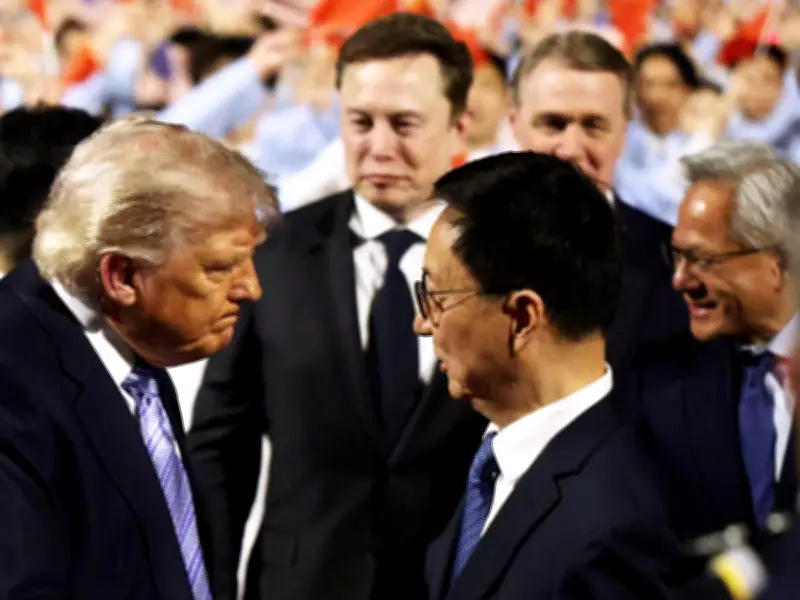
U.S. President Donald Trump is in Beijing this week for a high-stakes summit with Xi Jinping, their first meeting of 2026 after a year of tariff escalation and just months after Prime Minister Mark Carney's own trip to China. The talks, beginning Thursday, cover issues ranging from Iran and Taiwan to trade.
Carney has said nothing publicly but will be watching for signs of a new balance on trade. The question for Ottawa is whether progress at the Xi-Trump summit undermines Carney's recent efforts to diversify Canadian export markets, because any thaw in U.S.-China relations could come at Ottawa's expense.
Risks for Canada
Stephen Nagy, senior fellow at the Macdonald-Laurier Institute and politics professor at the International Christian University, warned that Beijing and Washington are setting the table, and Canadians, Japanese, and South Koreans are on the menu. "We have a lot to lose if the summit goes in a positive way for the U.S., and we have a lot to lose if China is able to secure some flexibility on the Taiwan issue," he said.

What's on the Agenda
The summit was planned by Treasury Secretary Scott Bessent and his counterpart in China, so economic issues will likely take precedence over foreign policy. Dominic Chiu, senior analyst at Eurasia Group, expects modest agreements on "low-hanging fruit," such as Chinese commitments to buy more U.S. exports, including soybeans, beef, and energy. More news about creating a U.S.-China Board of Trade is likely, though Chiu describes this as "old wine in new wineskins."
Reza Hasmath, a politics professor at the University of Alberta, predicts a big announcement about aircraft sales. "It's not coincidental that Boeing's CEO is there," he said. "I suspect Beijing's going to offer to purchase Boeing aircraft." Some trade watchers also anticipate an extension to the rare-earth truce, a one-year agreement made in Busan last year to stabilize critical mineral supply.
But Nagy says Trump wants more than an extension—durable guarantees about a steady supply of rare earth materials from China to reduce reliance on China's dominance in rare-earth processing. While unlikely this week, any such deal would be bad for Canada because it would weaken Ottawa's use of rare earths to curry favour with the United States and the Trump administration.
Little movement is expected in other high-tech areas. Jake Werner, director of the East Asia Program at the Quincy Institute for Responsible Statecraft, noted that one of the red lines for the U.S. is concessions on any of the established export controls or regulations regarding advanced technology and especially AI.