Jack Mintz: Neither Trump's Nor Carney's New World Order Will Last
In a world increasingly defined by geopolitical turbulence, the visions for global order presented by both U.S. President Donald Trump and Canadian Prime Minister Mark Carney are fundamentally flawed and unlikely to endure. This is the central argument put forth by economist Jack Mintz, who contends that Canada's best interests remain inextricably linked to a robust partnership with the United States, despite the current era of uncertainty.
The Davos Divergence: Competing Visions for Global Power
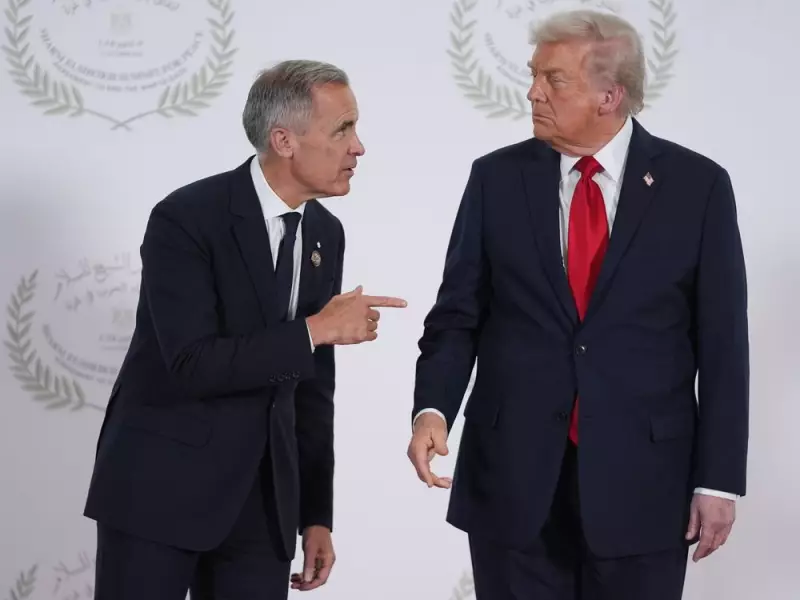
Prime Minister Mark Carney, in a recent address at the World Economic Forum in Davos, declared the liberalized world order to be on its deathbed. He pointed to China's ascendant military and economic might, Russia's ongoing aggression, and Trump's America First doctrine as catalysts for this shift. Carney warned that the era of trade liberalization and financial integration is giving way to one dominated by economic warfare and waning support for international institutions like the United Nations and the World Trade Organization.
In a contrasting speech delivered in Davos, former and once-again U.S. President Donald Trump asserted that American supremacy is ultimately beneficial for the entire world. "The U.S.A. is the economic engine of the planet. And when America booms, the entire world booms," Trump proclaimed. He signaled a willingness to leverage American power fully, even if it unsettles long-standing allies who have historically benefited from U.S.-provided open markets, defense security, and financial stability. Trump specifically noted Carney's lack of gratitude for these benefits to Canada, foreshadowing potentially contentious future trade negotiations between the two nations.

Carney's Counter-Strategy and the Historical Context of Order
In response to America's assertive posture, Prime Minister Carney has advocated for a "principled and pragmatic" approach grounded in what he terms "value-based realism." His strategy suggests that middle powers, like Canada, should form flexible, issue-specific coalitions to collectively assert their influence on the global stage.
Mintz, however, argues that neither leader's framework is correct. He invokes the late statesman Henry Kissinger, who in his 2014 book World Order, posited that "No truly global order ever existed." The foundations for modern international relations were laid by the Peace of Westphalia in 1648, which ended the devastating Thirty Years' War. With a quarter of Central Europe's population dead, sovereign states agreed to non-interference in each other's domestic affairs, establishing the principle of territorial sovereignty.
"As Kissinger puts it, order requires 'commonly accepted rules that define the limits of permissible action and a balance of power that enforces restraint where rules break down, preventing one political unit from subjugating all others,'" Mintz notes, adding that this has historically been easier to achieve regionally than on a global scale.
The Forces of Conflict and Cooperation
These Westphalian principles later underpinned both the League of Nations and the United Nations. As President Harry Truman observed after WWII, the U.S. uniquely had the capacity to defeat enemies and then reintegrate them into the international community. History suggests that war can sometimes create the necessary conditions for subsequent peaceful coexistence. Simultaneously, powerful forces—including deep economic linkages, rapid technological advancement, and increasingly mobile populations—continue to push nations toward cooperation in pursuit of their own self-interest.
Mintz clarifies that Donald Trump did not single-handedly invent today's global tensions. The United States was already grappling with the consequences of costly wars in Vietnam, Iraq, and Afghanistan, and was further weakened by the 2008 financial crisis. China's remarkable economic rise was facilitated by its 2001 entry into the WTO, an accession championed by the U.S. itself. By aggressively pursuing export-led growth, China has built the world's second-largest economy, now leveraging its military to pressure neighbors and using Belt and Road initiatives to seek resource dominance across multiple continents.

Meanwhile, following the Soviet Union's collapse in the 1990s, Russia has dramatically reasserted its military power, most notably through its ongoing aggression in Ukraine. These complex, pre-existing dynamics underscore that the challenges to global stability are multifaceted and deeply rooted.
In this fragmented landscape, Jack Mintz concludes that neither the unilateralism of Trump's "America First" nor the coalition-based "value-based realism" of Carney provides a sustainable blueprint for the future. For Canada, navigating this precarious new world necessitates a clear-eyed recognition that its prosperity and security are still best served by maintaining the strongest possible partnership with its closest neighbor and largest trading partner, the United States.