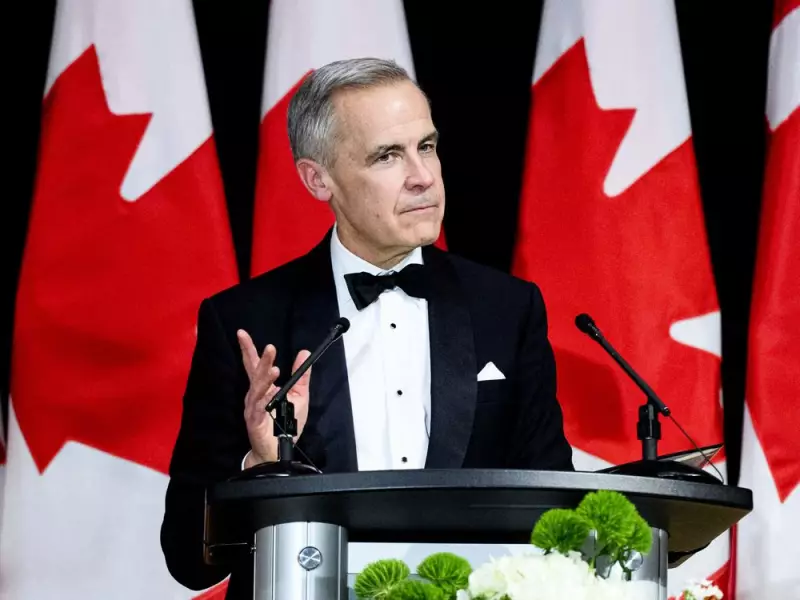
As Canadians settle into the new year, prominent economist Jack Mintz has issued a sobering assessment of the economic landscape facing the country in 2026. Mintz argues that achieving meaningful economic progress will require significant patience, as the Liberal government's strategy to "build a stronger Canada" and diversify trade confronts substantial headwinds.
A Stalled Economy and a Worried Public
Mintz points to two critical data points from December that set the stage for a challenging year. First, Canada's GDP contracted by 0.3% in October 2025. While monthly figures can be volatile, the broader trend is concerning: economic growth has been virtually stagnant over the past year, rising a mere 0.4% since October 2024.
With the population growing at 1.4%, this translates to a full percentage point decline in per capita GDP. This continuation of what Mintz calls "Canada’s lost decade" is reflected in public sentiment. Recent polling from Nanos indicates deep economic anxiety among Canadians, which helps explain why the Conservative Party is now virtually tied with the governing Liberals in voter support.

The Stark Contrast with the United States
The second pivotal piece of news highlights a growing divergence with Canada's largest trading partner. The United States reported surprising third-quarter growth at an annualized rate of 4.3%. Even on a year-over-year basis to September, U.S. growth was 2.3%—six times higher than Canada's rate.
Mintz notes that factors like rapid AI adoption, tax cuts, and deregulation are poised to boost U.S. growth further in 2026. The only potential weakness he identifies is a "jobless recovery," as American companies may not significantly expand hiring despite economic gains.
Carney's Uphill Battle and the Capital Spending Plan
Mintz states that if Prime Minister Mark Carney aims to demonstrate he is building a stronger nation, 2026 must show clear improvement. The government is relying on an $80 billion federal deficit to inflate the economy, spurring short-term growth and job creation. AI adoption is also expected to contribute, though likely at a slower pace than in the U.S.
However, Mintz outlines several persistent challenges:
- Falling commodity prices for oil and agricultural products are expected in 2026.
- Business investment remains moribund, virtually unchanged from four years ago, hampered by U.S. tariffs and a weak domestic recovery.
- Residential investment, down 10% over four years due to oversold condos in major cities, is not forecast to recover this year.
The Nation-Building Strategy: A Long-Term Gamble
Prime Minister Carney's response is a nation-building plan focused on fast-tracking federally approved projects by suspending obstructive regulations. This is backed by a massive capital spending commitment.
Key budgeted items include:
- Over $10 billion in subsidies for large-scale private capital over five years.
- $2 billion in new military capital spending.
- $6 billion for the Build Canada Homes initiative.
- Continuing commitments like $10 billion for EV battery manufacturing and $46 billion in corporate tax incentives.
Overall, cash spending on capital projects is budgeted to average $90 billion annually—roughly 2.5% of GDP—over the next five years.
In conclusion, Jack Mintz emphasizes that patience is not just a virtue but a necessity for Canadians in 2026. Major capital projects unfold over years, and the countries targeted for trade diversification are often growing as slowly as Canada. The path to a stronger economic future, as outlined by the government, is a marathon, not a sprint, and the coming year will test the resilience of both the strategy and the national economy.