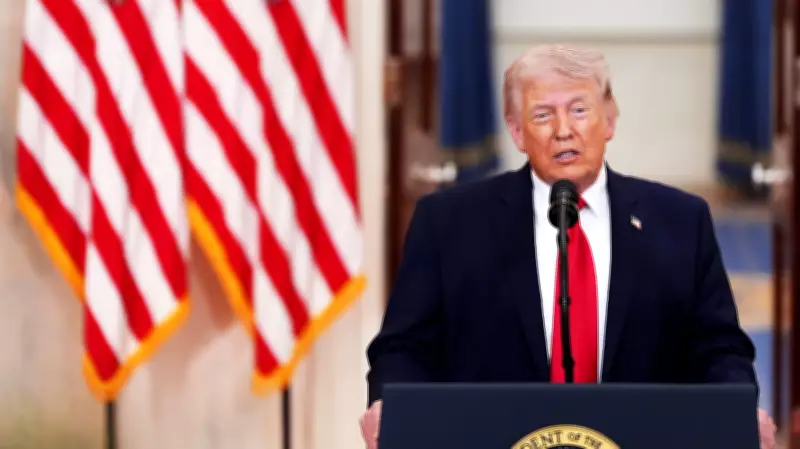
WASHINGTON — The conflict between the United States and Iran took a dramatic turn on Friday when a U.S. fighter jet was shot down, significantly complicating President Donald Trump's military campaign. An F-15 aircraft was targeted, forcing two Air Force crew members to eject and prompting a high-risk search-and-rescue mission inside Iranian territory. Hours later, one crew member was reported rescued, while the other remained missing, raising concerns about potential capture by Iranian forces.
Claims of Air Superiority Challenged
This incident directly contradicts recent assertions by both President Trump and Defense Secretary Pete Hegseth regarding Iran's military capabilities. On Wednesday night, Trump boasted from the White House, "They have no anti-aircraft equipment. Their radar is 100% annihilated. We are unstoppable as a military force." Last month, Hegseth declared that the U.S. had achieved "total air dominance," implying American aircraft could operate without threat. However, Iranian state media published a photo showing what appears to be the tail fin of an F-15E, undermining these claims and highlighting ongoing vulnerabilities.
Escalating Threats and Strategic Implications
As the war enters its sixth week, exceeding Trump's initial estimate of "four to five weeks," the president has offered no clear endgame. On Wednesday, he threatened to bomb Iran "back to the Stone Ages" if Tehran does not agree to his terms. On Friday morning, Trump reiterated his plan to confiscate Iran's oil, posting on Truth Social, "With a little more time, we can easily OPEN THE HORMUZ STRAIT, TAKE THE OIL, & MAKE A FORTUNE. IT WOULD BE A 'GUSHER' FOR THE WORLD???" If Iran captures the missing crew member, it could provide Tehran with additional leverage, beyond its control of the Strait of Hormuz, which has been used to drive up global oil prices.

Humanitarian and Legal Concerns
The loss of the F-15 adds to a growing toll for the U.S. military, including previous incidents such as the March 12 crash of a refueling tanker that killed six crew members, accidental shoot-downs by Kuwait, and Iranian missile attacks early in the war that resulted in seven service member deaths. Trump vowed in his Wednesday speech to continue attacks to honor these sacrifices. However, threats from Trump and Hegseth, including targeting civilian infrastructure like electric plants and drinking water facilities, have been condemned by legal experts as potential war crimes under international law. Hegseth's early vow to offer Iran "no quarter," which involves killing surrendering soldiers, also raises serious legal and ethical questions that could affect the treatment of Americans in Iranian custody.
With one-fifth of the world's crude oil previously moving through the Strait of Hormuz, Trump has not provided a coherent plan for resuming this flow, alternating between calls for other nations to force it open, claims it will open "naturally," and threats of further attacks. The downing of the F-15 underscores the complexities and risks of this ongoing conflict, challenging the administration's narrative of military invincibility and highlighting the urgent need for a strategic reassessment.