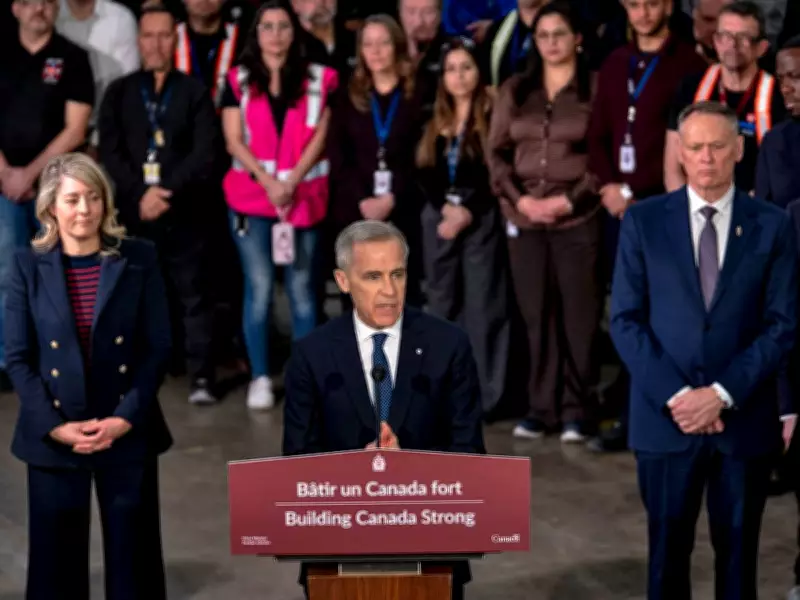
Internal Government Conflict Emerges Over Carney's Defense Spending Strategy
The announcement of Prime Minister Mark Carney's new defense industrial strategy has exposed significant internal divisions within the government, despite public appearances of unity. Industry Minister Mélanie Joly appears to have taken control of the plan, sidelining Defense Minister David McGuinty, who was reduced to a silent presence during the February 17, 2026 announcement at CAE Inc. in Montreal.
Ambitious Economic and Military Targets
The comprehensive strategy document outlines aggressive targets for the next decade, positioning defense spending as a major economic driver. The plan promises to create 125,000 new jobs while significantly boosting Canada's innovation capacity and national resilience. Most notably, the government aims to increase domestic defense acquisitions from approximately 30 percent to nearly 70 percent of total procurement.
Key financial commitments include:

- An 85 percent increase in government investment for defense-related research and development
- A 240 percent expansion of defense industry revenue
- A 50 percent growth in defense exports
Military Readiness Improvements
The strategy establishes specific operational readiness targets across military branches. The government aims to raise maritime fleet serviceability to 75 percent, land fleet readiness to 80 percent, and aerospace fleet operational capacity to 85 percent for training and missions. These represent substantial improvements from 2022 levels of 50 percent, 56 percent, and 44 percent respectively.
Unprecedented Financial Commitment
Prime Minister Carney's government has committed to an additional $80 billion in military spending over the next five years, with even more ambitious long-term goals. If the administration achieves its target of allocating 3.5 percent of GDP to core defense spending by 2035, annual military expenditure would reach $132 billion in today's dollars.
"None of these goals will be attained easily," Carney acknowledged during the announcement. "But Canadians are up for it. The various assumptions which have defined Canadian policies in terms of defense and foreign affairs have been completely upended."
Strategic Independence and Economic Nationalism
The policy enjoys substantial public support despite concerns about increasing short-term deficits, largely because it reduces Canadian dependency on what Carney characterized as a "more hostile United States." The prime minister emphasized partnerships with "trusted allies" in the United Kingdom, Europe, and the Indo-Pacific region, conspicuously omitting mention of the United States.
Carney stressed that the new strategy would ensure Canada "is not hostage to the decisions of others when it comes to our security" and would build resilience against "any single point of failure." This language has raised questions about potential implications for ongoing procurement decisions, including the possible purchase of American F-35 fighter jets.
Long-Term Economic Implications
While the government plans to finance initial spending increases through deficits, analysts question whether such massive outlays can be sustained without consuming impractical portions of future government program spending. The strategy's viability ultimately depends on generating the substantial economic benefits Carney has predicted, including the promised job creation and industry growth.
The move toward economic nationalism in defense procurement represents a significant departure from traditional market competition approaches. Critics warn that this shift risks introducing mismanagement, inefficiency, and potential corruption into defense contracting processes, even as supporters argue it will strengthen domestic industry and national security independence.