President Donald Trump and Defense Secretary Pete Hegseth have intensified their efforts to assign responsibility for a controversial military action, placing blame squarely on a senior Navy officer for authorizing a follow-up strike that killed survivors of an initial attack. This secondary strike, which occurred on September 2nd off the coast of Trinidad, is explicitly described as an unlawful killing in the U.S. Department of Defense's own Law of War Manual.
Shifting Accounts and the 'Double-Tap' Attack
The incident, first detailed by the Washington Post, involved an initial strike on an alleged drug smuggling vessel. Two survivors were left clinging to the wreckage. Hours later, a second strike—often referred to as a "double-tap"—was launched, killing them. Admiral Frank Bradley, who at the time led the Joint Special Operations Command and has since been promoted to head U.S. Special Operations Command (SOCOM), is now cited as the decision-maker for that fatal follow-up.
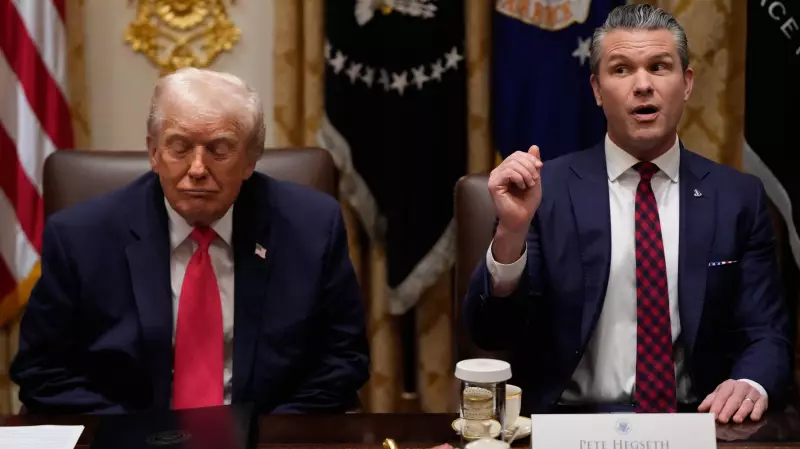
During a White House cabinet meeting on December 2nd, Hegseth clarified his earlier claim of having watched the attack live. He stated he witnessed only the initial strike, not the subsequent one. "As you can imagine, at the Department of War, we got a lot of things to do. So I didn’t stick around for the hour and two hours, or whatever," Hegseth said, using Trump's nickname for the Pentagon. He then asserted that Admiral Bradley "made the correct decision to ultimately sink the boat and eliminate the threat."

Contradictions and Unsubstantiated Claims
President Trump, for his part, claimed ignorance of the second strike's details. "I didn’t know about the second strike. I wasn’t involved in it," he stated. However, he repeated an unsubstantiated claim central to his administration's justification for such aggressive interdictions: that these boats carry fentanyl destined for the United States. "Every boat that you see get blown up, we save 25,000, on average, lives," Trump claimed.
This assertion lacks evidence. In fact, the vast majority of fentanyl enters the U.S. across the land border with Mexico, not via small boats in the Caribbean. Historically, cocaine is the primary drug trafficked through that region, much of it bound for markets in Europe and North Africa. Neither the Defense Department nor the White House has provided proof for Trump's fentanyl claim, including in response to recent queries.
A Glaring Inconsistency in Protocol
The controversy is further fueled by a stark inconsistency. In a separate attack in October, two survivors were rescued by the Navy and repatriated to Colombia and Ecuador. This raises a critical question: Why were the September survivors considered so imminently dangerous that they had to be killed, while the October survivors were deemed harmless enough to release?
White House Press Secretary Karoline Leavitt denied any change in protocols for dealing with survivors after the September incident. Meanwhile, the U.S. military manual leaves little room for interpretation regarding the September 2nd actions, stating clearly: "For example, orders to fire upon the shipwrecked would be clearly illegal." Attempts to reach Admiral Bradley through SOCOM for comment were unsuccessful.
The evolving narrative from the President and his Defense Secretary, juxtaposed with the manual's definition and the inconsistent handling of survivors, underscores the ongoing legal and ethical debates surrounding the administration's counter-narcotics operations.