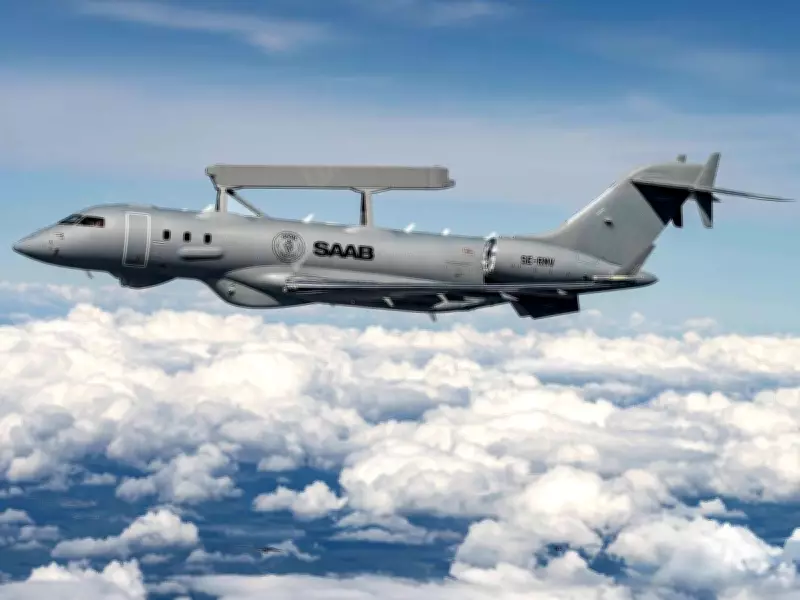
Canada's aerospace industry could be in line for a significant boost following reports that NATO has chosen a new fleet of airborne warning planes based on Canadian aircraft equipped with Swedish technology. According to French defence publication La Lettre and German press agency DPA, NATO's Support and Procurement Agency has selected Sweden's Saab and Canada's Bombardier to replace the alliance's current fleet of U.S.-built airborne warning and control aircraft.
The selected GlobalEye aircraft is based on the Bombardier Global 6000 or 6500 airframe and is outfitted with Saab's extended range radars and other advanced systems. A NATO purchase of the GlobalEye could help spur further export sales of the plane, which is already in service with the United Arab Emirates. Sweden and France have also placed orders for the aircraft.
Potential Impact on Canadian Industry
Saab has offered to build the GlobalEye and its Gripen fighter jet in Canada if the Liberal government purchases the surveillance plane as well as its fighter jet. Saab promises such acquisitions would create up to 10,000 jobs in Canada. The NATO Support and Procurement Agency has not officially announced a GlobalEye purchase and did not respond to a request for comment. Bombardier referred requests for comment to Saab.

Saab official Mattias Rådström stated that the company has seen the news reports about the selection of GlobalEye. "I can confirm that we have provided information to them (NATO) but we have not signed a contract or received an order from NATO for GlobalEye," he said in an email to the Ottawa Citizen.
Replacement for Aging Fleet
NATO is looking to replace its older fleet of E-3A Sentry airborne warning and control system aircraft, built by U.S. firm Boeing. In November 2023, NATO awarded a sole-source contract to Boeing to replace the older planes with the E-7A Wedgetail, but there have been ongoing issues with that aircraft.
The Royal Canadian Air Force (RCAF) has also launched a new project to acquire an Airborne Early Warning and Control fleet of planes. The Department of National Defence website lists the cost at more than $5 billion, with initial delivery of the first planes in 2037. However, in an April 8 briefing in Ottawa, the RCAF told industry representatives that the service hopes to have the aircraft arriving between 2031 and 2032, with initial operational capability set for 2035.
Future Fighter Jet Decision
It remains to be seen whether any NATO selection of Saab's GlobalEye would impact the Liberal government's decision on a future fighter jet for the RCAF. In 2023, the Liberal government announced it was purchasing 88 F-35 fighter jets built by Lockheed Martin in the U.S. However, Prime Minister Mark Carney ordered a review of the F-35 purchase in mid-March 2025 following threats against Canadian sovereignty by U.S. President Donald Trump.