Iran Protest Death Toll Climbs as U.S. Military Presence Intensifies
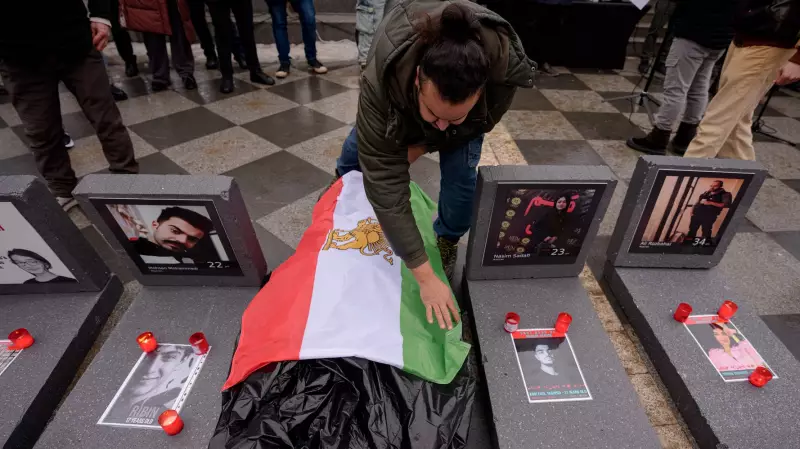
Human rights activists have released a devastating new report indicating that Iran's violent suppression of nationwide protests has resulted in the deaths of at least 6,126 people, with many more feared dead. This grim assessment comes as a United States aircraft carrier group has arrived in the Middle East, positioning American forces to potentially lead a military response to the ongoing crisis.
Escalating Tensions and Military Posturing
The arrival of the USS Abraham Lincoln aircraft carrier, accompanied by guided missile destroyers, significantly enhances the U.S. military's capability to conduct strikes against Iran. This deployment occurs despite signals from Gulf Arab states that they prefer to remain uninvolved in any potential attack, even as they continue to host American military personnel on their soil.
In a concerning development, two Iranian-backed militias operating in the Middle East have indicated their readiness to launch new attacks. This move appears designed to support Iran following repeated threats from former U.S. President Donald Trump regarding military action. Trump's warnings were prompted by Iran's killing of peaceful protesters and reports of mass executions in the aftermath of the demonstrations.

A Shattered Defensive Network
Iran has consistently threatened to draw the entire Middle East into a broader conflict, though its military and air defenses remain weakened following Israel's June war against the country. The nation's projected power across the region, once maintained through the so-called "Axis of Resistance"—a network of proxy militant groups in Gaza, Lebanon, Yemen, Syria, and Iraq—has effectively collapsed.
This defensive buffer, intended to keep conflicts away from Iranian borders, disintegrated after Israel targeted Hamas, Hezbollah in Lebanon, and other groups during the Gaza war. Notably, both the Houthi rebels in Yemen and the Kataib Hezbollah militia in Iraq refrained from participating in Israel's 12-day war against Iran, which saw U.S. airstrikes on Iranian nuclear facilities. Their hesitation reveals the ongoing disarray within Iran's alliance network.
Detailed Breakdown of Casualties
The newly released casualty figures, provided by the U.S.-based Human Rights Activists News Agency on Tuesday, offer a detailed and sobering account of the crackdown's human cost. The agency, which has maintained accuracy during multiple rounds of unrest in Iran, verifies each death through an extensive network of activists operating within the country.
According to their report, the dead include:
- At least 5,777 protesters
- 214 government-affiliated forces
- 86 children
- 49 civilians who were not participating in demonstrations
The crackdown has also led to more than 41,800 arrests, according to the activists' documentation. The Associated Press has been unable to independently verify these numbers due to Iranian authorities severing internet connections and disrupting communications into the Islamic Republic.
Discrepancies in Official Reporting
Iran's government has presented a significantly lower death toll of 3,117, claiming that 2,427 were civilians and security forces while labeling the remainder as "terrorists." Historically, Iran's theocratic government has been known to undercount or completely omit fatalities resulting from periods of civil unrest.
The current death toll surpasses that of any protest movement or unrest in Iran over the past several decades, drawing comparisons to the chaotic period surrounding the country's 1979 Islamic Revolution.
Origins of the Protests and Communication Blackout
The protests began on December 28, initially sparked by the dramatic collapse of the Iranian currency, the rial. They rapidly spread across the nation, met with a violent response from Iran's theocratic leadership. The full scale of this crackdown is only now becoming apparent as the country emerges from more than two weeks of the most comprehensive internet blackout in its history.

Diplomatic Confrontations and Accusations
At a United Nations Security Council meeting late Monday, Iran's U.N. ambassador, Amir Saeid Iravani, stated that Trump's repeated threats to use military force against Iran "are neither ambiguous nor misinterpreted." Iravani further alleged, without providing evidence, that the U.S. leader incited violence through "armed terrorist groups" supported by the United States and Israel.
Meanwhile, Iranian state media has attempted to blame foreign forces for instigating the protests, as the theocracy struggles to address the country's severely weakened economy. This economic distress persists due to ongoing international sanctions, particularly those related to Iran's nuclear program.
Militia Threats and Strategic Ambiguity
Yemen's Houthi rebels, backed by Iran, have repeatedly warned they could resume attacks on shipping in the Red Sea if necessary, releasing old footage of a previous attack on Monday as a demonstration of capability. Ahmad "Abu Hussein" al-Hamidawi, leader of Iraq's Kataib Hezbollah militia, issued a stark warning: "the enemies that the war on the (Islamic) Republic will not be a picnic; rather, you will taste the bitterest forms of death, and nothing will remain of you in our region."
The Lebanese militant group Hezbollah, one of Iran's most steadfast allies, has maintained strategic ambiguity regarding its potential response to a possible attack. In a video address, Hezbollah leader Sheikh Naim Kassem acknowledged that "several parties have asked me a clear and frank question: If Israel and America go to war against Iran, will Hezbollah intervene or not?"
Kassem stated that the group is preparing for "possible aggression and is determined to defend" against it, but clarified that specific actions would be determined "according to the interests that are present" once any battle commences.