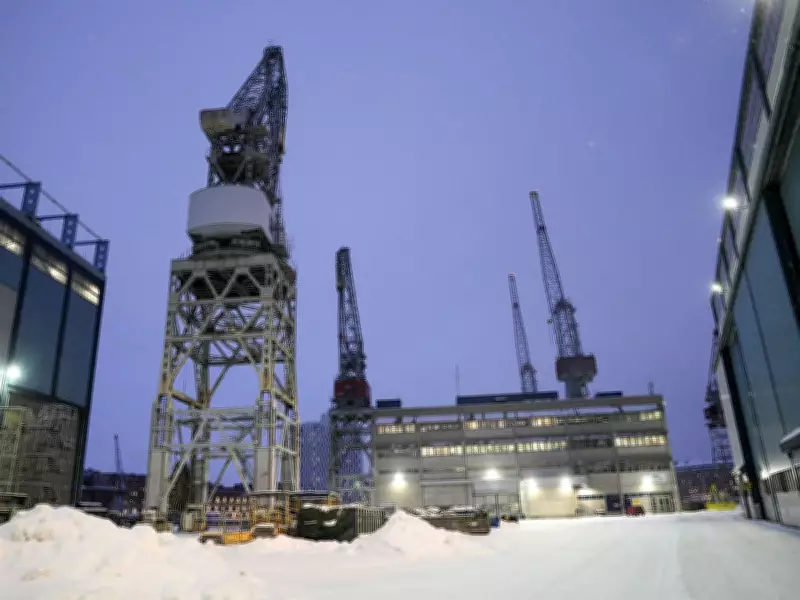
Finnish Shipyards, Including Canadian-Owned Facility, Build U.S. Icebreakers Amid Greenland Tensions
Finland is currently constructing a new fleet of icebreakers for the United States Coast Guard, a significant project that involves shipyards across the country, including one that is Canadian-owned. However, this lucrative deal faces growing scrutiny due to geopolitical tensions surrounding Greenland and strained U.S.-European Union relations.
Finland's Dominance in Icebreaker Technology
According to Arctia, the state-owned firm managing Finland's icebreaker fleet, the country holds a commanding position in this specialized maritime sector. Approximately sixty percent of the world's icebreakers are Finnish-made, with Finnish companies responsible for designing around eighty percent of these vessels globally.
Jukka Viitanen, Sustainability and Communications Director at Arctia, explained that Finland's expertise stems from necessity. "We are the only country in the world where all ports can freeze in winter," Viitanen noted. "We need to export and import goods to maintain our population's livelihood, which is why icebreaking capability is essential for our national economy."

The U.S. Icebreaker Procurement Deal
In October, the United States and Finland announced a major agreement for the U.S. Coast Guard to procure eleven new icebreakers. This represents a substantial upgrade from the Coast Guard's current fleet of just three aging vessels. Under the arrangement, four of these icebreakers will be constructed in Finnish shipyards, with the remaining seven to be built in the United States.
The deal, estimated at approximately US$6.1 billion according to media reports, provides a welcome economic boost for Finland. The country has been grappling with record-high unemployment and economic challenges, making this international contract particularly significant for its industrial sector.
Geopolitical Concerns and Arctic Competition
The Arctic region has become an area of intense strategic competition among global powers. Nations including China, Russia, and the United States are actively seeking to establish footholds in the Arctic to access vast natural resources and secure strategic advantages. "It is not possible to sail through the Arctic Sea without icebreakers," Viitanen emphasized, "and many major nations have significant interests in the Arctic right now."
However, the icebreaker deal faces potential complications from geopolitical tensions. Former U.S. President Donald Trump's expressed interest in acquiring Greenland—an autonomous territory of Denmark—has raised what one expert describes as "more and more suspicions" about the icebreaker agreement.
Greenland Tensions Cast Shadow Over Deal
Sanna Kopra, a professor of Arctic geopolitics and security at the University of Lapland, warned that Trump's territorial ambitions regarding Greenland could jeopardize the icebreaker contract. "If Trump changes his mind about taking control over Greenland and U.S. politics turns increasingly imperialistic," Kopra stated, "it raises questions about how wise it is to proceed with these deals."
Trump's interest in Greenland previously triggered what many analysts consider the most serious crisis in NATO's history. Although the former president eventually backed away from threats to use force and instead initiated talks with Danish and Greenlandic authorities, the underlying tensions remain.
Kopra further noted that if discussions about seizing Greenland resurface, "the question of cancelling these deals could become a very important political issue."
Diverging Expert Opinions on Deal's Future
Not all experts share the same level of concern about the icebreaker agreement's vulnerability. Charly Salonius-Pasternak, CEO of the Finnish think-tank Nordic West Office and an expert in geopolitics, expressed skepticism that Trump's threats would actually endanger the deal.

"There are voices against it," Salonius-Pasternak acknowledged, but added, "Are these people influential in the matter? No." This perspective suggests that despite the geopolitical tensions, the practical benefits of the icebreaker procurement may outweigh political considerations for all parties involved.
The situation highlights how international business agreements in strategically sensitive sectors like Arctic maritime technology can become entangled with broader geopolitical dynamics, creating uncertainty even for economically significant contracts.