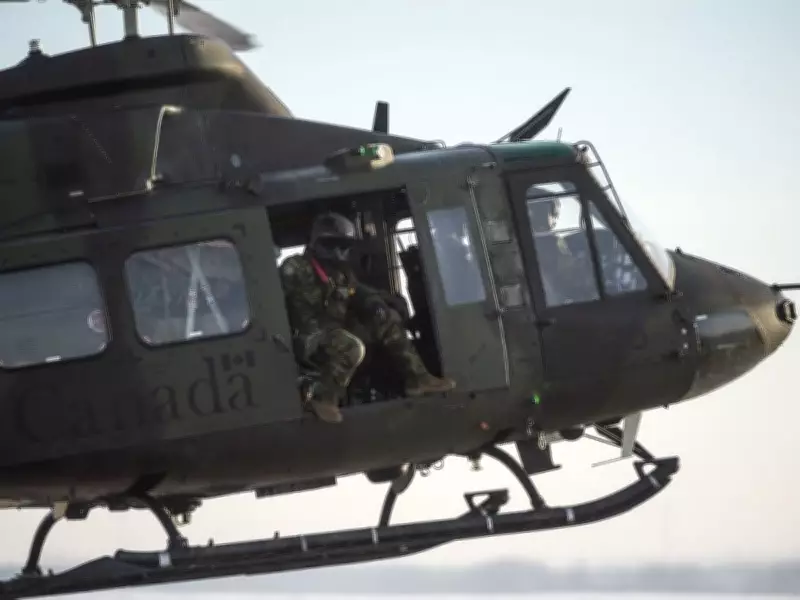
Edmonton's 408 Squadron Takes Helicopters to Alaska for International War Games
Edmonton's 408 Tactical Helicopter Squadron has launched a significant deployment to Alaska for Operation Striking Bat, a month-long international military exercise that brings together armed forces from multiple nations. The mission represents a crucial opportunity for Canadian military personnel to train in unique environments and collaborate with international partners.
Preparing for Arctic Operations
Capt. Roxanne Robitaille and her crew prepared their CH-147F Griffon helicopter for the long journey to Fairbanks, Alaska, where they will participate in five weeks of intensive war games. The deployment marks the second dispatch of helicopters from the squadron, with aircraft departing from CFB Namao on January 29, 2026.
"I think it's going to be an exciting opportunity to work with other members. More dynamic. There's lots of groups involved," said Capt. Robitaille, who emphasized the professional value of training in different environments.

The captain highlighted the importance of breaking out of routine training scenarios: "I think it's important to work in different environments, to push ourselves professionally, to not always be in the same bubble of exercise. Working with different people, different tactics, different ways of working, it's always interesting to see other perspectives and how we fit into that."
Historic Flight Path to Alaska
The squadron's journey to Alaska follows a historic route that retraces the old Northwest Staging Route, a sky highway that once facilitated the movement of American aircraft to support Russian forces during World War II. This time, the Canadian helicopters will make several stops along the way, including:
- Peace River
- Fort Nelson
- Whitecourt
- Watson Lake
- Whitehorse
After crossing into the United States, the helicopters will land at Fort Wainwright in Fairbanks. The aircraft will fly at relatively low altitudes of approximately 500 feet above treetops, loaded with equipment for the extended mission.
International Collaboration in the Arctic
Operation Striking Bat represents a significant international military collaboration in Arctic conditions. For one month, the 408 Squadron will work alongside forces from:
- The United States (host nation)
- Norway
- Italy
- Mongolia
This diverse coalition reflects shifting global alliances and the growing importance of Arctic military preparedness. The participation of Mongolia, a landlocked nation situated between China and Russia, adds particular strategic significance to the exercise.
Squadron History and Modern Role
The 2026 deployment coincides with the 85th anniversary of the 408 Tactical Helicopter Squadron's formation. Originally established in 1941 at Lindholme, U.K., as a Second World War bomber unit, the squadron suffered significant losses during the conflict, with 930 personnel casualties and 170 aircraft lost.
After being disbanded in 1970, the squadron was reborn in 1971 as a tactical helicopter unit. Their most recent combat deployment was in Afghanistan from 2006 to 2011, where they gained valuable operational experience in challenging environments.
The CH-147F Griffon helicopters, which have served as the squadron's primary aircraft for three decades, will provide the platform for this latest international exercise. These versatile aircraft, with their distinctive mechanical dragonfly appearance, are well-suited to the demanding conditions of Arctic operations.
Capt. Robitaille expressed enthusiasm for the deployment, noting: "I just love that, getting out. Traveling is always fun. We've got a great view from the cockpit, but an even better view when we go elsewhere. It's a really fun opportunity to leave the house and do what we train to do."
This deployment underscores Canada's commitment to international military cooperation and Arctic readiness, while providing valuable training opportunities for Edmonton-based personnel in some of the world's most challenging operational environments.