

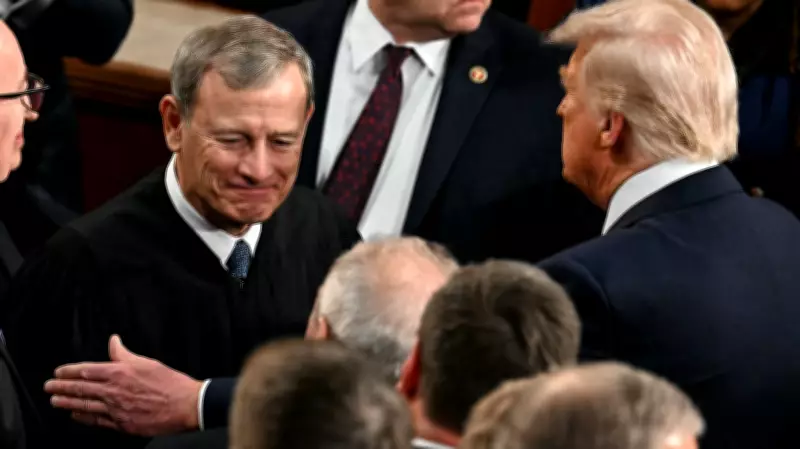
Supreme Court Rejects Trump's Emergency Tariff Claims, Signaling Potential Checks on Power
In a landmark decision, the Supreme Court has ruled against President Donald Trump's assertion that his emergency-imposed tariffs are beyond judicial challenge. The 6-3 ruling, delivered on Friday, saw Chief Justice John Roberts and Trump appointees Neil Gorsuch and Amy Coney Barrett join the court's three Democratic-appointed justices to reject Trump's claims of unchecked authority. This move has sparked cautious optimism among critics who fear Trump's expanding autocratic tendencies, suggesting a possible shift in the court's approach to limiting presidential overreach.
A Roadmap for Judicial Oversight
Legal experts view the decision as a critical step in curbing Trump's use of "emergency" declarations to bypass laws. Norm Eisen, a former lawyer in Barack Obama's White House, hailed the ruling, stating, "The Supreme Court's decision provides a roadmap for how the new left-right court majority intends to check Trump's unlawful abuses of power. The opinion resoundingly rejects Trump's contention that courts cannot review a president's declaration of an emergency." This sentiment underscores the broader implications for future cases involving presidential authority.
Historical Context and Concerns
Since taking office, Trump has frequently invoked "emergencies" to advance policies, such as opening Alaska for fossil fuel drilling under an "energy" emergency and curtailing refugee programs via a "border" emergency. Friday's ruling marks the first time the Supreme Court has blocked such actions, specifically targeting tariffs imposed due to fentanyl trafficking and trade imbalances. The court's opinion emphasized that "there is no exception to the major questions doctrine for emergency statutes," reinforcing limits on executive power.

Mixed Reactions and Future Implications
While some, like neoconservative scholar Robert Kagan, acknowledge the decision's positive aspect, they remain skeptical about the court's willingness to intervene in more contentious issues, such as election disputes or national security claims. Kagan noted, "The fact that they were willing to do this is better than if they had gone the other way. Does it mean they are ready to step in on something like an election dispute? I can still see them delaying or punting on those questions." This highlights ongoing fears about Trump's potential to exploit emergencies for political gain, including scenarios where elections could be postponed.
Judicial Opinions and Constitutional Insights
In concurring opinions, Justices Gorsuch and Roberts offered pointed critiques of presidential power. Gorsuch wrote, "Our founders understood that men are not angels, and we disregard that insight at our peril when we allow the few (or the one) to aggrandize their power based on loose or uncertain authority." Roberts further challenged Trump's emergency claims by stating, "The United States, after all, is not at war with every nation in the world," and warned that emergencies can serve as "a ready pretext for usurpation" of congressional power.
Broader Democratic Concerns
Democracy advocates have been wary of the Supreme Court since its 2024 decision granting broad immunity for presidential "official" acts, which delayed Trump's prosecution related to the January 6, 2021, coup attempt. Ty Cobb, a former prosecutor in Trump's administration, expressed relief at Roberts' ability to assemble a six-vote majority but noted concerns about Justice Brett Kavanaugh's dissenting opinion. "The Kavanaugh dissent is very discouraging," Cobb said, adding that Roberts, Barrett, and Gorsuch "seem to understand the stakes now, which is a good thing."
Despite Trump's defiant response, vowing to replace the struck-down tariffs, the ruling sets a precedent for judicial review of emergency powers, offering a glimmer of hope for those concerned about the erosion of democratic norms.






