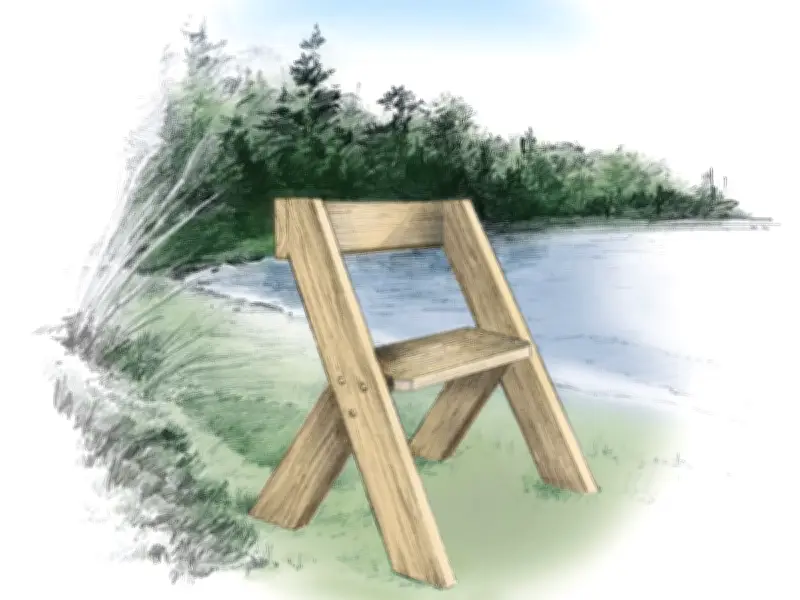
Some outdoor furniture is meant to impress, but a Leopold bench is different. It sits quietly in the landscape, inviting you to slow down. The design is named after Aldo Leopold, author of the 1949 environmental classic A Sand County Almanac and cofounder of The Wilderness Society. Leopold spent much of his life thinking about land, wildlife, conservation and the human place in creation. The simple bench associated with his name still fits that spirit beautifully.
A bench like this is also a good woodworking project because it offers a lot of usefulness without requiring a lot of tools. A hand saw, drill, a few 3/8” x 2 1/2” carriage bolts, #10 corrosion-resistant screws, exterior glue and a small amount of lumber are enough.
Choose Wood with Enough Strength
Start by choosing wood. Standard 1 1/2”-thick lumber makes a stout bench, while 1”-thick stock produces something lighter and easier to move. This is called 5/4 x 6 decking and it’s the only kind of manufactured lumber I know of that actually measures 1” thick. It’s sold for deck surfaces, but is also great for outdoor furniture. Don’t use 3/4” thick lumber. It’s too thin.

Build the Angled Leg Frames
The most important parts of the project are the two leg frames. Each frame is made from one long leg and one short leg crossing at an angle. Cut the angled ends carefully. If you’re using a handsaw, mark the angles first with a protractor and pencil. If you’re using a chopsaw, set the saw to the required angle, but it still helps to draw the lines. Pencil marks make it easier to see what’s supposed to happen before you make a mistake.
Set the Leg Angles
Lay one long leg on a flat surface, then position one short leg across it. A scrap block under the lower end of the short leg helps keep the parts aligned while you work. The plans here show the lower ends of the long and short legs should be 9 3/8” apart, while the top end of the short leg sits 17 5/8” above the bottom of the long leg. Get these two measurements right and the angles take care of themselves.
Bolt the Joints for Strength
Although the finished leg joints should be bolted, there’s an easier way to begin assembly. Apply weatherproof glue where the leg parts cross, then hold each joint temporarily with three #10 screws. Let the glue dry overnight, remove the screws, then drill 3/8” holes where the screws were. Install carriage bolts and tighten them until the domed heads draw firmly into the wood. Repeat the same process for the second leg frame.
Add Seat and Back Boards
Next, cut the seat and back boards. The seat looks and feels better if you clip the two front corners at 45 degrees before installation. With help, stand the two leg frames upright, position the seat and back board, and mark screw locations. Bore pilot holes with a 1/8” twist bit, then fasten the boards with #10 x 3 1/2” corrosion-resistant screws and more weatherproof glue.