We apologize, but this video has failed to load. Try refreshing your browser, or tap here to see other videos from our team.
Eat Streets: Forget Trendy — Vancouver's South Fraser Is 'Where You Come for Authentic'
Sunset's Fraser strip, quietly, might just outdo Vancouver's Chinatown for Chinese meat shops, and it has more Punjabi markets than the Punjabi Market.
Dan Fumano, Published Jun 11, 2026 • Last updated 0 minutes ago • 8 minute read

You can save this article by registering for free here. Or sign-in if you have an account.
Exploring the restaurants that bring Metro Vancouver neighbourhoods to life.
Rob Nijjar recently heard a few comments about south Fraser Street's restaurant scene from someone unfamiliar with the neighbourhood and its charms. “They said: 'Fraser Street, they've really got to do something about the restaurants,'” Nijjar recalled. “They said: 'There isn't any fusion! Where's the fusion restaurants? What's going on?'”
Nijjar, who grew up in this part of southeastern Vancouver and is now the Sunset on Fraser Business Improvement Association's executive director, quickly set them straight. “I said: 'Hey, if you want fusion, go to the hipsterville of Main Street … or go downtown. But Fraser Street's not for fusion,'” he said. “The fusion restaurants, and the ones you see on Instagram — that's a different world. … This place gives you authentic food. You want authentic curries, you want authentic Japanese, authentic Korean, dim sum, Chinese food, Hong Kong-style, whatever — this is where you come for authentic.”
Lee Loy BBQ Meats Co. on Fraser Street in Vancouver. Photo by Arlen Redekop /PNG
This stretch of Fraser, between 41st and 51st Avenues, is not among Vancouver's most Instagrammed neighbourhoods. And you shouldn't come here looking for molecular gastronomy, 12-course seasonal tasting menus, or flashy cuisine striving for recognition from the Michelin Guide. Of course, there's nothing wrong with those kinds of restaurants, and just a little further north on Fraser, you can find some wonderful Michelin-recommended restaurants like the boisterous Greek taverna Nammos Estiatorio, hip Thai spot Zab Bite, Bar Bravo's acclaimed seafood, contemporary Italian at Osteria Savio Volpe, Masayoshi's high-end omakase sushi experience, and Bonjour, a stylish Vietnamese bistro.
But once you get south of Mountain View Cemetery, southern Fraser street has a distinctly different vibe. Less modern and less Michelin. More grocers and grandmothers. Chinese barbecued ducks and slabs of Filipino lechon pork proudly hung in storefront windows, fishmongers, halal butchers, Punjabi shops with aisles of bulk spices, Chinese greengrocers' boxes of leafy gai lan on the sidewalk, Indian sweet shops' rainbow displays, late-night biryani lounges, pho.
Fraser Street is not as widely known internationally — or even locally — as Vancouver's Chinatown or Punjabi Market, which are considered Canada's largest Chinatown and North America's oldest Little India. Chinatown and the Punjabi Market are both historically important Vancouver neighbourhoods, where passionate locals today work hard to keep them vibrant. But Sunset's Fraser strip, quietly, might just out-do Chinatown for Chinese meat shops, and it has more Punjabi markets than the Punjabi Market.
Seth Rogen grew up in this area, before becoming an internationally famous, award-winning comedic actor, writer, and producer. In 2019, when Rogen was featured on American celebrity chef David Chang's Netflix show Breakfast, Lunch, and Dinner, the Vancouverite showed the American gourmand around his old East Van stomping grounds. After Rogen and Chang smoked a hefty joint outside the Old Catholic Church at 715 East 51st Avenue, they popped into Apna Bhaia Sweet Shop & Restaurant around the corner on Fraser for a box of takeout samosas. As the pair enjoyed their snack on the bench out front of the shop, their eyes were almost as red as the tamarind chutney they used for dipping. It made for great TV, and a good advertisement for both the shop and the area.

Apna Bhaia has been serving samosas, pakoras, gulab jamuns and, as they like to say, catering for parties between 10 and 1,000 people, for more than 20 years. But Rogen's endorsement was a pleasant surprise and a nice boost for business, Apna Bhaia owner Sarbjit Ugre said this month. “I really appreciate him,” Ugre said of Rogen. “He brought the American guy (Chang) to my store and he enjoyed my food … and many people saw and came and told me.”
Neighbourhood resident Genny Loo recently took us for a tour walking up and down Fraser Street, poking in and out of grocers, bakeries, cafés and specialty shops. Over a big lunch of shrimp dumplings, pea tips with ginkgo, chow fun noodles and seafood-stuffed eggplant at Good Choice, a bustling Cantonese-style dim sum restaurant, Loo shared her views of Fraser's past and present. She grew up further north on Fraser Street near Kingsway, in an apartment above the small grocery store her family ran, before moving south to Sunset in the mid-1960s, where she and her late husband raised a family. Loo still lives, shops, and eats there today.
When Loo first arrived in Sunset in 1966, the area had a significant German community, she recalls, with German delis, bakeries, businesses, and churches. The original location of the Breka Bakery and Coffee Shop chain, which opened in 2006 at 6533 Fraser St., inhabits the former site of a German bakery, and they still serve bienenstich, a family-sized apple strudel as an homage to those roots. But other than that, there are not many vestiges of the area's former German character. Indeed, there's not much European food here, other than the colonial Spanish and Portuguese influences in the Filipino and Hong Kong restaurants.
It's mostly Asian food here, with flavours from all over that continent, reflecting the waves of immigration that shaped this neighbourhood over the last half-century or so: South Asian, East Asian, and more recently, southeast Asian. There are not only long-running northern Indian restaurants serving dishes like butter chicken that have become mainstream staples of Vancouver cuisine over the last few decades, but also some newer south Indian eateries serving biryani and dosas, and a Pakistani restaurant called Dewan-E-Khass, serving haleem and nihari, dishes that, until more recently, were less common in Vancouver.
Some of the neighbourhood's oldest restaurants are Chinese-owned, and in recent decades, more Vietnamese, Filipino, Korean and Japanese restaurants have opened, as well as Momo Hut, which touts itself as B.C.'s first Nepalese restaurant. Within the past year, two Latin American businesses opened: Sal y Limon taqueria, and Latin Market Express.
Although Sunset's cultural demographics — and the food — have evolved over the 50 years Loo has lived here, the feel of the neighbourhood hasn't changed nearly as much as some parts of Vancouver that have been transformed by new development. The languages on the signs may have changed, but walking the sidewalk at Fraser and 47th doesn't seem all too different from 20 years ago, compared with how wildly other areas have changed in that time like, say, Broadway and Cambie, or Main and Keefer. “It's still the old neighbourhood,” Loo said.
The city's most recent data for this neighbourhood showed about 30 per cent of residents reporting English as their native language (an increase from past decades), with 19 per cent listing Punjabi and 18 per cent Chinese, with significant populations of Vietnamese, Hindi, and Tagalog speakers as well. As immigration from the Philippines grew, the percentage of Tagalog speakers in this area tripled between the mid-90s and the mid-2000s. Today, this area is a hub of Filipino commerce, food, and culture.
Last week, we met Mable Elmore, who in 2009 became the first person of Filipino heritage elected to B.C.'s legislative assembly, at her constituency office at 45th and Fraser, and went for lunch across the street at Pampanga's, a popular Filipino restaurant. The restaurant, and Elmore's office, are just steps away where last year's Lapu Lapu Day festival turned, in an instant, from a joyous celebration of Filipino culture, into a shocking nightmare, when an SUV driver plowed into the street party, killing 11 people, injuring dozens more, and traumatizing countless others. In the days and weeks after the tragedy, Elmore's office became like an unofficial “crisis centre,” she said. “In terms of the community coming together and healing, I found it really deepened the sense of community.”
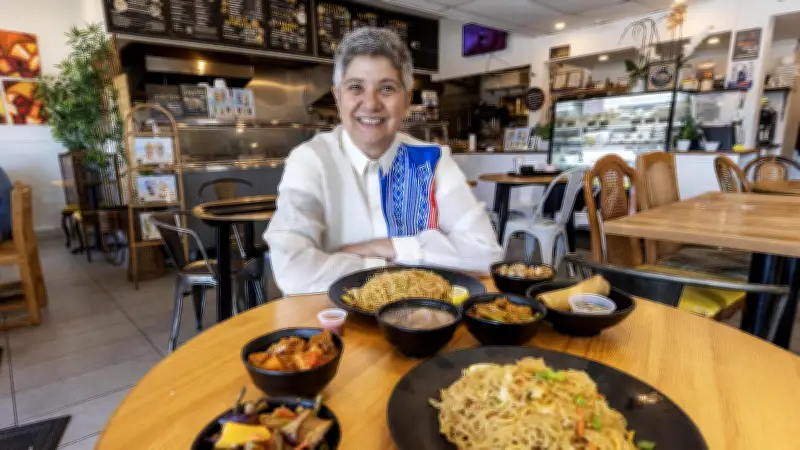
Pampanga's offers a lunch combo with two meat or veggie items and rice, plus soup, for $18, but it's way too much food for one person, even a hungry reporter. We ordered several dishes, including sisig (my favourite, crispy chunks of pork jowl with ginger, chili and spices), kare-kare (Elmore's mother's favourite, oxtail pieces cooked in peanut sauce with eggplant), pinakbet (mixed veggies with shrimp paste), and pancit, the classic mixed noodle dish. It was way too much. But ordering too much food when you go out — or cooking too much when you're hosting at home — is also a Filipino tradition. “We'll come together, we'll have food, and then it's also a custom that you'll always have something to take home,” Elmore said. “That's always a practice.” The Tagalog language has several different words for “leftovers,” depending on the context. It's a big part of the culture, and many dishes are celebrated for tasting even better leftover. I ate leftovers for the next two days. It was perfect.
Eat Streets: What to Know About South Fraser
- Location: Fraser Street between 41st and 51st Avenues.
- Number of restaurants and food options: 50+
- Parking: City of Vancouver parking metres on Fraser, and free parking on side streets.
What Are Metro Vancouver's Eat Streets?
This article is part one of a series highlighting Metro Vancouver's must-visit Eat Streets. With the goal of celebrating — and maybe even introducing you to — stretches of community around the region that have a notable concentration of local food businesses. Know of a great Eat Street in your community? Let us know where. Email us at artslife@vancouversun.com.
Read about more of Metro Vancouver's Eat Streets: • Eat Streets: A United Nations of cuisine on Vancouver's Victoria Drive • Eat Streets: Langley City's one-way a hub of local food • Eat Streets: Delta and Surrey unite over food on this stretch of Scott Road • Eat Streets: Comfort food served Hong Kong-style at Richmond's Empire Centre • Eat Streets: There's now a world of flavours on Vancouver's Commercial Drive • Eat Streets: North Vancouver's Lower Lonsdale reinvented as a foodie destination • Eat Streets: Where hippies used to gather on West 4th Avenue, foodies now flock for the old and the new • Eat Streets: New Westminster gets fresh life on Columbia Street (and in a SkyTrain station) • Eat Streets: Vancouver's Yaletown a place to eat, drink, and 'to see and be seen' • Eat Streets: The ever-evolving waterfront food scene on White Rock's Marine Drive • Eat Streets: The hidden gem of Burnaby Heights • Eat Streets: Kerrisdale transforms from typical British fare to a world of delicious new flavours • Eat Streets: Abbotsford's old town an epicentre of quirky cafés • Eat Streets: Vancouver's Main Street remains valiantly local, international and eclectic • Eat Streets: The unexpected culinary delights of Vancouver's Joyce Collingwood
Bookmark THIS PAGE to read the latest instalment every Wednesday.
Then and Now: Vancouver's South Fraser
1911: Fraser Street between 50th and 51st. Real estate office and streetcar are visible. Photo by Vancouver Public Library. 1916: Exterior view of W.N. Bertram Marble Works, 4904 Fraser St., showing tombstones and monuments with a streetcar in the distance. Photo by W.J. Moore /City of Vancouver Archives. 1930: Fraser Street and East 47th Ave. Jack Oakie in 'Hit the Deck,' a side-splitting comedy at the Fraser Theatre at 6294 Fraser St. Photo by Leonard Frank / VPL 11042. 1936: Hilton Dairy fleet of trucks and drivers beside 6395 Fraser St. Photo by City of Vancouver Archives. June 1939: Northwest in 6400 block Fraser from E. 49th. Canada Safeway Ltd. and Fraser Drug Co. Fraser was a wooden road at this time. Photo by Dominion Photo Co. / VPL 25008. 1952: Becker Motor Sales, 6196 Fraser St. Photo by Art Jones / VPL 81992. 1966: Grand opening of the women's committee to Vancouver symphony's “New to You Shop” at 41st and Fraser. Mrs. Gerald Thompson (left) points out the sign to Symphony president, Mr. G.B. McIntosh, and Mrs. E.C. Dobell. The shop was one of the committee's money making ventures with proceeds going to children's concerts. Photo by Gordon Sedawie /The Province. 1974: 6169 Fraser St. in Vancouver. Visible are the business signs for Autoplan, Brendon Bros. Ltd. Real Estate and Insurance and Union Electronics. Photo by City of Vancouver Archives. 1974: 5927 Fraser St. Visible are the business signs for Paramount Music Studios, Yarns knitting store, and Grimm's Delicatessen. Photo by City of Vancouver Archives. 1974: 6035 Fraser St. Visible are the business signs for Fraser Billiards and Snooker, The Salvation Army Thrift Shop, and J. Tong. Photo by City of Vancouver Archives. 1978: 6000 block of Fraser St. includes a sign for the 89th Inn restaurant. Photo by Ralph Bower /Vancouver Sun. 1985: 6181-6191 Fraser St. Signs for Cottage Cleaners, Fraser Variety and Mennonite Thrift Store are visible. Photo by City of Vancouver Archives. 2026: Good Choice Chinese Restaurant on Fraser Street. Photo by Jason Payne /PNG. 2026: Fraser Street in Vancouver. Photo by Jason Payne /PNG. 2026: Fraser Street in Vancouver. Photo by Jason Payne /PNG.