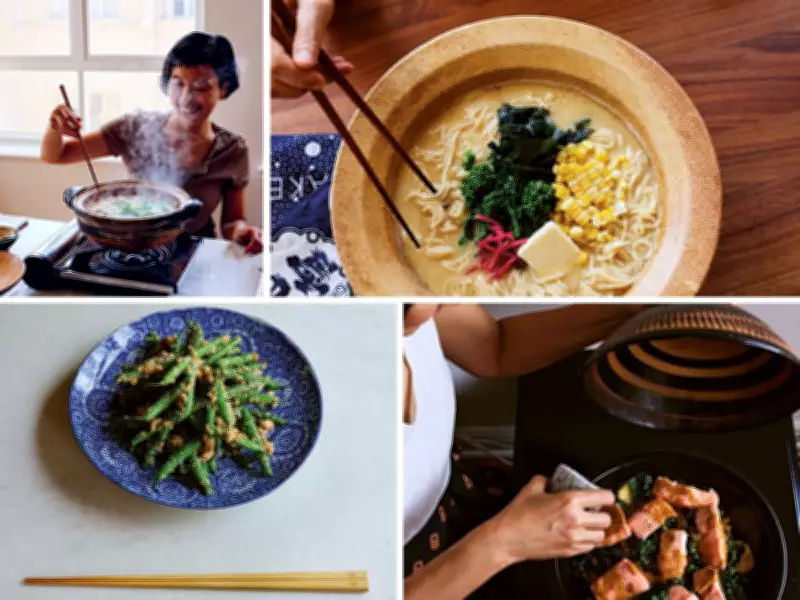
Cookbook author Naoko Takei Moore has nearly 30 donabe to choose from in her home kitchen. Japanese cooks have used the clay pot for centuries. "It's almost like our national cookware," she says. But more than a cooking vessel, as Takei Moore writes in her third book, Simply Donabe (Quadrille, 2026), it's "a way of life."
As true today as it was in her childhood home in Tokyo in the 1980s, when a communal donabe meal was synonymous with family bonding, Takei Moore says that this way of cooking brings people together. But she also welcomes it as a personal ritual. "It's always just me and my thoughts, and then my donabe. To me, it's a really special, almost spiritual time. I communicate with the donabe. You can focus, and you feel so grounded. I enjoy cooking a one-pot, single-serving meal as much as I do cooking a large meal to share with people."
This communication sometimes begins before Takei Moore has even decided on a dish or ingredients. "The first communication is like, 'Who wants to have a relationship with me for this meal?'" she says, laughing. "All the donabe are like my children. I love each piece equally, but sometimes I use one donabe more often than the other. So, I'm like, 'Oh, I don't want you to feel neglected.' That's how I often start. I often start not by what to cook, but by looking at the donabe, and deciding what donabe to use."

The book is an ode to Japanese one-pot cooking, with chapters following the flow of a meal: appetizers and side dishes, main dishes, rice and noodles, and dessert. For each recipe, Takei Moore specifies the type of donabe and suggests an alternative vessel, showing that you don't need an earthenware pot to embrace this style of home cooking. "It doesn't matter if you have an old aluminum pot or a small pan. That's OK. What's most important is the spirit of donabe cooking."
Born in Yokohama and raised in Tokyo, Takei Moore has fond memories of her mother's cooking. "My mom was an amazing cook, and we loved cooking and eating at home a lot, and it was very natural for me to get into cooking and food in general." Takei Moore's father was an editor for a magazine and worked long hours. On weekends, the family would gather, usually for a donabe meal. One of Takei Moore's earliest cooking memories was preparing yose-nabe hotpot, adding ingredients to the donabe sitting in the centre of the table. "That made me feel like, 'I'm cooking. I'm part of this.' That's how I got into cooking," she recalls.
As she got older, Takei Moore realized how central donabe is to connection. In conversation, people use the word "nabe," which means "pot." But it doesn't only refer to the vessel or what you cook in it. If you say, "Let's nabe sometime," it means, "I want to get to know you better," she explains.
In 2008, after moving to California to attend culinary school at Le Cordon Bleu following a career in the music industry in the U.K., Takei Moore founded the shop TOIRO. She initially sold handmade donabe out of her home and, in 2017, expanded into a brick-and-mortar store in Los Angeles, where she sells kitchen tools and tableware imported from all over Japan.
Sake-Steamed Salmon and Kale over Buttery Sweet Potato
This dish combines tender salmon and nutritious kale with creamy sweet potato, all infused with sake for a delicate flavor.
Miso-Simmered Ramen
A comforting bowl of ramen simmered in a rich miso broth, perfect for a cozy meal.
Green Beans in Walnut Miso Cream
Fresh green beans tossed in a creamy walnut miso sauce, offering a delightful blend of textures and umami.